A growing system of private accreditation with public impact
Across Ireland, a growing number of organisations are engaging with private consultancy bodies offering workplace “diversity”, “equity”, and “inclusion” accreditation, training, and awards.
One of the most prominent of these frameworks is the Investors in Diversity programme, delivered by private consultancy firms and used by hundreds of organisations across the State and private sector. Publicly available information indicates that over 300 organisations are now engaged with such frameworks in Ireland, spanning industry, finance, education, and public bodies.
These schemes are presented as structured pathways for workplace “progress”, often using tiered certification models such as Bronze, Silver, and Gold.
While participation is formally voluntary, their increasing adoption raises serious questions about influence, transparency, and cultural direction within Irish institutions.
Private “Diversity Accreditation” Schemes in Ireland: Transparency, Cultural Impact, and Public Understanding
Expanding role of private accreditation in Irish workplaces
Private organisations offering workplace “diversity”, “equity”, and “inclusion” accreditation, training, and consultancy services have become increasingly embedded across Irish workplaces, including in some public sector contexts.
These schemes are generally voluntary and commercially provided. However, their growing visibility and adoption across influential institutions raises broader questions about transparency, public understanding, and their wider cultural and societal impact.
Concerns regarding perceived authority and presentation
A recurring concern in public discussion is that the language and branding used by some of these organisations—terms such as “accreditation”, “institute”, “framework”, or “centre”—may, in certain contexts, give an impression of formal authority or institutional status.
While these bodies are private entities but from my understanding, do not have statutory or regulatory powers, the use of such terminology may lead some organisations and members of the public to reasonably assume a level of official endorsement or governance function that is not present in law.
This raises questions about clarity of representation and public understanding, particularly where such certifications are referenced in organisational branding or public reporting.
Cultural influence and wider societal implications
Beyond questions of terminology, there is a growing debate about the broader cultural influence of privately developed workplace frameworks.
The widespread adoption of external diversity is certainly, visibly contributing, to a shift in workplace culture and staffing level of Irish employees. This has not been the subject of open democratic debate. Concerns expressed in public discourse include:
- the increasing influence of externally developed workplace standards on Irish institutional culture
- the perception that participation in such frameworks may become informally expected or reputationally necessary
- and the potential for cultural norms within Irish workplaces to be shaped by private bodies rather than domestic public policy processes
These frameworks are supposed to be promoting inclusion, fairness, and improved workplace standards. However, the scale of their adoption has led to legitimate questions about how cultural norms are being shaped and by whom.
Public confidence and rights based considerations
Concerns about whether the growing prominence of these frameworks may indirectly affect perceptions of fairness, neutrality, and equal treatment in the workplace.
While these schemes do not have legal authority and do not replace employment or equality law, their increasing presence in organisational policy may lead to questions about:
- transparency in how workplace standards are set
- whether employees fully understand the voluntary nature of such frameworks
- and whether sufficient clarity exists to distinguish private consultancy standards from rights-based legal protections
In this context, it is important that civil and human rights protections remain grounded in Irish an EU law and democratic accountability, rather than in privately developed certification systems.
Public sector engagement and accountability
Where public bodies engage with private accreditation providers, additional scrutiny may be warranted regarding:
- procurement processes and value for money
- the evidence base supporting such frameworks
- the clarity with which their voluntary nature is communicated
- and the extent to which they influence internal policy development
Given the expanding role of these organisations, there is a legitimate public interest in ensuring that their involvement in public sector environments is transparent and clearly understood.
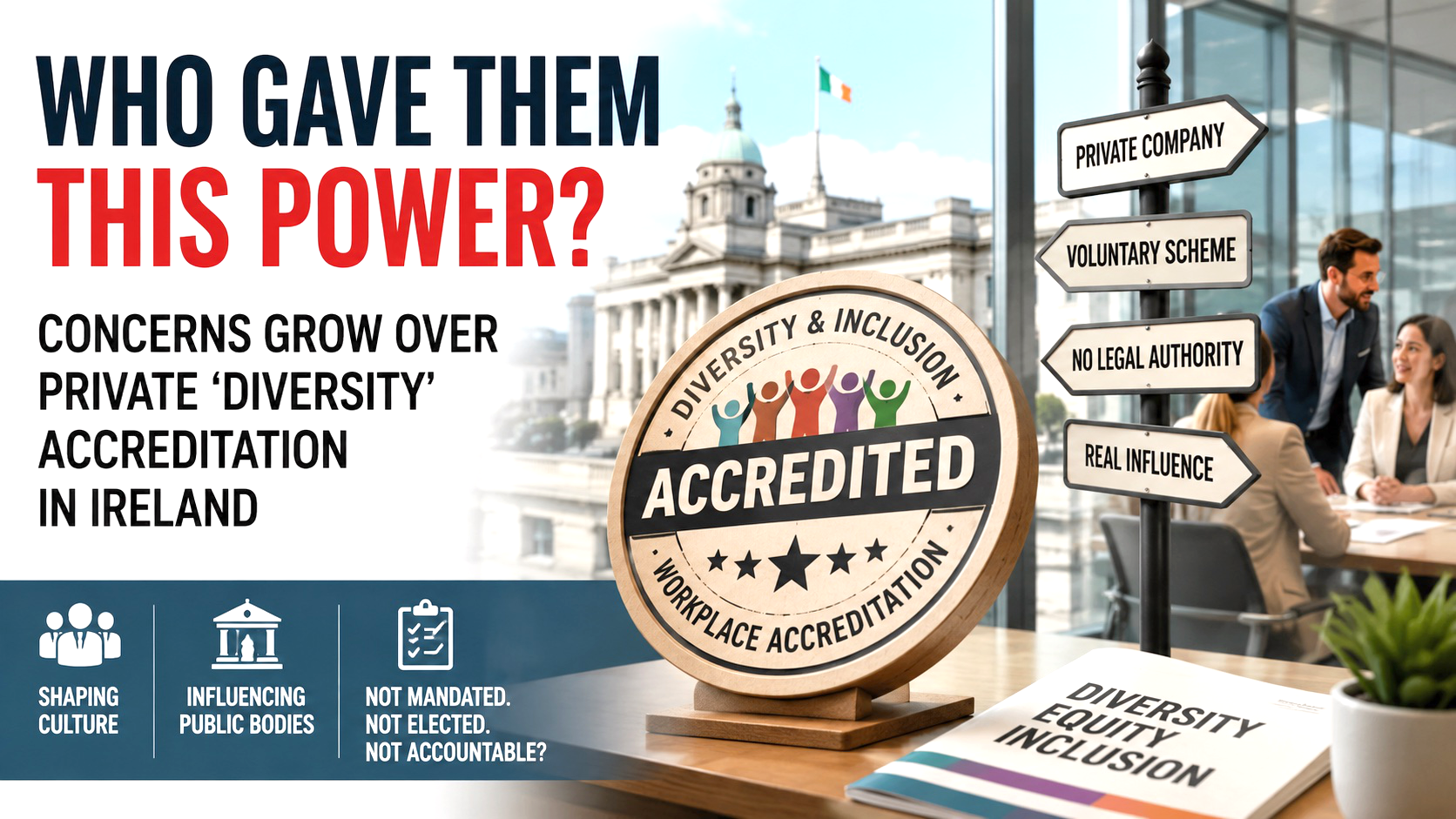
The legitimacy of privately run diversity accreditation bodies operating as informal standard-setters within Irish workplaces. With no democratic mandate or statutory authority, their growing influence raises concerns about regulatory overreach by consultancy driven frameworks.
The key question is not only who has empowered these organisations to shape workplace norms, but why such significant quasi-regulatory influence has developed outside public oversight, and what implications this has for accountability in Irish employment policy.
As such certifications become embedded in procurement decisions, recruitment signalling, and reputational benchmarking, organisations may feel compelled to engage in order to remain competitive or avoid perceived disadvantage.
This raises questions about the extent to which “voluntary” frameworks function in effect as soft requirements within the Irish labour market, despite lacking any statutory basis or democratic oversight.