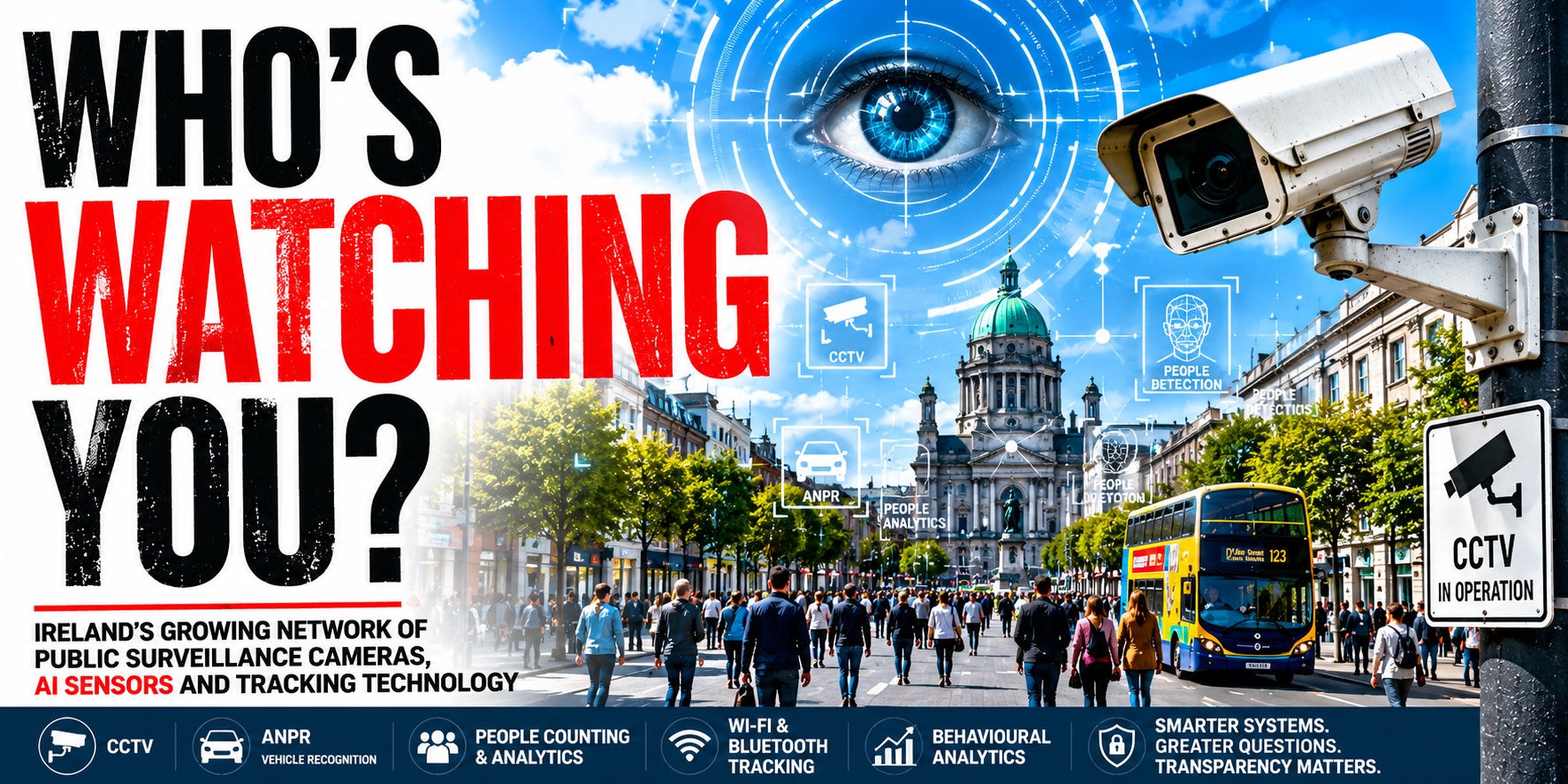
Exclusive: An OnlineNews.ie county-by-county investigation into the surveillance technologies quietly monitoring public spaces across Ireland.
Every day, millions of people walk through Ireland’s streets, shopping centres, transport hubs and public buildings without giving much thought to the cameras and digital sensors surrounding them.
Most people expect CCTV in banks, airports and train stations.
What many don’t realise is that modern surveillance increasingly extends far beyond traditional video recording. Today’s systems can include Automatic Number Plate Recognition (ANPR), AI-assisted behavioural analysis, people-counting software, smart parking systems and cameras capable of facial detection even if those advanced features are not always activated.
An investigation by OnlineNews.ie, drawing on Data Protection Commission (DPC) decisions, Freedom of Information disclosures, procurement records and published reports, shows that surveillance technology has become deeply embedded throughout Ireland’s public infrastructure.
The findings also reveal a lack of transparency. While individual councils and public bodies publish some information, Ireland has no central register that can be located, showing where surveillance technology is deployed, what capabilities it possesses, or how data collected from members of the public is processed.
Surveillance extends beyond CCTV
Modern surveillance systems increasingly combine multiple technologies, including:
• Conventional CCTV
• Automatic Number Plate Recognition (ANPR)
• AI-assisted people counting
• Behaviour analysis software
• Traffic monitoring cameras
• Waste enforcement cameras
• Smart parking systems
• Cameras capable of facial detection
• Network-connected IP cameras
• Potential Bluetooth and Wi-Fi device detection systems
Importantly, the presence of these capabilities does not necessarily mean every feature is enabled. Several Irish public bodies have stated that facial recognition and behavioural analysis functions available within their camera systems have been disabled.
Nevertheless, particularly software upgrades or configuration changes could enable more intrusive monitoring in the future.
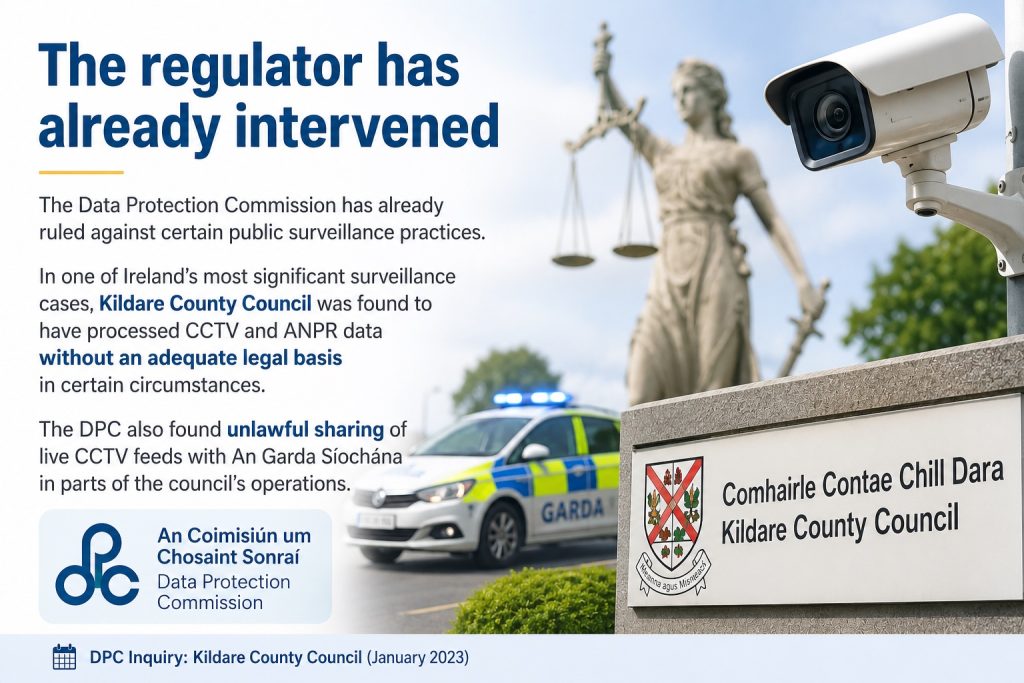
Ruling Against
Kildare County Council
https://www.dataprotection.ie/en/dpc-guidance/decisions/inquiry-kildare-county-council-january-2023
Domestic CCTV and Doorbells
Meanwhile, complaints relating to domestic CCTV and smart doorbells remain one of the DPC’s busiest areas of enforcement, with many complaints involving cameras recording public roads, footpaths and neighbouring properties.
https://www.dataprotection.ie/en/dpc-guidance/case-studies/cctv/domestic-cctv
Hundreds of AI-capable cameras already installed
Investigative reporting has identified hundreds of Hikvision cameras installed across Irish local authorities.
Some of these camera models include software capable of:
• facial detection
• people counting
• intrusion detection
• behavioural analysis
• vehicle recognition
County-by-county inventory
The following public inventory found reflects publicly documented surveillance deployments. Presently, it should be regarded as a baseline for clarification.
OnlineNews.ie intends to submit Freedom of Information requests. Known public surveillance technologies (to confirm and update).
_________________________________________
Carlow
Council CCTV; SETU campus CCTV; transport CCTV
Cavan
Approximately 135 Hikvision cameras across council facilities; public CCTV
Clare
Council CCTV; Hikvision equipment reported; ATU campus CCTV
Cork
Council CCTV; waste enforcement cameras; traffic cameras; Cork Airport CCTV and parking ANPR; UCC CCTV
Donegal
Council CCTV; Hikvision systems reported; ATU CCTV
Dublin
Extensive council CCTV; motorway cameras; Dublin Bus, Luas and Irish Rail CCTV; Dublin Airport CCTV and ANPR; Trinity, UCD and TU Dublin CCTV; shopping centre CCTV and parking ANPR
Galway
Council CCTV; transport CCTV; University of Galway CCTV
Kerry
Council CCTV; Kerry Airport CCTV; MTU CCTV
Kildare
Council CCTV; ANPR systems; DPC enforcement action concerning CCTV and ANPR; Maynooth University CCTV
Kilkenny
Approximately 151 Hikvision cameras across council sites; SETU CCTV
Laois
Council CCTV; rail CCTV
Leitrim
Council CCTV; transport CCTV
Limerick
Council CCTV; University of Limerick CCTV; Hikvision systems reported
Longford
Hikvision cameras with facial-detection capability reported
Louth
Council CCTV; Dundalk Institute of Technology CCTV
Mayo
Council CCTV; Ireland West Airport Knock CCTV; parking ANPR; ATU CCTV
Meath
Approximately 288 Hikvision cameras across council facilities
Monaghan
Hikvision cameras with AI capability reported
Offaly
Hikvision cameras reported
Roscommon
Council CCTV; ATU CCTV
Sligo
Hikvision systems reported; ATU CCTV
Tipperary
Council CCTV; Technological University of the Shannon CCTV
Waterford
Council CCTV; SETU CCTV
Westmeath
Council CCTV; Technological University of the Shannon CCTV
Wexford
Council CCTV; SETU CCTV
Wicklow
Hikvision cameras with smart detection capability reported
What remains hidden?
Perhaps the most striking finding is not what is known—but what remains unknown.
There is little publicly available information on:
• Bluetooth tracking of mobile phones
• Wi-Fi analytics used to measure footfall
• AI-powered retail behaviour analysis
• Camera systems estimating age or gender
• Anonymous pedestrian tracking
• Smart city sensor platforms
Many of these technologies are widely used internationally, yet there is almost no publicly accessible information about their deployment within Ireland.
Questions that deserve answers
As surveillance technology becomes more sophisticated, several questions arise:
• How many AI-capable cameras operate in Ireland today?
• Which systems possess facial recognition capability?
• Are behavioural analytics being used?
• How long is surveillance data retained?
• Who has access to recorded information?
• Is data shared between public bodies?
• Are privacy impact assessments routinely published?
Without a national register, the public has little visibility over the scale of surveillance taking place in public spaces.
The next stage of the investigation
OnlineNews.ie intends to submit Freedom of Information requests to every local authority seeking:
• Complete CCTV asset registers.
• ANPR deployment locations.
• Camera manufacturers and software capabilities.
• Whether facial recognition or behavioural analysis functions are enabled or disabled.
• Contracts with surveillance technology suppliers.
• Data Protection Impact Assessments (DPIAs).
• Data-sharing agreements with other public authorities.
The results could provide the first comprehensive picture of Ireland’s public surveillance infrastructure.
An Garda Síochána launched a public consultation for a draft Code of Practice on Public Closed Circuit Television (CCTV) at the beginning of this year
To date: There has been no published final version of the Public CCTV Code of Practice on the Garda website.
Surveillance is no longer confined to cameras mounted on buildings. It increasingly consists of interconnected digital systems capable of analysing movement, vehicles and, potentially, individuals in real time.
Most of these technologies serve legitimate purposes such as public safety, traffic management and crime prevention. However, transparency has not kept pace with technological development.
As Ireland expands its digital infrastructure, several questions becomes increasingly important:
How much monitoring should people expect simply by walking through a public place and how much should they know about it?Who has access to this data, who owns the data if you are in the frame? Do you have a legal right to access it?
What is the legal framework for people working in the court services? How are they dealing with this situation?
Hidden in the terms and conditions: Who owns your smart home data, and how is it used with open CCTV? How could this data be used in a Court Of Law and how would it be acquired?
Millions of consumers purchase smart home devices believing they are buying security, convenience, and peace of mind. Instead, many discover they are also being asked to surrender large amounts of personal data simply to use the products they have already paid for.
Screenshots, or even videos can been accessed and taken from their TV’s or other WiFi enabled devices by a system called Automatic Content Recognition (ACR) which is usually enabled on by default. Automatic Content Recognition (ACR) is a technology built into Smart TVs and media devices that identifies the exact content—such as TV shows, movies, and commercials—playing on the screen. By taking digital “fingerprints” of audio and video, it instantly matches them against massive content databases without requiring user input. Your Smart TV can take up to 7,200 Screenshots Every Hour from your TV.
With even more shocking invasive technology on the way that can see through walls, developed by a University in London by: Facebook AI Lab, to detect humans and their movements behind walls.
Advancing technology is getting more frightening by the minute leaving people completely vulnerable to rouge agents or big tech companies scraping information for advertising or other uses with literally no control or accountability.
The expansion of surveillance and data-driven business models has fueled concerns that individuals and society as a whole is losing control over privacy and civil liberties.
Public CCTV systems are common place but who is responsible for the data, who is looking at it? There seems to be little or no proper regulation. It is hap – hazard to say the least. It needs serious urgent regulation.
The problem is not technology it is the constant lack of transparency and regulation.
Across the industry, customers are routinely presented with lengthy, complex terms and conditions that few people have the time or legal expertise to understand. Buried within these agreements are permissions allowing companies to collect, analysis, store, and in some cases share data generated inside people’s homes. The practical reality is that consumers are often given no meaningful choice: accept the terms or lose access to essential functions of the device.
That is not genuine informed consent. It is consent obtained through necessity. People feel they are being deceived.
Many customers are deeply uncomfortable with this arrangement. They do not object to a device using the minimum amount of data necessary to perform its advertised function.
What they object to is being required to agree to broad data collection practices, extensive analytics, or future uses of their personal information, being sold onto advertisers or data brokers, that have little or nothing to do with the service they intended to buy.
For many people, their home is their most private space. Security cameras, smart speakers, doorbells, sensors, and connected appliances can reveal daily routines, family life, visitors, conversations, and patterns of behaviour. Such information should never be treated as a commercial asset without the customer’s clear, specific, and freely given permission.
Companies frequently state that data is encrypted and protected by security measures. While security is important, it does not address the fundamental issue: customers deserve to know, in plain language, exactly what information is collected, why it is collected, who can access it, how long it will be retained, and whether it will be used for purposes beyond providing the service they purchased.
Privacy should never be hidden behind dozens of pages of legal language. It should be explained clearly before a customer buys the product—not discovered afterwards.
Honesty and Accountability
The technology industry has demonstrated extraordinary innovation. It should now demonstrate the same commitment to honesty and accountability. Consumers should not have to choose between protecting their privacy and using products they have legitimately purchased.
Governments and regulators also have a role to play.
Companies should be required to provide simple, understandable privacy notices, meaningful opt-in choices for non-essential data collection, and the ability to use core product functions without being compelled to surrender unnecessary personal information.
Trust cannot be demanded through legal agreements. It must be earned through openness, respect, and genuine transparency.
Consumers or people walking in public spaces deserve nothing less.