https://advertcouncil.gov.ng/documents/Publications.pdf
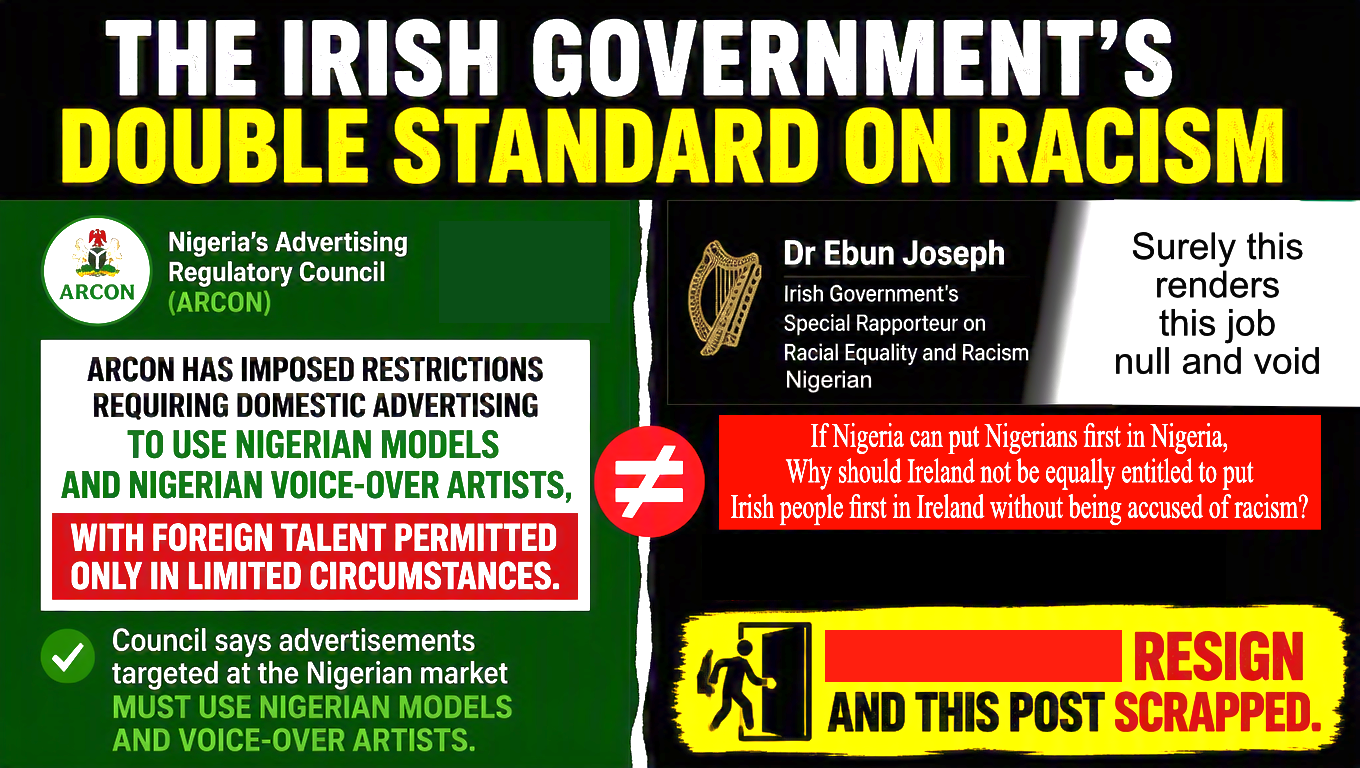
The Irish Government’s Double Standard on Racism?
Nigeria’s Advertising Regulatory Council (ARCON) introduced a policy requiring models and voice-over artists in advertising directed at the Nigerian market to be Nigerian citizens, subject to limited exceptions.
The ARCON directive was issued on 22 August 2022 and took effect on 1 October 2022. The requirement remains reflected in ARCON’s current advertising guidelines.
Yet in July 2024, then Minister Joe O’Brien appointed Dr Ebun Joseph as Ireland’s Special Rapporteur on Racial Equality and Racism, almost two years after the Nigerian policy had come into force.
Dr Joseph, have you ever condemned Nigeria’s policy requiring Nigerian citizens in advertising as racist or discriminatory? If not, why is nationality-based preference acceptable in one context but potentially racist in another? Is the principle against discrimination universal, or does it depend on who benefits?
Critical Race Theory
Dr Joseph’s academic work is firmly rooted in Critical Race Theory, whiteness, white privilege, white supremacy and racial stratification. Her research identifies skin colour, foreign-sounding names, accent and nationality as factors reported in experiences of discrimination.
Joseph’s work devotes substantial attention to whiteness, white privilege and white supremacy. Why does her critical lens appear to run overwhelmingly in one direction?
This raises a serious question of racial double standards.
Nigeria has adopted a nationality-based local-content policy that prioritises Nigerian citizens in a sector of its economy. Would the same principle be regarded as discriminatory if Ireland adopted it?
Irish people have every right to protect their culture, traditions, heritage and national identity without being collectively portrayed as a racial problem.
White Irish people are entitled to challenge sweeping racial narratives about their community. We are no longer prepared to sit quietly while our race is repeatedly placed under the microscope and collectively portrayed through the language of privilege, supremacy and racial advantage.
This is our homeland. We should not be expected to apologise for who we are, nor accept being collectively judged because of the colour of our skin.
Nor should an Irish Government be so quick to lecture its own people about equality while appearing unwilling to stand up for Irish workers in the same way that Nigeria has stood up for Nigerian workers through its local-content policies.
If Nigeria can put the interests of its own citizens first and take decisive steps to protect Nigerian workers, why are Irish politicians so weak?
Was There Proper Due Diligence?
Or did political enthusiasm for DEI override proper scrutiny of the appointment?
Dr Joseph has built her career and public profile in Ireland, yet for almost two decades she has subjected Irish society, its institutions and its people to sustained criticism through the lens of race and inequality. But now that she holds an official government-appointed position with influence over national policy, Irish citizens are entitled to ask a straightforward question: why has this criticism been so persistent, what is driving it?
The Government should conduct an independent review of Dr Joseph’s appointment and the operation of the Special Rapporteur role. If that review establishes that the role is being exercised in a manner that is not sufficiently independent, balanced or consistent, the appointment should be terminated.
What due-diligence process was followed before the appointment, and what criteria were used to assess the candidate’s independence and suitability?
Dr Joseph was appointed by then Minister Joe O’Brien in July 2024.
- Independence: whether Dr Joseph’s published academic framework allows her to assess racism impartially across racial and nationality groups.
- Consistency: whether the same principles she applies to Ireland are applied to nationality-based policies elsewhere, including Nigeria’s advertising rules.
- Due diligence: whether the Government examined her publications, public statements and academic methodology before appointing her.
- Scope of the role: whether her activities in schools and public advocacy go beyond independently monitoring and reporting on the National Action Plan Against Racism.
- Public confidence: whether the role is now sufficiently controversial that the Government needs to demonstrate that it is genuinely independent and balanced.
If countries around the world can openly prioritise their own citizens without that automatically being defined as racism, then the entire argument that doing so is inherently racist is collapsing. The goalposts have shifted globally.
Dr Joseph’s first report recommended mandatory anti-racism education in Irish schools.
What exactly would that education contain, and will competing perspectives on race, identity and equality be presented?
Critical Race Theory
The real question, therefore, goes beyond Dr Joseph. She is one participant in a much wider academic and institutional project that has spent many years reframing Irish society through the language of race, whiteness, privilege and structural discrimination.
Dr Alice Feldman’s long-standing work, her collaboration with Joseph, her involvement in anti-racism policy and UCD’s current teaching of Critical Race and Decolonial Theory show that this intellectual approach extends beyond one individual.
The question Irish citizens are entitled to ask is much bigger: who developed this framework of Critical Race Theory, whiteness and structural racism, what exactly does it claim, why was it embraced so extensively by Irish institutions, and what role did Alice Feldman play in bringing it into the Irish mainstream?
This is the debate Ireland now needs to have openly.
A Double Standard at the Heart of NAPAR – Is NAPAR Itself Racially Selective?
There is another troubling question within NAPAR itself. The plan describes its purpose as addressing “racism in all its forms”, yet when describing the particular experiences that informed the plan, it specifically highlights antisemitism, anti-Muslim prejudice, racism affecting Traveller and Roma communities, and racism affecting people of African descent.
Where is the explicit recognition of racism directed at the native Irish population? If the Government insists that NAPAR applies equally to everyone, where is that principle reflected in its priorities, language and implementation? An anti-racism framework must apply the same standard to everyone, including the majority population.
https://assets.gov.ie/static/documents/6bd783c4/The_Annual_Report_2025_of_the_Special_Rapporteur.pdf
NAPAR we are told, was explicitly developed to address not only individual racism but structural racism.
NAPAR stands for National Action Plan Against Racism
My conclusion is straightforward:
The Irish Government should remove Dr Joseph from the position and abolish the office of Special Rapporteur on Racial Equality and Racism. Ireland needs laws and institutions that protect everyone from racism, not an office that risks turning racial identity itself into the organising principle of public debate.