Government Accused of Abandoning Its Own People
Ireland is supposedly one of the wealthiest countries in Europe, officially ranked second in the EU for GDP per capita, yet Irish people are leaving because they cannot see a secure future in their own country. 600,000 Irish Workers Gone in Two Decades
https://www.cso.ie/en/releasesandpublications/ep/p-ana/annualnationalaccounts2025/keyfindings
That makes the Government’s failure record on housing, emigration, public services, population planning and employment a central part of the story.
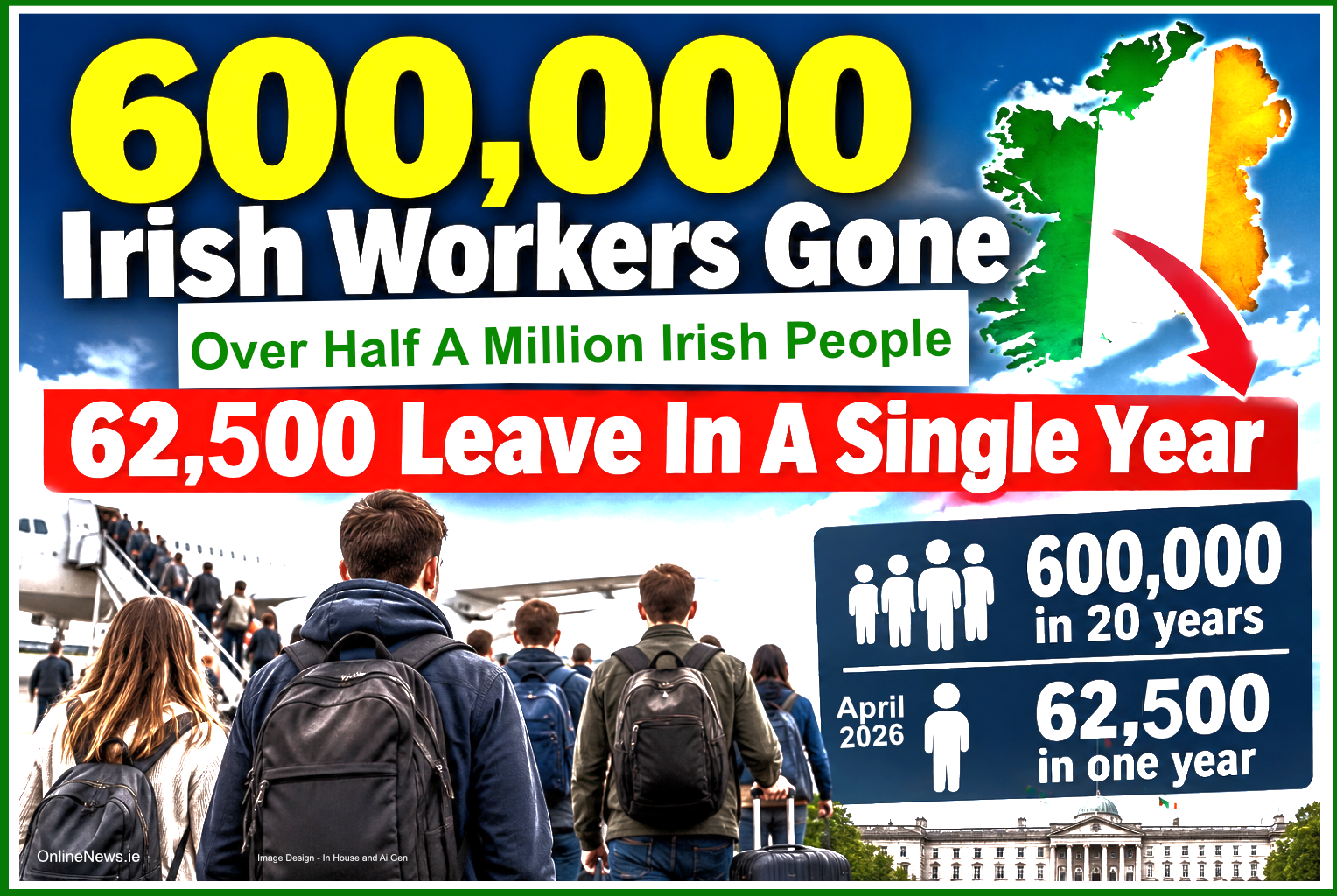
600,000 Irish Workers Gone in Two Decades – 62,000 Leave In A Single Year
Sharon Keogan accuses Government of abandoning its own people as young Irish workers leave, housing becomes unaffordable, and the country’s population policy comes under increasing scrutiny making the point that 62,000 people left in just one year.
Sharon Keogan condemns Government over Irish emigration 23.09.2026, 14:32 @videoparliamentireland
Young people cannot afford homes. Working families are struggling with rents and household bills. Graduates are leaving to find opportunities elsewhere, and communities are watching another generation depart in search of the security and independence they cannot achieve at home.
And now Independent Senator Sharon Keogan has put a figure on the scale of the problem that should demand the Government’s attention: 600,000 working Irish people have left the State over the past two decades.
Population in 2006: approximately 4.24 million.
Population in 2026: approximately 5.53 million.
Population increase: approximately 1.29 million.
Senator Keogan’s claim: 600,000 working Irish people emigrated over two decades.
Irish citizens are being pushed out of their own country by unaffordable housing, mounting living costs and a lack of opportunities, while continued inward migration is fundamentally changing the country’s population and communities.
How can a Government preside over the departure of hundreds of thousands of its own working citizens while overseeing enormous population growth, and still claim that its policies are delivering for the Irish people?
Keogan’s message was unmistakable:
The Government has failed its own people, particularly the young, and the consequences are being measured in lives uprooted, families separated and a country losing the very people it has spent years educating.
62,000 leave in a single year and the Government calls this progress?
Keogan began by highlighting the departure of more than 62,000 people from Ireland in the preceding year.
She compared that number with the population of Drogheda or Dundalk. She then offered an even more striking image, asking colleagues to imagine Croke Park completely empty and silent rather than filled with the crowds celebrating Mayo’s All-Ireland victory.
That, she argued, was the scale of the loss.
Her words were uncompromising:
“This is the number of people that we have failed.“
She went further, describing the situation as an abject failure by Government and making clear that responsibility rested directly with those in power.
And the question she put to the Government was entirely reasonable: if the country is enjoying economic growth, collecting substantial revenues and announcing bumper budget surpluses, why are so many people finding it necessary to leave?
This is the contradiction that ministers need to answer.
How can a country with such considerable economic resources fail to provide enough affordable housing, secure opportunities and liveable communities for its own young workforce?
The Government has had years to address these problems. Young people have had years of promises. Meanwhile, the cost of establishing an independent life has continued to place enormous pressure on an entire generation.
Economic statistics are of little comfort to someone working full-time who cannot afford to rent a home, never mind save for a mortgage.
600,000 working Irish people: a staggering loss of skills and investment
Perhaps the most important figure raised by Keogan was the 600,000 working Irish people she said had left the State over the previous two decades.
She pointed out that many were educated young people whose education and professional training had been supported by billions of euro in public investment.
Think about what that means.
The State invests in schools, universities, training and professional development. Families make sacrifices to help their children secure qualifications. Young people work hard to build careers.
Yet, when they reach the point where they should be establishing their futures, many discover that Ireland cannot offer them an affordable home or the quality of life they expected.
They take their qualifications, skills and productive capacity elsewhere.
Other countries benefit from the workers Ireland has helped educate.
And what does the Government do? It continues to argue that additional workers are needed.
Keogan challenged precisely this contradiction. Ireland had workers, she argued. It had educated young people and a skilled workforce. But instead of creating the conditions to retain them, the State was allowing them to leave.
This is a serious indictment of economic and social policy.
It is not enough to produce graduates. A country must also create an environment in which those graduates can build careers, buy or rent homes, raise families and contribute to the communities in which they grew up.
The population question the Government cannot avoid
There is another issue sitting behind this debate, and it is one that the Government cannot simply dismiss.
The Government must answer for the population changes taking place under its watch. It must explain its immigration and population policies, its failure to retain so many Irish workers, and how it intends to protect the long-term sustainability of Irish communities.
Welcoming newcomers and retaining Irish people should not be competing objectives. A responsible Government should be capable of doing both in proper perspective.
Young people told to live with their parents until they are 40
Keogan’s criticism became particularly pointed when she addressed the reality facing young workers.
She described a generation being effectively told to remain living with their parents until they are 40, while their pay packets are consumed by rent and household bills.
Her criticism goes beyond the housing market itself.
It is about the loss of independence, the postponement of family life and the erosion of the basic expectation that working hard should allow someone to build a secure future.
What message does this send to a young person who has spent years studying, qualified for a profession and secured a job, only to discover that an ordinary home is financially out of reach?
What message does it send to a young couple who want children but cannot find suitable accommodation?
And what message does it send when the most practical solution appears to be buying a one-way ticket?
The Government cannot continue to treat this as an inevitable consequence of modern life.
A Government that needs to explain its priorities
Keogan also challenged the Government over its claims that immigration is necessary to provide workers for the economy.
Her point was straightforward: Ireland has already educated and trained hundreds of thousands of its own people, yet many have gone abroad.
Why has the Government failed to create the industries, employment opportunities and liveable towns and cities necessary to retain them?
Why have years of economic growth not translated into a housing system that ordinary working people can access?
Why are young Irish people expected to accept living with their parents well into adulthood as though it were a reasonable substitute for independent living?
And why does the Government continue to measure success through economic indicators when so many citizens feel that the benefits of that success are passing them by?
These are questions of accountability.
A country needs a coherent population policy, a functioning housing system and an economy that provides opportunities for the people who live here. The Government is responsible for putting those elements together.
It cannot blame young people for leaving when the conditions that influence their decision have been shaped by years of political choices and failures.
Ireland cannot afford to lose another generation
There is a human cost to all of this that cannot be captured in GDP figures or budget announcements.
Parents are watching children move abroad. Grandparents are missing out on seeing grandchildren grow up. Families are being separated by distance and the cost of travelling home.
Irish Communities are losing young workers, skilled professionals, volunteers and the people who would otherwise be building the next generation of local businesses, clubs and families.
The departure of hundreds of thousands of working Irish people over two decades, combined with more than 62,000 emigrants in the latest annual figures, demands much more than another political statement promising improvement.
It demands action.
The Government must be held accountable for its housing record, its failure to provide affordable living conditions, its approach to workforce planning and its inability to give young Irish people confidence in their future.
Sharon Keogan’s contribution brought these issues directly into the parliamentary chamber. Her criticism was clear: Ireland is losing its people because Government has failed to make this a liveable country for them.
With relentless pressure from the EU and its migration pact to take in more and more, the situation is rapidly spiralling out of control.
Work Visas – 2026
Nearly 30,000 Employment Permits Issued in Nine Months.
Breakdown by nationality
| Nationality | Permits issued |
|---|---|
| India | 9,120 |
| Philippines | 4,402 |
| Brazil | 3,611 |
| China | 1,719 |
| Pakistan | 1,448 |
| South Africa | 1,117 |
| United States | 927 |
| Zimbabwe | 917 |
| Sri Lanka | 704 |
| Nigeria | 624 |
| Nepal | 426 |
| Malaysia | 410 |
| Mexico | 391 |
| Bangladesh | 227 |
| Türkiye | 223 |
| Kenya | 195 |
| Egypt | 194 |
| Chile | 181 |
| Canada | 169 |
| Japan | 169 |
https://enterprise.gov.ie/en/publications/employment-permit-statistics-2026.html
How does the Irish Government reconcile the departure of Irish workers with continued recruitment from outside the EEA, what labour shortages justify these permits, and whether domestic workers are being given adequate opportunities?
Emigration = April – 2025 – 65.600
Emigration = April – 2026 – 62.500