Ireland celebrates its craftspeople, promotes Irish design and proudly showcases its creative talent. But when it comes to supporting the small businesses behind these products, funding agencies are failing the very people who deserve that support?
I attended an arts and crafts fair in Ireland lately, where 55 exhibitors were showcasing their work. The standard of creativity, design and craftsmanship on display was exceptional. These were independent designers, and small business owners who have invested their time, skills, money and considerable effort into producing unique products.
I decided to ask some of the exhibitors a straightforward question:
“Have you ever received any financial assistance or business grant or funding from organisations such as your Local Enterprise Office (LEO) or Enterprise Ireland or the Arts Council”?
The response was remarkable. Every person I spoke to indicated that they had not received funding and that, in their experience, accessing financial support for their small business was virtually impossible, a nightmare process in fact.
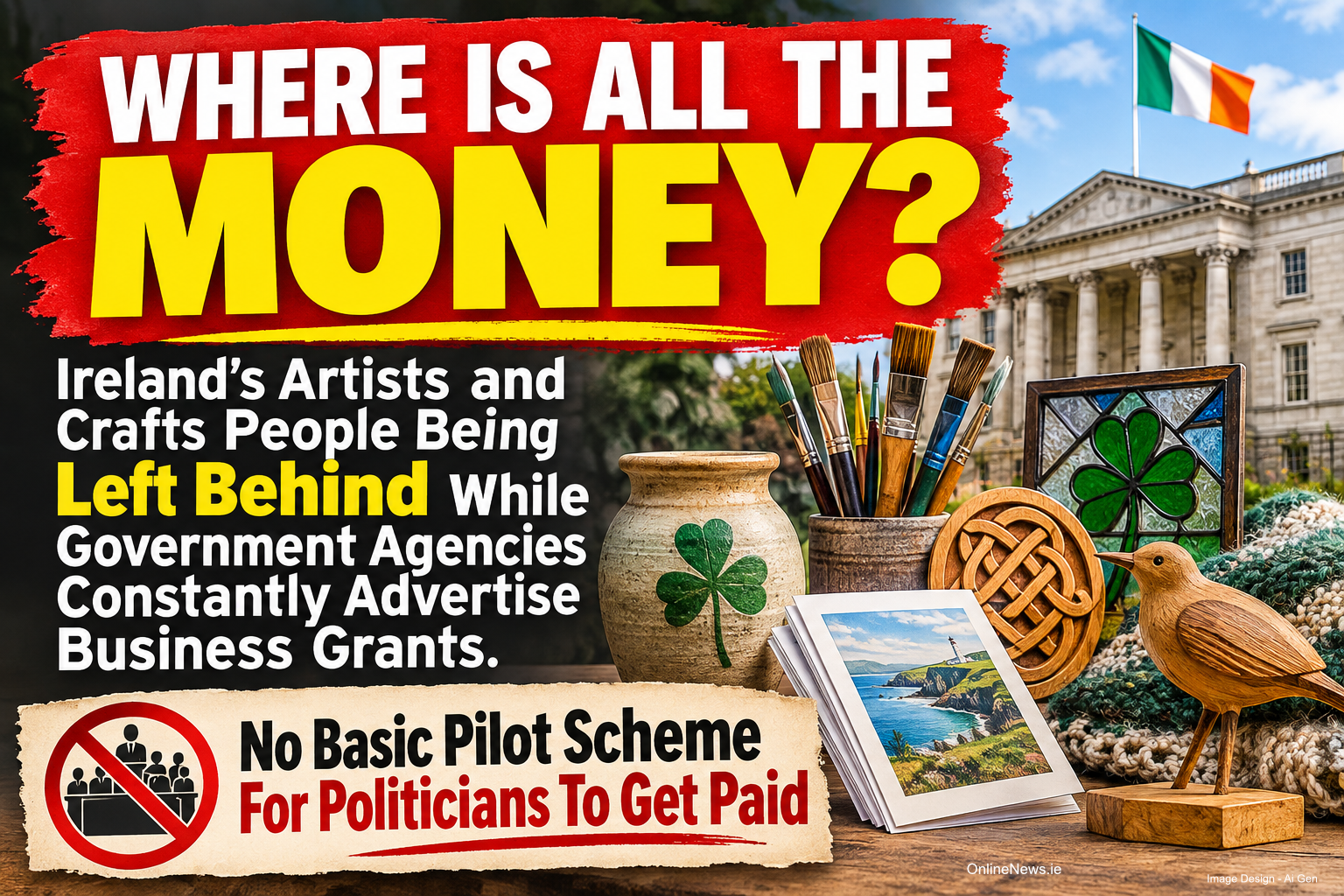
This raises a very serious question: Where is all the money going, and why are so many small craft businesses apparently unable to access it? Arts and crafts people are so important to our country and culture. But seemingly not important enough to get any business assistance.
The gap between the promises and reality
We regularly hear announcements from government departments, Local Enterprise Offices (LEO) and Enterprise Ireland about grants, business supports and funding opportunities for small businesses.
As a matter of fact there is an ad running on national media about Enterprise Ireland giving grants to small business in Ireland.
There is no shortage of publicity telling entrepreneurs that assistance is available. There are schemes, initiatives, development programmes and announcements about supporting Irish enterprise.
But what is happening on the ground?
If the funding is there, why are so many independent business owners like I spoke to unable to access it, who is getting all this money? I’m not suggesting there is corruption going on here, but something is certainly not right.
Are the requirements simply too narrow and out of touch with the realities of running a small creative business, or is the system effectively designed in such a way that makes it almost impossible for many of these people to qualify?
I certainly know what it is like to be on the outside.
This is not an issue I have arrived at through casual observation. I have experienced these difficulties first-hand over many years as an independent creative entrepreneur.
I had my own greeting card business for ten years, developing and producing my own distinctive designs and supplying more than 60 local shops and post offices. These were high-quality products featuring local scenes and Irish designs, created entirely by myself.
The business had an established customer base, a very good webstore and my cards were posted across the world, particularly to people in the UK, America and Australia. I genuinely believed the business had the potential to expand nationally and internationally with the right financial backing.
Alongside my greeting card business, I am also a photographer and digital artist, with several exhibitions to my credit. My work has been exhibited at Cork Airport for one month, Shannon Airport for three months, and at The Sea Church in Ballycotton for a week. These were significant opportunities to showcase my work and demonstrate the quality and commercial potential of my creative output.
Yet, despite these achievements, I spent years applying for financial assistance from both my Local Enterprise Office (LEO) and the Arts Council, only to face repeated rejections.
What I find particularly difficult to understand is that, at one stage, LEO actually paid a representative from a marketing company to visit me and advise me on how to run and develop my business. The representative was paid for this service, but despite the time and effort invested in assessing my business, I still received no financial assistance to help it grow.
It seemed extraordinary that an agency could recognise a need for professional business advice, arrange and pay for that advice, yet provide no meaningful financial support to help an established business with a distinctive product and an international customer base develop further.
My experience was that, despite having a proven product, an established route to market and considerable potential for growth, the grants and financial support so frequently advertised were frustratingly constantly simply beyond my reach.
If craftspeople like myself, are not receiving this funding, then who exactly is benefiting from it? Where is the money going, and why are the very people it is supposed to support being left out? Are all the funding ads just political spin?
The conversations I had with craftspeople at the recent fair resonated very strongly with me. I recognised their utter frustration when I mentioned it, because I have lived through years of it myself.
My Experience with LEO and the Arts Council: A System That Seems Designed to Keep People Out? Well most people.
My experience with the Local Enterprise Office (LEO) over the years has been deeply frustrating. On numerous occasions, I came away from discussions with the impression that more effort was being made to establish why I did not qualify for financial assistance than to explore how my business might be supported. It often felt as though the conversation, and ultimately the grant application process, was directed towards finding reasons to exclude me rather than identifying opportunities to help an established small business develop.
My experience with the Arts Council over a number of years has been, quite frankly, absolutely disgraceful. Some of my dealings with that organisation have left me questioning not only its attitude towards independent artists but also what I can only describe as an ignorant and dismissive approach to the very people it is supposed to support. The apparent lack of understanding, consideration and basic assistance shown towards some independent artists is deeply disappointing and, in my opinion, completely unacceptable.
On one occasion, while attempting to upload supporting material for a grant application, I encountered problems with the Arts Council’s website. The system would not allow me to upload the required material. Despite my attempts to resolve the problem, I was subsequently informed that my application was too late.
How can an applicant reasonably be expected to meet a deadline when the organisation’s own online system prevents them from submitting the required information?
What makes this particularly difficult to accept is subsequently seeing reports. Almost €6.7 million of public money was spent developing a new IT system which was ultimately abandoned.
I have to question whether agencies established to support artists, designers and small businesses are actually fulfilling that responsibility. From my own experience, the system felt closed, bureaucratic and unwelcoming, as though access to support is available to a particular circle of applicants while many independent creatives and small entrepreneurs are left struggling outside it.
I appreciate that grant applications must have criteria and that not every application can be successful. However, there is a fundamental difference between having fair eligibility requirements and operating a system in which applicants with proven portfolios repeatedly feel discouraged, and excluded.
Frankly, I question whether organisations that consistently fail to provide accessible and effective support are fit for purpose in their current form. Perhaps their structures, priorities and even their continued existence in their present form need to be seriously examined, maybe closed down and restructured.
How many other talented Irish designers, artists, craftspeople and small business owners have spent years trying to access support, only to encounter the same barriers? And how many potentially successful Irish businesses have been prevented from reaching their full potential because the financial and other assistance they needed was never forthcoming?
Irish crafts are part of our national identity.
There is another dimension to this issue that should not be overlooked.
Irish crafts, independent design and handmade products are an important part of our cultural identity. They showcase individual talent, imagination, traditional skills and contemporary Irish creativity.
The people behind these businesses are not simply selling products. They are developing designs, preserving skills, creating employment opportunities, supporting local retailers and contributing to the reputation of Irish creativity.
Many of these products are exceptional. They are precisely the kind of original Irish products that should be encouraged, developed and promoted. The products on show at this Arts and Crafts fair were of very high quality. Some of these designers are brilliant and with proper support could have long careers in their chosen crafts.
But talent alone does not keep a business alive.
Small businesses need working capital, investment in equipment, marketing support, assistance with production and opportunities to grow. Without access to appropriate financial support, many talented designers and craftspeople will struggle to develop their businesses or may eventually be forced to give up as I have.
It would be a serious loss to Ireland if businesses producing genuinely original Irish products disappeared simply because they could not obtain the support needed to survive and grow.
Question for LEO and Enterprise Ireland and Arts Council
I believe it is time for the agencies responsible for supporting Irish enterprise to explain exactly how their funding programmes are working for the smallest businesses.
I would like to see clear answers to the following questions:
- How much funding was allocated to microbusinesses and independent craft and design businesses in 2024, 2025 and 2026?
- How many applications were received from these businesses, and how many were successful?
- How much money was actually distributed to independent designers, craftspeople and small product-based businesses?
- What are the main reasons applications from these businesses are rejected?
- Are the existing funding criteria unintentionally excluding small businesses that have viable products but limited turnover or employment numbers?
- What specific financial assistance is available to an individual designer or craftsperson who wants to develop, manufacture and market an original Irish product?
- How many of the businesses receiving grants are genuinely small, independently owned enterprises employing fewer than five people?
It is time to listen to the small businesses
Ireland cannot continue to celebrate its independent designers and craftspeople at exhibitions, trade fairs and promotional events while ignoring the financial difficulties many of them face.
We should not simply congratulate these people for their creativity and then leave them to struggle alone.
If government agencies are serious about supporting small businesses, they need to demonstrate that the funding they advertise is reaching the people who need it.
I would particularly like to hear from other small business owners, designers, craftspeople and independent manufacturers who have tried to access grants or financial assistance through LEO Arts Council or Enterprise Ireland.
Were you successful? Were you turned down? Did you find the application process too complicated?
This conversation needs to happen.
I intend to seek answers directly from the relevant agencies.
Irish craftsmanship, independent design and small creative businesses deserve more than publicity. They deserve practical support, meaningful investment and a genuine opportunity to grow.
The question is no longer whether Ireland has talented craftspeople. Craft fairs and exhibitions all over Ireland demonstrated beyond doubt that it does. The question is whether the organisations established to support Irish enterprise are doing enough to help them survive and succeed.
So, LEO and Enterprise Ireland, Arts Council where is the money, and how much of it is actually reaching Ireland’s crafts people businesses?
I would make it clear that these are observations from the exhibition you personally attended, rather than general claims about all craft fairs.
Are Artists Being Charged Twice?
Who is this exhibition actually designed to benefit the artists and craftspeople, or the organisation running the event? Are Some Events Marketed as Arts and Crafts Fairs Simply Money-Making Exercises for the organisers?
At this exhibition I attended, I observed that artists and craftspeople were paying for table space to display their work, while visitors were also being charged €8 admission, reduced to €5 with a flyer. In my opinion, this creates a double financial burden. The exhibitors had already invested their time, money and effort in preparing for the event, yet potential customers were being asked to pay simply to enter and browse. During my visit, I heard several people comment that the exhibition was very quiet. I cannot say whether the admission charge was responsible, but it certainly raises the question of whether it might be discouraging visitors. How is this arrangement benefiting the artists? If exhibitors are paying to display their work and the public are paying to enter, who is actually benefiting financially, and what return are the artists getting for their investment?
______________________________________
Why Must Artists and Craftspeople Prove They Deserve Support?
The Basic Income for the Arts pilot scheme provided €325 per week to 2,000 selected artists.
There is another issue here that I find particularly difficult to accept. I believe most artist and crafts people find this rather insulting.
When a politician is elected to the Dáil and takes up public office, they receive a salary for carrying out that role, some with no experience at all. They are not required to undergo a pilot programme, compete against thousands of other people or repeatedly submit applications to prove that they deserve to be paid.
So why should artists, designers and craftspeople be treated so differently?
These are people with qualifications, skills, experience and, in many cases, years of dedication to developing their craft and building a business. They contribute to Ireland’s culture, tourism, identity and economy. Many create original work, employ their own skills and invest their own money in producing goods that represent this country at home and abroad.
Yet when they seek financial support, they can be subjected to complicated application procedures, competitive selection and repeated rejection. The Basic Income for the Arts pilot scheme provided €325 per week to 2,000 selected artists, but what about all the equally talented and qualified people who were left out?
I find it deeply insulting that people who have devoted their working lives to developing their artistic and creative skills should have to continually compete for recognition and basic financial support. Their contribution should not have to be validated by winning a place after some ridiculous pilot scheme.
If public representatives are paid for the work they do, why should the people who create, design, make and preserve so much of Ireland’s cultural identity have to fight so hard simply to have their work and contribution recognised?
Artists and craftspeople are not asking for charity. They are asking for fairness, respect and a support system that recognises their value.
_______________________________________
My Photo & Digital Art, Exhibition, Sea Church, Ballycotton, Co. Cork, 2022. (Video taking during setup)