
For more than 20 years Ireland has been told about racism. But where is the evidence that proves the crimes actually exist?
For more than two decades, Irish people have been presented with reports, surveys and statistics warning of racism.
The numbers are repeated, the reports are funded, the headlines follow and the narrative becomes established.
But there is a fundamental question that has never received enough attention:
How many of the alleged crimes were actually proven?
Not reported.
Not perceived.
Not entered on PULSE.
Proven.
It began with an ESRI survey.
ESRI (The Economic and Social Research Institute)
The ESRI itself describes what it measured as “perceived discrimination.”
One of the important early pieces in this process was the 2006 ESRI report, Migrants’ Experience of Racism and Discrimination in Ireland: Survey Report.
It was produced by Frances McGinnity, Philip J. O’Connell, Emma Quinn and James Williams, all associated with the Economic and Social Research Institute at the time. The research was carried out in 2005 for the European Union Monitoring Centre on Racism and Xenophobia (EUMC) as part of a comparative study covering 12 EU Member States.
The report surveyed recent non-EU adult migrants, specifically work-permit holders and asylum seekers, asking about their experiences in workplaces, public places, shops, commercial transactions and institutions. The ESRI itself describes what it measured as “perceived discrimination.”
That distinction is crucial.
This was not a Garda crime survey.
It did not establish how many crimes had been committed.
It did not produce a list of convictions.
It did not establish that every reported experience had occurred as alleged.
And it certainly did not prove that Irish people as a population were racist.
It measured what respondents said they had experienced.
No proof of any criminality.
Then the allegations became numbers
Alongside surveys, the NCCRI developed its own voluntary system for recording alleged racist incidents.
Reports they stated: came from victims, witnesses, and organisations working with migrants, asylum seekers, and other groups, capturing incidents that might never have reached the Gardaí.
Yet, without convictions, it was impossible to establish whether the allegations were true.
They were merely reports.
They were not court findings.
They were not convictions.
Yet in the years that followed, these figures were absorbed into a far larger public narrative about racism in Ireland, one that evolved into a damning indictment of our beautiful nation.
That is where the distinction between reported, perceived, recorded and proven becomes absolutely essential.
2024: 676 Incidents — But How Many Led to Convictions?
Fast-forward more than two decades.
In 2024, An Garda Síochána recorded 592 hate crimes and 84 hate-related non-crime incidents — 676 incidents in total.
But that headline figure requires some important context.
The Gardaí describe these numbers as operational PULSE figures. A discriminatory motive may be recorded when a victim or another person perceives an incident to have involved hostility or prejudice.
Importantly, 84 of the 676 recorded incidents were not crimes at all.
The public does not have access to the PULSE system, and these operational records should not be treated as equivalent to proven criminal offences or court convictions. A recorded incident is not, by itself, evidence that a crime occurred or that anyone was found guilty.
So the crucial question is: how many of these recorded incidents ultimately resulted in a conviction in court?
So where is the corresponding figure showing how many of the alleged crimes ultimately resulted in convictions?
That is the figure the public needs.
Where are the convictions? Why are these figures being released to the public when they seemingly hold no real legal credibility?
The cycle continues
The names and organisations may change, but the basic process remains remarkably familiar.
A person reports an incident.
An organisation records it.
A number is produced.
A report is published.
The report is quoted as evidence of the scale of racism.
Government policy follows.
Funding follows.
Then another report appears.
And another.
More than 20 years later, we are still being presented with essentially the same kind of unproven evidence, while the public is rarely given the full criminal-justice outcome of those allegations.
At some point, that has to be challenged.
And the money keeps growing
The taxpayer is now funding an increasingly large anti-racism infrastructure.
The Government’s Ireland Against Racism Fund alone provided €1.1 million to 28 projects in 2024, €1.539 million to 37 projects in 2025, and up to €1.4 million was made available for 2026. That is almost €4.1 million across those three funding rounds alone.
And that is only one funding stream.
There are Government departments, agencies, committees, strategies, programmes and numerous organisations operating in this area.
The Government describes the National Action Plan Against Racism as a whole-of-Government approach.
So the question becomes unavoidable:
How much public money is being spent on this system — and what independently verified evidence demonstrates that the claims driving it are accurate?
If you want eggs, buy chickens.
The same people,
The same questions,
More reports, Same unanswered question.
After more than two decades, some of the organisations and individuals involved in researching, reporting and campaigning on racism remain prominent in the field.
That does not, by itself, prove wrongdoing.
But it does raise an important question about independent verification.
A system should never become self-confirming:
fund the organisations → collect the allegations → publish the reports → cite the reports as evidence → use the evidence to justify more funding.
There must be an independent point at which somebody asks:
How many of these allegations were actually established?
Otherwise, the system risks measuring the number of allegations being generated rather than the number of crimes being proven.
We need the complete audit trail
There should be a simple chain:
Reported → Investigated → Charged → Prosecuted → Convicted.
Give the public every stage.
If 600 incidents are reported and 60 result in convictions, tell us.
If 600 are reported and 10 result in convictions, tell us.
If 600 are reported and none results in conviction, tell us.
And if some of the reports were never criminal offences in the first place, make that unmistakably clear.
That is how an honest debate should work.
If somebody is assaulted because of race, investigate it.
If somebody commits a hate-motivated crime and is convicted, publish the conviction.
If hundreds of racist crimes are being committed, show us the criminal-justice figures.
But if your number represents a survey respondent’s perception, say so.
If it represents an allegation, say so.
If it represents a PULSE entry, say so.
Do not allow a reported allegation to acquire the authority of a conviction simply because it has been given a number.
After more than 20 years — and with millions of euro now being spent on an expanding anti-racism infrastructure — asking for proof is not unreasonable.
It is basic democratic accountability.
Where is the proof?
Allegations are not convictions.
Perceptions are not proof.
PULSE entries are not court judgments.
Reports are not verdicts.
If the claim is serious enough to influence national policy and to repeatedly place an accusation of racism against Irish society, then it is serious enough to withstand independent scrutiny.
Over twenty years is long enough.
Show us the real evidence.
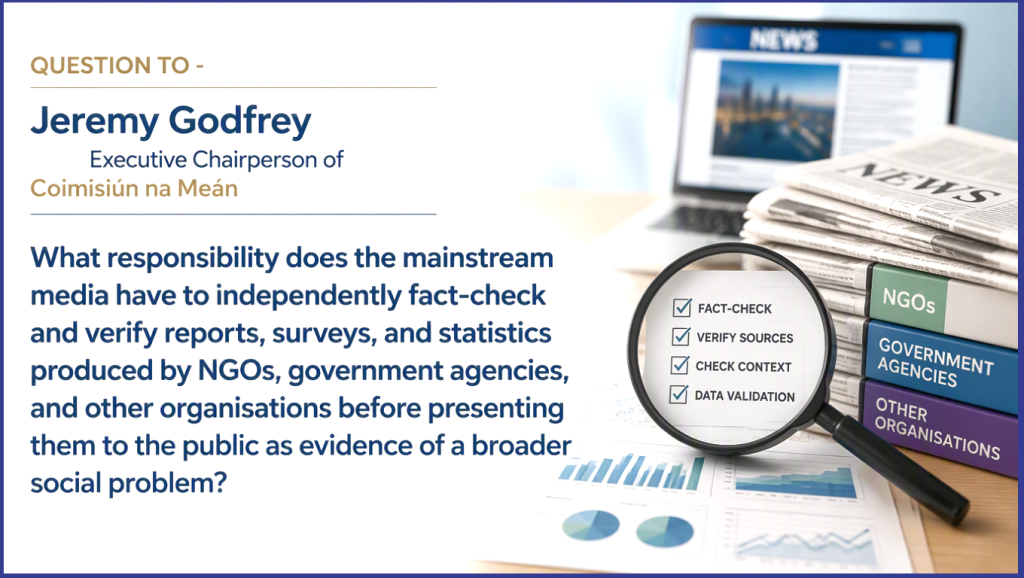
Mr Godfrey
I would be interested in your view on an important issue this article raises.
What responsibility does mainstream media have to independently fact-check and verify reports, surveys and statistics published by NGOs, government agencies or other organisations before presenting them to the public as evidence of a wider social problem?
In particular, should journalists distinguish clearly between perceptions, allegations, recorded incidents and independently verified or legally proven offences, rather than allowing reported figures to be presented as established facts?
Where reports may reflect the methodology, assumptions or ideological perspectives of the organisations producing them, should the media also examine the underlying evidence, methodology, funding and potential conflicts of interest?
I believe this is an important question of journalistic standards and public accountability, particularly when such reports are subsequently used to influence public policy and the spending of taxpayers’ money.
I would appreciate your thoughts on what standards mainstream media should be expected to apply in these circumstances.
Sean Treacy
OnlineNews.ie
“If you want eggs, buy chickens” means that the answers we get from research are often shaped by who we choose to ask. If we keep getting the same people, using the more or less the same questions, and relying on the same funding organisations, we may get different answers, but they will still be variations of the same overall perspective.
Like chickens laying eggs of different colours and sizes, the eggs may look different, but they are still eggs.
To find genuinely different answers, we need to involve different people, communities, experiences, and independent sources of funding rather than repeatedly drawing from the same pool.