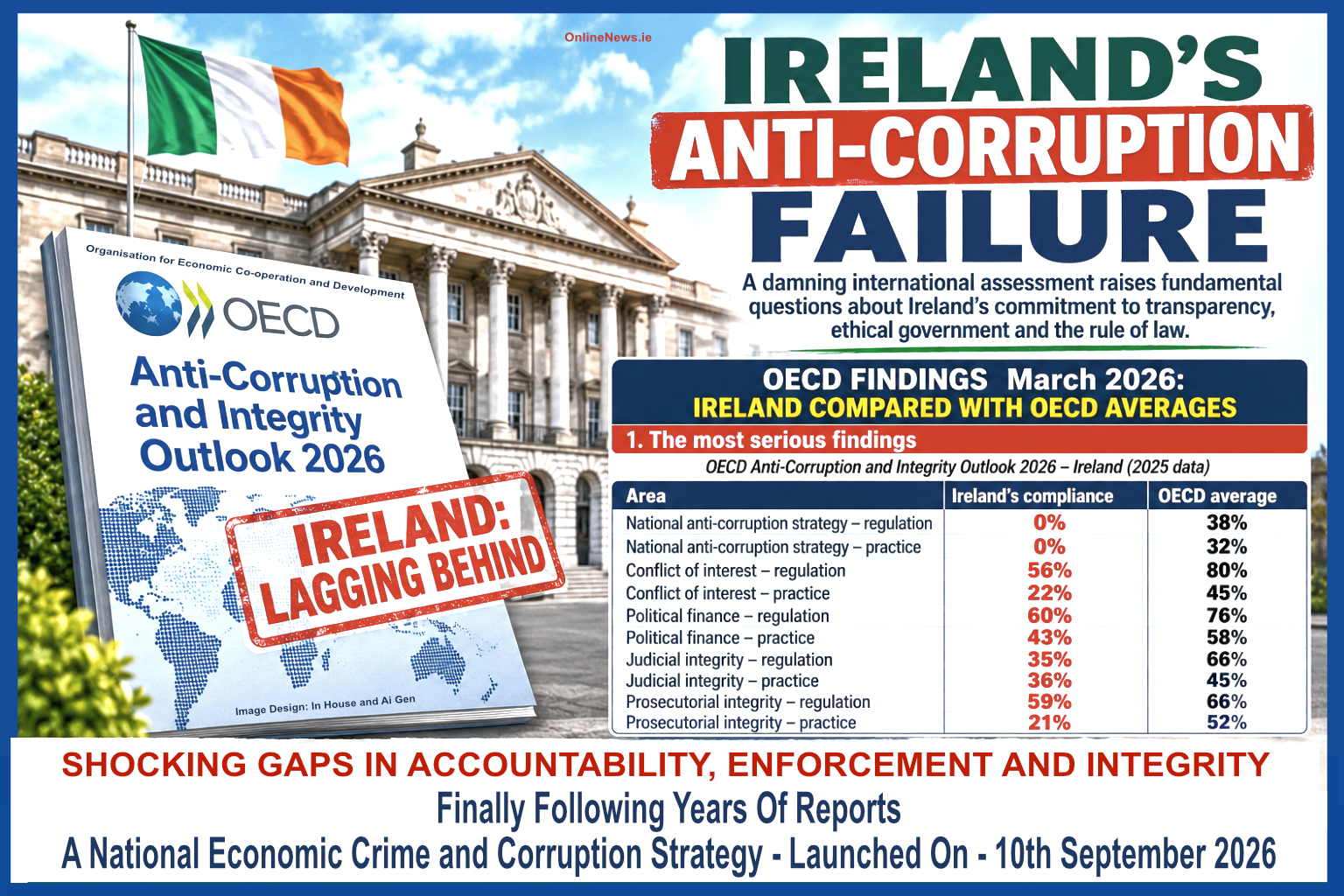
Organisation for Economic Co-operation and Development (OECD) EXPOSES SHOCKING GAPS IN ACCOUNTABILITY, ENFORCEMENT AND INTEGRITY
Ireland’s compliance
OECD average
National anti-corruption strategy
Regulation 0% – 38%
National anti-corruption strategy
Practice 0% -32%
A damning international assessment raises fundamental questions about Ireland’s commitment to transparency, ethical government and the rule of law.
YEARS OF WARNINGS BUT NO ACTION TAKEN – WHY HAS IT TAKEN SO LONG?
Perhaps the most disturbing aspect of this situation is that Ireland cannot claim it was unaware of the problems. International monitoring bodies, including GRECO and the OECD, have been examining Ireland’s anti-corruption arrangements for years.
Recommendations, compliance assessments and warnings have been repeatedly published, yet the Government did not launch its new National Economic Crime and Corruption Strategy until 10 September 2026.
Will there be retrospective legal penalties?
Even more significantly, the OECD’s 2024 assessment had already recorded that Ireland’s national strategy was still being developed and was not yet in place. The March 2026 OECD assessment subsequently exposed further substantial deficiencies.
The findings raise an uncomfortable question: has Ireland created an accountability framework that allows those in positions of political power to escape meaningful independent scrutiny?
OECD FINDINGS March 2026: IRELAND COMPARED WITH OECD AVERAGES
1. The most serious findings
OECD Anti-Corruption and Integrity Outlook 2026 – Ireland (2025 data)
| Area | Ireland’s compliance | OECD average |
|---|---|---|
| National anti-corruption strategy – regulation | 0% | 38% |
| National anti-corruption strategy – practice | 0% | 32% |
| Conflict of interest – regulation | 56% | 80% |
| Conflict of interest – practice | 22% | 45% |
| Political finance – regulation | 60% | 76% |
| Political finance – practice | 43% | 58% |
| Judicial integrity – regulation | 35% | 66% |
| Judicial integrity – practice | 36% | 45% |
| Prosecutorial integrity – regulation | 59% | 66% |
| Prosecutorial integrity – practice | 21% | 52% |
Source: OECD, Anti-Corruption and Integrity Outlook 2026 – Country Note: Ireland, 2025 data.
View original OECD report (PDF)
Key observation: Ireland scores 0% on both national anti-corruption strategy indicators, 22% on conflict-of-interest practices and 21% on prosecutorial integrity practices. These figures highlight substantial gaps against OECD standards.
Source: OECD, Anti-Corruption and Integrity Outlook 2026 – Ireland Country Note. Data extracted from the OECD Public Integrity Indicators Database on 7 March 2026 (2025 data or latest available). Percentages represent the proportion of specified OECD regulatory and practical implementation criteria fulfilled by Ireland. They measure the effectiveness and completeness of integrity safeguards, not the percentage of public officials involved in corruption.
THE CONSTITUTIONAL ACCOUNTABILITY QUESTION
Articles 6 and 15 of Bunreacht na hÉireann establish that governmental powers derive from the people and that legislative authority rests with the Oireachtas. Article 28.4.1 provides that the Government is responsible to Dáil Éireann.
These are not optional principles. They establish the constitutional framework within which political authority must be exercised.
Politicians cannot reasonably demand public confidence in the rule of law while accepting an oversight system that fails to provide adequate verification and enforcement of the very standards governing public office.
The OECD identifies particularly serious weaknesses:
- Conflicts of interest: SIPO receives declarations but does not verify their accuracy or impose sanctions.
- Political finance: Independent external auditing of donation and election expenditure statements is limited.
- Judicial integrity: Significant gaps remain in the regulatory and practical safeguards.
- Prosecutorial integrity: Ireland achieves only 21% of the OECD’s practice criteria.
The submission of a declaration is not proof of compliance. The existence of legislation is not proof of enforcement.
WHO HOLDS THE POLITICAL ESTABLISHMENT ACCOUNTABLE?
There is an inherent institutional concern when politicians legislate on the rules governing their own conduct and determine the powers and resources of the bodies responsible for overseeing them.
The OECD findings expose serious questions about the independence and effectiveness of Ireland’s existing accountability framework, which appears to offer little practical assurance that compliance is properly monitored or that breaches result in meaningful consequences.
Under the Constitution, the Oireachtas has legislative authority, the Government is accountable to the Dáil, and the courts protect the constitutional order. Article 15.10 also gives each House powers to regulate its own proceedings and impose penalties for breaches of its rules.
Political accountability must be legally enforceable in practice, with elected representatives subject to effective independent oversight and meaningful consequences for any breach of their constitutional, statutory or ethical obligations.
IRELAND NEEDS ANSWERS
The Government and Oireachtas should explain:
- Why are declarations of interests not independently verified?
- Why are oversight and enforcement powers insufficient?
- Why do such substantial gaps remain in political, judicial and prosecutorial integrity?
- What safeguards prevent politicians from weakening or avoiding effective scrutiny?
- Who is responsible for implementing reforms, and when will measurable compliance be achieved?
If Ireland’s Constitution guarantees accountable government, why are the institutions entrusted with upholding it failing to ensure that those exercising political power are genuinely subject to the law, independent scrutiny and meaningful consequences for non-compliance?
The Irish public should not have to accept a system in which rules exist on paper but effective oversight and enforcement remain inadequate.
No political office should place anyone beyond meaningful accountability. The Constitution establishes the framework; the State must ensure that its principles are respected in practice.
Ireland does not need another declaration of good intentions. It needs demonstrable compliance, independent oversight and real accountability for those entrusted with public power.
The constitutional references: Articles 6, 15 and 28 provide a sound basis for examining the accountability of political power. irishstatutebook.ie
European democracies, not simply Ireland’s position against an OECD average.
EUROPE’S WIDER FAILURE: A DISTURBING PICTURE OF DEMOCRATIC ACCOUNTABILITY
Perhaps even more disturbing is that Ireland is not the only country facing these problems. The OECD’s international assessment exposes a much wider failure to translate anti-corruption legislation and integrity standards into effective practice across developed democracies.
Europe regularly presents itself as a global defender of democracy, transparency, human rights and the rule of law. Yet the OECD findings raise serious questions about how effectively these principles are being implemented within European countries themselves.
The fact that only one in four OECD member countries tracks the implementation of its anti-corruption strategy, while the average gap between regulation and actual practice stands at 19 percentage points, should concern every European citizen.
This is a deeply uncomfortable picture. Countries can establish legislation, create oversight bodies and make public commitments to integrity, yet still fail to demonstrate that those safeguards work in practice.
What credibility do European governments have when they demand transparency, accountability and the rule of law internationally, while their own systems continue to demonstrate substantial weaknesses in implementation and enforcement?
Democracy cannot be measured by the number of laws passed, institutions established or declarations signed. It must be measured by whether those exercising public power are genuinely accountable and whether the rules apply equally to everyone.
Europe must move beyond political rhetoric and confront the legal and institutional realities laid bare by these findings.
One important qualification: the OECD’s 19-point figure is an average for OECD members, not a Europe-only average.
It appears in two places:
- Executive Summary – Key Figures, page 10 of the full report.
- Chapter 2 – Strategy, section titled “Well-designed strategies tend to have better implementation rates, but only 1 in 4 OECD Member countries track implementation in practice”.
Full Report
PRIMARY SOURCES
OECD, Anti-Corruption and Integrity Outlook 2026 – Ireland.
Constitution of Ireland – Irish Statute Book.
Please Note:
One in four refers to OECD member countries, not European countries alone.
OVERALL BAD REFLECTION OF COUNTRIES ACROSS MEMBER COUNTRIES
Fundamental to democratic accountability, transparency and public integrity.
32% Regulation and 38% Practice
The OECD covers 37 member countries and 25 partner countries.
The wider international picture is deeply troubling. The OECD averages themselves reveal how poorly countries are performing in areas regulation and practice 32% and 38% respectively. These are not impressive benchmarks against which Ireland can claim to be doing well; in several areas, the OECD averages are shockingly low and surely unacceptable.
The figures raise an uncomfortable question for democracies across Europe and beyond: if these are the standards being achieved by developed democratic states, how robust is the protection against conflicts of interest, political influence and failures of accountability in practice?
Group of States against Corruption.
5th Round
https://www.anticorruption.ie/reports
https://www.anticorruption.ie/national-economic-crime-and-corruption-strategy-launched
Culture of endless reports
Europe has developed an extensive institutional machinery for analysing problems, PRODUCING REPORTS and PRODUCING REPORTS, setting objectives and issuing recommendations. However, its capacity to translate this knowledge into timely, coordinated and measurable action remains inconsistent. Too often, the production of strategies and policy documents becomes a substitute for political accountability and effective implementation.
European institutions must confront a deeply entrenched culture of endless reports, studies and recommendations with little tangible action. Identifying problems is not solving them, and publishing another strategy is not delivering results. This institutional cycle of analysis without accountability must end. Enough reports. What Europe needs is action, implementation and measurable results and those responsible must be held accountable when nothing changes