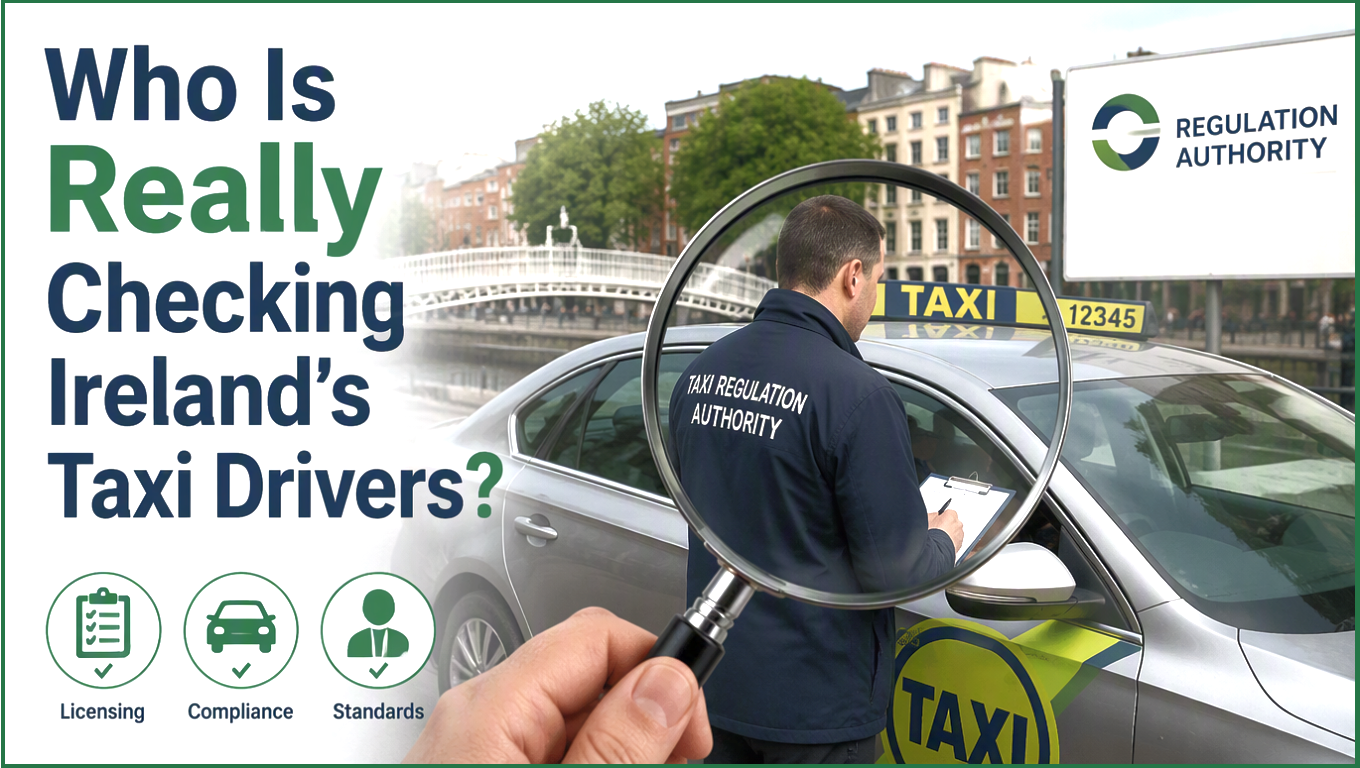
Ireland’s taxi industry is changing rapidly. The number of SPSV drivers is substantial, the workforce is increasingly international, and passenger complaints are rising.
In 2025, the National Transport Authority recorded 1,815 SPSV complaints — a record high and 106 more than in 2024. Fare disputes accounted for 54%, hiring issues 22% and driver behaviour 20%. Around six in ten complaints required no further action, but 165 resulted in fines and 28 were referred to other agencies, including An Garda Síochána.
Are Ireland’s safeguards keeping pace with the changing taxi industry?
Who actually licenses the driver?
There is an important distinction that is often lost.
The National Transport Authority regulates the SPSV sector and licenses the vehicle. But An Garda Síochána is the licensing authority for the person driving the taxi. Gardaí are responsible for determining whether an applicant is suitable to hold an SPSV driver licence.
That means questions about a driver’s background and suitability ultimately lead back to Gardaí.
And this is where overseas applicants raise an obvious question.
Garda’s SPSV application documentation requires a Police Certificate of Character from each country in which an applicant has resided.
But the public deserves to know exactly how those certificates are checked.
Where an applicant submits a Police Certificate of Character issued by a non-EU country, does An Garda Síochána have the ability to independently query that country’s criminal-record database or competent authority, or does the SPSV licensing process ordinarily rely upon the certificate supplied by the applicant?
That is not an attack on people from overseas. It is a basic question about the strength of Ireland’s licensing system.
If a person has spent many years living outside Ireland, or from another country, how does the State establish that the certificate is genuine, complete and actually relates to that individual?
And if an overseas authority cannot provide an effective independent verification mechanism, what additional safeguards do Gardai use, or for public safety should “no license” be issued?
These are questions that should be answered with figures and procedures, not assurances.
Then there is the English-language question
How could somebody with little or no functional English work as a taxi driver in Ireland, how could they have functional communication?
A taxi driver needs to understand passengers, destinations and changes to journeys. They may need to explain a fare, deal with a dispute, assist a disabled passenger, communicate with Gardaí or respond to an emergency.
Yet there is no separately stated English-language proficiency examination in the NTA’s published SPSV entry requirements that I am aware of. This s seriously bizarre, how could the driver find people’s addresses or read road signs?
More concerningly, this issue has already surfaced within the regulator’s own Advisory Committee.
In November 2024, industry representatives reported that candidates with poor understanding of English had allegedly been provided with an interpreter during the SPSV Driver Entry Test and that the interpreter allegedly went beyond interpretation and supplied answers. The NTA disputed that interpreters were provided, saying candidates could receive certain supports and that it would clarify what assistance was actually available.
That allegation should not simply disappear.
The obvious question is:
What objective test does Ireland use to establish that a person has sufficient English to safely and effectively carry passengers as a professional taxi driver?
And if there is no separate test:
That makes the division of responsibility between Gardaí and the NTA even more important.
The NTA can regulate the industry, test applicants and investigate complaints.
But Gardaí decide who gets the driver licence.
So the questions should be directed squarely at the licensing authority:
How many overseas police certificates were independently verified?
How many could not be independently verified, were they allowed to proceed regardless?
How many applications were refused because of overseas criminal-record information?
How many applicants receive language assistance during the SPSV test?
What exactly does that assistance permit?
If a person is unable to complete a basic form to apply for a taxi licence, why should they be allowed to apply for a licence at all? This has to be considered a basic level of competency. Taxi drivers need to be able to read addresses, street names and road signs, as well as understand restrictions such as one-way streets, particularly when carrying passengers.
And most importantly:
Can An Garda Síochána guarantee that every person granted an SPSV driver licence has had their relevant overseas history properly checked and has demonstrated sufficient ability to communicate with passengers and authorities?
Nobody is suggesting that being foreign makes somebody unsuitable to drive a taxi.
The issue is much simpler.
If you are licensed to carry the Irish public for money, the same high standard of vetting, competence and communication should apply to everyone.
With complaints at a record level and the taxi workforce changing, the public is entitled to demand evidence that the system is actually delivering that standard.
If the safeguards are working, publish the evidence. If they are not, fix them.
Reply to email I sent to National Transport Authority
National Transport Authority
Haymarket House
Smithfield
Dublin 7
D07 CF98To: Anne Shaw – Chief Executive Officer
____________________________________
Dear Mr. Treacy,
Thank you for your email.
The total number of active SPSV driver licences and SPSV vehicle licences are located here on the website: https://www.nationaltransport.ie/taxi/statistics-and-legislation/.
Compliance and enforcement statistics are reported here on the website:
https://www.nationaltransport.ie/taxi/compliance-enforcement/compliance-statistics/.
New vehicle licences issued are located here in our SPSV Stats Bulletin:
https://www.nationaltransport.ie/wp-content/uploads/2025/07/SPSV-Bulletin-2024.pdf
1,368 new vehicle licences were issued for 2025.
An Garda Síochána are the licensing authority for SPSV Driver Licences.
The NTA also provides the Driver Check App. This is a safety app for passengers. The app shows a driver’s name and the photo used in their licence application. All active SPSV driver and vehicle licences are listed in the app.
This means An Garda Síochána has checked, registered and approved the person to hold an SPSV driver licence. The app allows people to:
- Check if a driver and vehicle are licensed and on the SPSV Public Register.
- Confirm that the driver is linked to the vehicle they are using.
- Verify a driver’s identity. Passengers can use options on the app to verify and approve a driver, or they can report a driver and take a different vehicle
A small public service vehicle (SPSV) can by driven by multiple drivers. Each driver must advise the NTA every time they start operating that vehicle. SPSVs can be operated anywhere in Ireland and are not restricted to a specific geographical area.
Yours sincerely,
National Transport Authority