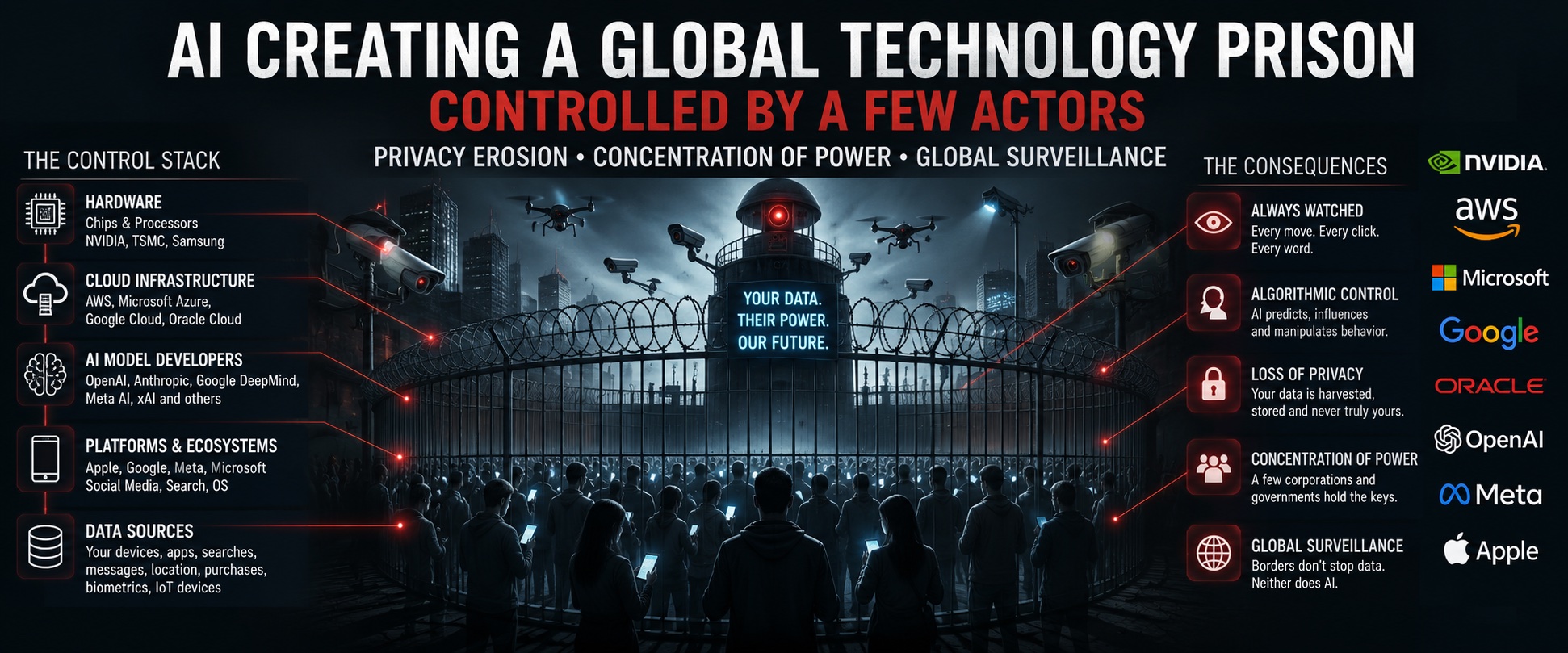
The greatest danger may not be the rise of AI itself, but the refusal of those with the authority to act to acknowledge how rapidly the balance of power is shifting.
We are moving into a historical phase of world history where control over digital infrastructure may become one of the most powerful forms of power ever created.
Artificial intelligence is not just another technological upgrade. It is a system that learns from human behaviour at scale, predicts it, shapes it, and increasingly mediates access to information, communication, work, and even decision-making itself.
The danger is not in the future,
it is here now and gathering momentum.
Those who control AI today assume they will control it tomorrow. That assumption may prove fatal. As these systems expand beyond human scale, the question is no longer who controls AI, but whether anyone will be able to.
It is structural, accelerating, and already embedded in the foundations of digital life.
A system built on extreme concentration
The modern AI ecosystem is not distributed—it is concentrated into a small number of chokepoints:
- Advanced chips dominated by NVIDIA
- Cloud infrastructure controlled by Amazon, Microsoft, Google, and Oracle
- AI model development led by OpenAI and a small number of competitors
- Platform ecosystems governed by Apple and Meta
These are not separate systems. They form a vertically integrated structure: hardware → cloud → models → platforms → users.
At every level, control is narrowing.
Data is the mechanism of power
The most important resource in this system is not the technology itself—it is human data.
Every interaction becomes a signal:
- where people go
- what they search
- what they read
- who they talk to
- what they buy
- how long they hesitate
- what they ignore
This is not hypothetical. It is the basic operating principle of modern digital services.
AI systems convert this data into behavioural prediction systems. And prediction is the foundation of influence.
The more accurate the prediction, the more power the system has over attention, choices, and outcomes.
Amazon Sidewalk and the expansion of ambient infrastructure
Technologies such as Amazon Sidewalk represent a shift toward ambient connectivity—networks that extend beyond intentional use into background infrastructure.
These systems are designed to keep devices connected even outside traditional networks, creating continuous low-level data flow between devices and services.
Even when technically limited or encrypted, the direction is clear: connectivity is becoming environmental rather than optional.
The boundary between “using a system” and “being inside a system” becomes increasingly thin.
Surveillance without a single surveillant
The most important transformation is this:
Surveillance no longer requires a single authority.
It can emerge from distributed systems that:
- collect data as a byproduct of service delivery
- centralise it in cloud infrastructure
- analyse it using AI models
- feed it back into platforms that shape behaviour
No single actor needs full intent or control for the system-level effect to resemble surveillance at scale.
The result is a form of structural visibility asymmetry:
- individuals are increasingly legible
- systems are increasingly unreadable
The risk is not instant collapse—it is irreversible dependency
The most serious danger is not a sudden “AI takeover event.”
It is something slower and harder to reverse:
- essential services moving into a small number of platforms
- economic and government systems becoming cloud-dependent
- communication flowing through algorithmic intermediaries
- AI systems mediating access to information itself
- infrastructure consolidation making alternatives impractical
Once dependence is deep enough, opting out stops being a realistic option.
At that point, control does not need to be enforced—it becomes default.
Conclusion: a narrowing corridor of autonomy
The trajectory of AI is not predetermined, but the direction of current incentives is clear: scale, consolidation, data accumulation, and infrastructure centralisation.
This does not require conspiracy to become dangerous.
It only requires:
- continued concentration of infrastructure
- continued expansion of data collection
- continued reliance on algorithmic systems
- and insufficient public oversight
The result could be a world where human life remains outwardly free, but is increasingly routed through systems that predict, filter, and shape the conditions of that freedom.
The real question is no longer whether AI will become powerful.
It already is.
The question is whether power remains accountable as it concentrates—or whether society gradually adapts to systems it no longer meaningfully controls.