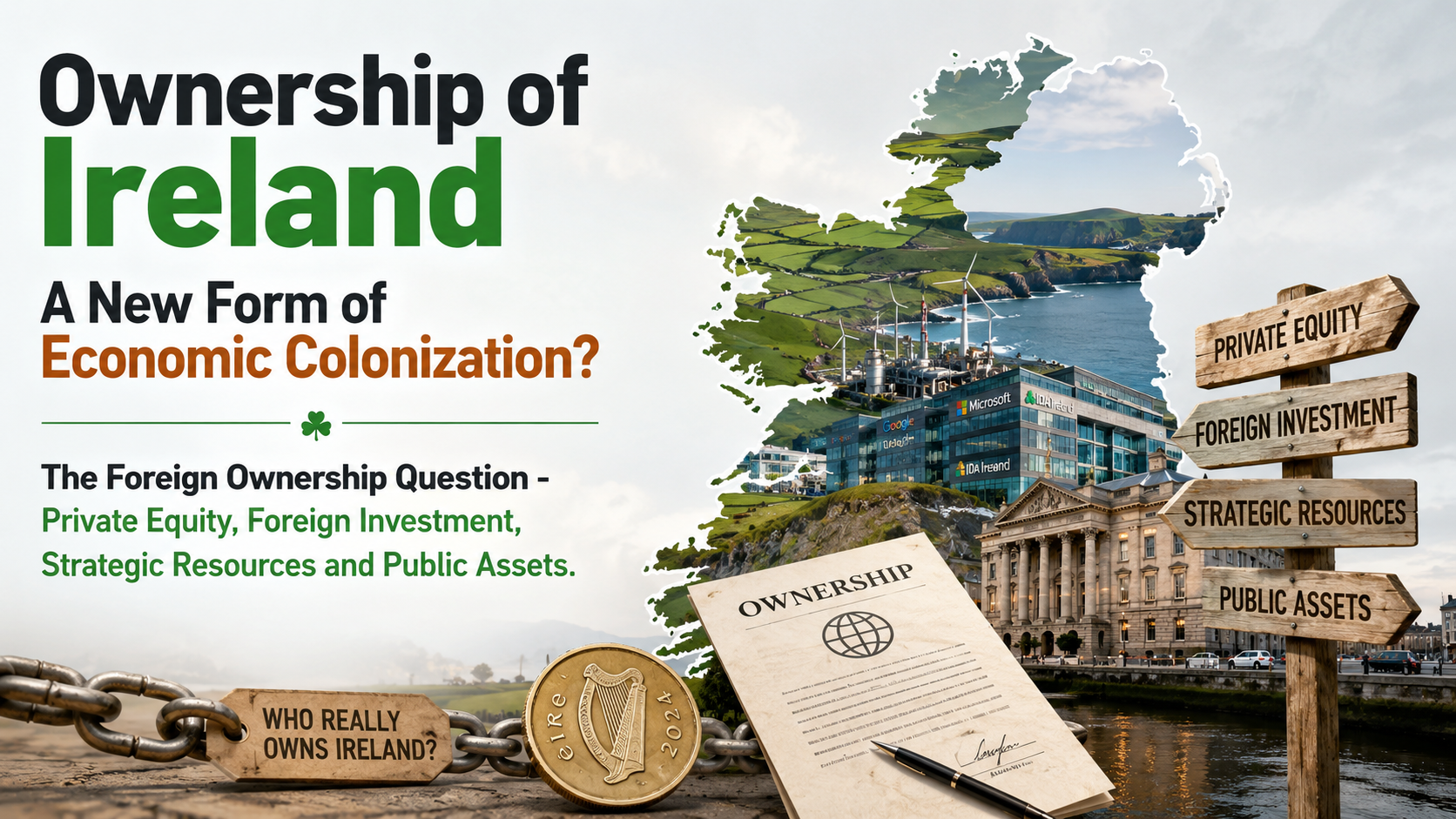
For centuries, Ireland’s political struggle was defined by questions of land, ownership and control.
Land was the central issue of Irish history. Ownership determined wealth, power and influence. The struggle for independence was, in large part, a struggle over who controlled Ireland’s resources.
Today, the debate has returned in a different form.
A Small Country Open
to the World – But Who Owns Our future?
Ireland has always had to navigate a difficult reality. It is a small island nation with limited domestic capital, a relatively small population and a history of economic vulnerability. Unlike larger countries, Ireland has often needed outside investment to build industries, create employment and compete internationally.
Companies such as Intel, Apple, Pfizer and many others, made Ireland a global business trading location. That success cannot be dismissed but has come at a price for many.
Economic Success For Who?
Who is gaining wealth and opportunity, who is loosing out?
Are benefits reaching workers, small businesses, families, and poorer communities, or mainly investors and large corporations?
A country can report impressive GDP growth figures while many of its citizens experience stagnant wages, rising rents, increasing living costs, and ongoing poverty, alongside a growing homelessness crisis. Economic statistics alone do not always reflect the reality faced by ordinary people.
Similarly, a company can announce record profits while its employees face job losses, reduced financial security, declining purchasing power, or the wider social consequences of labour policies that contribute to skilled workers leaving the country.
A country may have its own flag, its own Government and its own currency decisions, yet still see much of its productive wealth controlled elsewhere.
From Landlords to Investment Funds?
Ireland’s historic struggle over land was a fight against absentee landlords who controlled the nation’s most valuable resource. It wasn’t just about vast estates it was also about who owned the rivers, who controlled fishing rights, and ultimately who held power over the country’s wealth.
Yet, despite generations of sacrifice to reclaim control of Irish land, successive governments have failed to fully reverse that legacy. Many of the country’s largest estates remain in private hands, and instead of protecting Irish ownership, politicians are now allowing even more of our land to be sold to foreign investors. It is a bitter irony that, after centuries of fighting to regain control of our own country, we are once again watching ownership of Ireland pass out of Irish hands.
Just to mention a few:
The Devonshire family (United Kingdom) – Lismore Castle estate, County Waterford – Several Thousand Acres – Exact current acreage is not publicly disclosed.
The McIlhenny family (United States) Glenveagh Estate, County Donegal. Estimated 22,000 acres.
Castletown Cox (also called Castletown House), a Georgian estate near Piltown, County Kilkenny. Recently bought by Kelcy Warren.
The modern debate is different but with some striking parallels. Today, ownership sits with: multinational corporations; private equity funds; foreign investment companies; overseas pension funds; institutional investors, foreign Billionaires.
I know you are going to be surprised to find out that:
Ireland does not maintain a public register showing how much agricultural or rural land is owned by foreign individuals or companies. As a result, there is no definitive percentage for foreign-owned land. It’s all hidden from Irish people, I wonder why?
Who owns the assets that determine Ireland’s future, what assets are left, will they be protected or squandered?
Globalisation has created a world where people are increasingly viewed as commodities moved, replaced, and valued according to economic demand rather than their roots, communities, and contribution to society.
Forestry: Ireland’s Green Asset
The Coillte debate illustrates this tension.
Coillte was created as a State forestry company and manages a huge national landholding. Forestry is not simply a commercial activity.
It represents: land ownership; carbon storage; biodiversity; timber supply; rural development; future economic value.
When Coillte entered arrangements involving foreign investment capital, critics argued that Ireland was repeating a familiar pattern: allowing outside investors to gain exposure to strategic Irish assets because the State had failed to provide sufficient domestic investment.
Here is one particular instance: Source Irish Examiner: A plan by semi-state agency Coillte to sell thousands of acres of rural land to a British investment fund is a “done deal” despite intense political opposition to it.
The Sale of Irish Business
The same pattern can be seen in Irish companies. Ireland has produced globally recognised businesses, yet many have moved into foreign ownership.
Examples include:
Food and Consumer Brands
Valeo Foods – Bain Capital bought Valeo Foods in Ireland in 2021 – Boston, Massachusetts.
Valeo Foods had become one of Ireland’s largest food companies, built from a collection of famous Irish brands. 90 Brands
Its portfolio includes:
Jacob’s
Batchelors
Odlums
Chef
Shamrock
Erin
Fruitfield
Goodall’s
Roma
Robert Roberts
Kelkin
Bolands
It was a private transaction.
Valeo Foods exposes a weakness in today’s corporate model: businesses built over generations can now be bought, packaged together and sold as financial assets.Once placed inside a larger portfolio, decisions about their future are often driven by investor returns rather than the communities, local workers or local identities that created their value in the first place.
The Bigger List of Irish Companies That Changed Hands
The story extends beyond Valeo.
Irish names that have moved into foreign ownership or foreign control include but not limited to:
Food and Drink
Guinness – became part of Diageo after the merger of Guinness plc with Grand Metropolitan in 1997
Beamish and Crawford – Heineken
Murphy’s – Heineken
Irish Distillers — acquired by Pernod Ricard (France)
Jamson Irish Whiskey — acquired by Pernod Ricard (France)
Waterford Crystal — ultimately controlled by foreign owners before collapse
Tayto Republic of Ireland — acquired by Intersnack (Germany)
Telecommunications
Telecom Éireann / Eircom — privatized and later controlled through international investment ownership
Aviation
- Aer Lingus — State ownership ended, later acquired by IAG (British-Spanish aviation group)
Banking
- ACC Bank — sold to Rabobank
- ICC Bank — sold to Bank of Scotland
Energy
- Bord Gáis Energy retail business — sold to private investors
Oil, Fisheries and Natural Resources
The argument becomes even more sensitive when dealing with resources.
Critics argue that Ireland has historically failed to secure maximum national benefit from:
Offshore oil and gas;
Fishing resources;
Forestry;
Land.
The comparison often made is Norway.
Norway used its petroleum resources to create a sovereign wealth fund worth hundreds of billions.
Ireland, despite decades of exploration activity, has never developed comparable resource wealth.
The political question remains:
Did Ireland underestimate the long-term value of owning and controlling its own strategic assets, or were wider economic and political forces shaping these decisions? Were opportunities lost through short-term thinking and weak political leadership?
Waterford Airport: The Modern Symbol
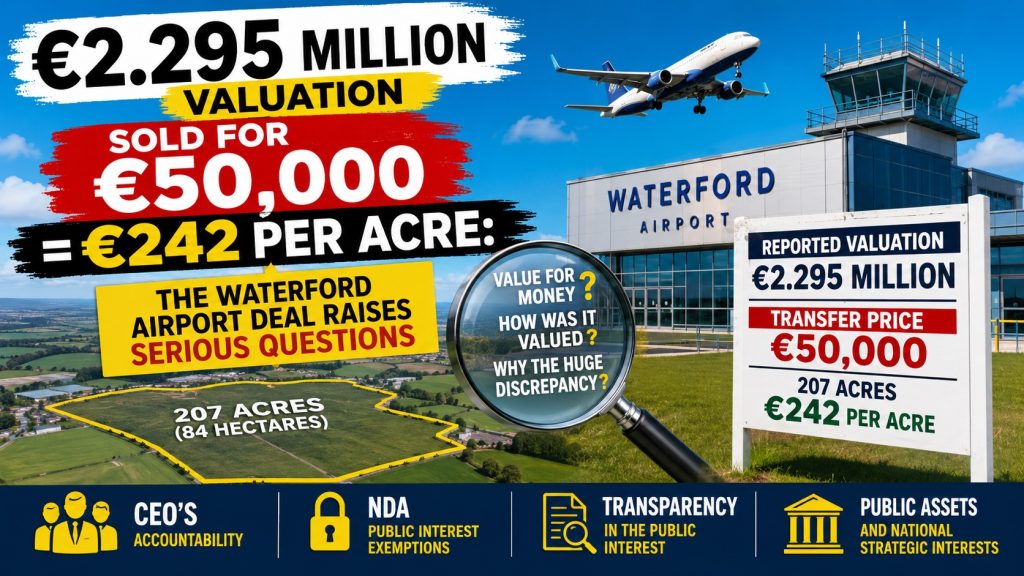
Waterford Airport sale may well go down as the deal of the century, at least for one person, the person who bought it. Acquiring valuable land at just a fraction of its apparent worth is the kind of opportunity most investors only dream of.
One can only imagine the celebrations in the boardroom.
The Question Ireland Must Face
What does independence mean if the land, businesses, forests, resources and infrastructure that shape the future are increasingly sold off and owned elsewhere?
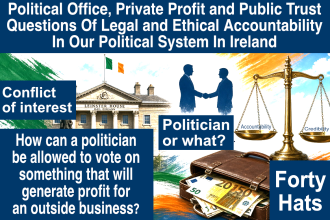
What is the responsible job politicians are given and do they really understand what they were elect for?
Ireland is facing a growing crisis of trust in political leadership, with many people demanding far greater accountability from those elected to serve the public.
There is deep frustration that decisions made by successive governments with little or no consultations with the public who elected them. Allowed extraordinary amount of national assets, housing, infrastructure, and essential services to become increasingly detached from the control and interests of Ireland and Irish people.
Politicians were quick to celebrate the arrival of globalisation and the promise of a new economic era, but far less eager to examine the wreckage left behind them.
Just another commodity traded in global markets.
Across the world, national assets are being quietly transferred into the hands of global investment firms and multinational interests, while governments stand by with limited power or political will to intervene.
Land, companies, natural resources, and essential industries that form the backbone of a nation’s identity are increasingly treated as mere financial instruments. The question is no longer just who owns these assets, but whether our nation is surrendering control of own future.