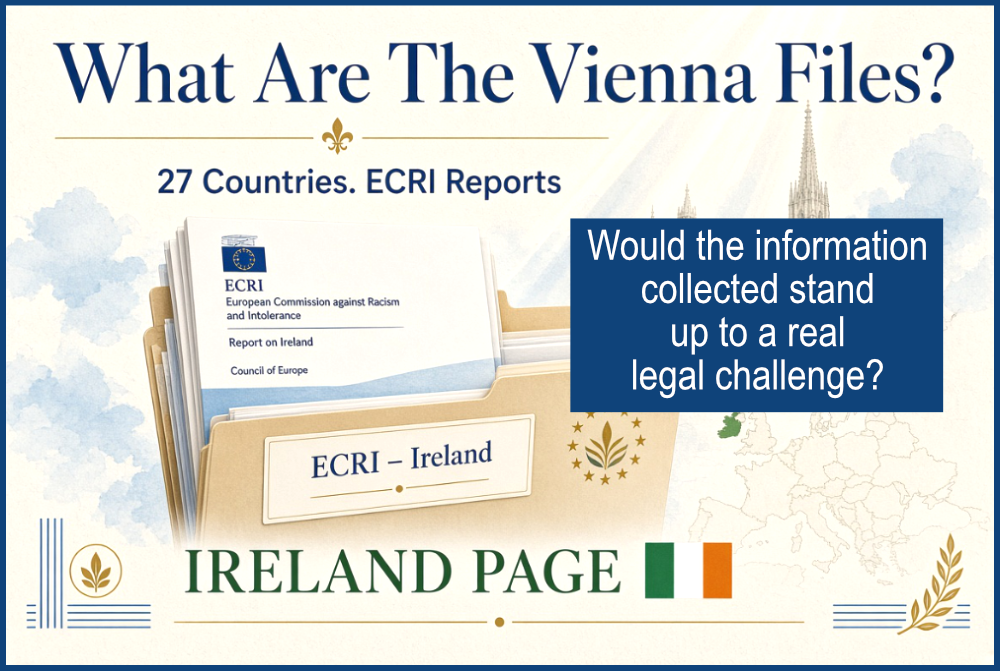
What are
“The Vienna Files“?
ECRI (European Commission against Racism and Intolerance) 27 Separate Annual Country Reports
In effect, it represents another year of what might be termed the “Racist Gravy Train”, sustaining a cycle of bureaucracy and institutional self-interest that appears increasingly difficult to distinguish from the continuation of the funding itself.
ECRI has no legislative or judicial authority to make or enforce Irish law. Its reports and recommendations are non-binding and do not, in themselves, constitute Irish law or judicial determinations of fact.
So what is its real purpose, why annual reports for 27 EU countries each year?
The Ireland Page – Annual Report
ECRI/European Council of Europe report on Ireland – Ireland Page – Adopted on 1 July 2025 – Published on 28 October 2025
https://rm.coe.int/sixth-report-on-ireland/48802911ef
The European Union Agency for Fundamental Rights (FRA) contracts external organisations through its FRANET research network. FRA's records identify Lattanzio KIBS an Itilian business, as the contractor the research body for the 2024 Ireland Country Report. I have written to Lattanzio KIBS for confirmation as I can find no company identification on the 2025 report, no reply yet.

This brings into the equation "outside influence".
So why are these reports needed?
Even though the ECRI has no legislative or judicial authority, the apparent purpose of collecting this data is to build a standardised, comparable profile of each member state, creating a ready-made body of material that EU institutions and policymakers can cite when developing policies on racism and xenophobia.
The concern is that once these reports are compiled and repeatedly referenced, their conclusions can acquire the appearance of established evidence simply through repetition and institutional endorsement. Politicians, bureaucrats and media organisations can then cite the reports as authoritative reference material, even where the underlying claims have not been independently tested or legally established.
But where do they get the data, can it be verified?
ECRI itself states that its reports are based on information obtained from a wide range of sources, including documentary material, meetings, and country visits, and characterises its function as monitoring and making recommendations.
However, the collection of information from multiple sources does not, in itself, establish the truth, accuracy, or evidential reliability of the material relied upon.
Any serious factual allegation should be capable of being objectively substantiated and distinguished clearly from opinion, interpretation, or unverified assertion.
Characterising Ireland as a “racist nation” is a grave and inherently damaging allegation, particularly when presented as a factual conclusion concerning an entire State and its society.
If that characterisation is materially false, misleading, or unsupported by sufficient evidence, its publication may cause serious reputational harm and raise substantial issues concerning accuracy, procedural fairness, and legal responsibility.
Describing the process as “monitoring” or the publication as a “report” does not, of itself, immunise the publisher from the legal consequences that may arise from the publication and international dissemination of false and defamatory factual allegations.
The watchdog that can never call time
This is the one result it cannot allow itself to produce or it could stop the funding gravy train and the whole charade could come crashing down around them.
A watchdog is supposed to be capable of telling us that the threat has diminished that the problem is small, declining or, in some cases, no longer warrants the machinery assembled to monitor it.
But what happens when the institution doing the monitoring has no obvious incentive to reach that conclusion? It would obviously close the whole thing down.
Irish
Human Rights and Equality Commission (IHREC)
Excerpt from ECRI 2025 Report
ECRI’s own 2025 report tells us that IHREC has grown from 47 approved posts and €6.5 million in funding in 2017 to 89 staff and approximately €8.4 million allocated for 2024.
So what is the head count now?
What are they actually getting paid to do?
The bigger the machinery becomes, the harder it is to imagine anyone volunteering the conclusion that the machinery is no longer necessary.
The uncomfortable conflict and truth at the heart of this model:
The institution must continually demonstrate the existence and persistence of the problem in order to justify its own continued existence and activity. In turn, the institution generates a continuing cycle of reports, recommendations and further interventions, and of course funding, regardless of the psychological distress or reputational harm these may cause to the Irish people or to Ireland itself as the recipient of them.
Where is the institutional incentive to say: actually, the problem is smaller than we thought? The trend is improving. We can scale this back. You can stop sending the money.
If there is no meaningful possibility of that conclusion, this isn’t independent monitoring in any meaningful democratic sense. It is an institution with a built-in interest in the perpetuation of its own mandate.
And that raises the most basic question of all: who monitors the monitors?
€8.4 million. Eighty-nine staff. Year after year, more reports, more recommendations, more monitoring.
At what point does the watchdog itself become the thing that needs watching?
Permanent bureaucracies do not have a sunset clause.
They need a reason to exist.
But what, exactly, is that reason? Unbeknownst to the Irish public, are as many as 100 people in Ireland alone being paid to continually produce reports that could be causing Ireland significant reputational damage?
Scrap it.
But can this ECRI Narrative and Reports Survive Legal Scrutiny?
There is a question that now needs to be asked after almost thirty years of ECRI reporting on Ireland: how would the claims made about Ireland stand up if they were subjected to the standards of an adversarial legal process?
An ECRI report is not a court judgment and it is not a judicial finding that Ireland has committed a legally established act of racism. ECRI describes its own work as monitoring, analysis and recommendations, based on information gathered from multiple sources, country visits, meetings and submissions. It is the multiple sources that are in question here.
Are these the very same sources that are benefiting from funding as a result of the very existence of the ECRI?
Reports can acquire considerable authority
These reports can acquire considerable authority once they are repeatedly cited by governments, institutions, academics and courts. Indeed, the Council of Europe itself has acknowledged that the European Court of Human Rights increasingly refers to ECRI recommendations.
Never been tested in a court of law.
If ECRI makes a recommendation and the Irish Government then seeks to introduce it into Irish law, the recommendation itself cannot constitute the legal or evidential basis for that legislation. ECRI reports are not judicial findings and have no direct force in Irish law; therefore, the Government must be able to demonstrate its own independent legal and evidential justification for acting upon the recommendation.
This raises a fundamental question of accountability: if the underlying claims in an ECRI report have not been independently verified, is the report being used to provide an appearance of external authority for decisions that ultimately have to be justified under Irish law? If so, the issue is not ECRI’s power to make law, but whether its non-binding recommendations are being used in practice as a substitute for the independent scrutiny and evidential justification that should underpin Irish legislation.
These reports are not harmless paperwork.
Repeatedly portraying Ireland as a racist country carries serious consequences. It can damage Ireland’s international reputation, undermine public confidence and leave millions of people being judged by a narrative that has never been, to my knowledge, tested in a court of law.
No legislative or judicial authority
“If an organisation such as ECRI has no legislative or judicial authority, cannot make binding findings of fact, but its recommendations can nevertheless exert significant influence over domestic legislation, then its role and accountability should be subject to serious scrutiny. If that influence cannot be justified by transparent evidence and clear legal authority, there is a reasonable argument that the organisation’s role should be fundamentally reformed or, if adequate safeguards cannot be established. Should it be completely abolished.”
Do you know the most shocking thing about all this: this has been allowed to go on in all 27 countries in the EU since 1997 unchallenged.
____________________________
Racism Allegation Verification Bill
I am asking each political party to support the introduction of a Racism Allegation Verification Bill, establishing a statutory code for the evidence, attribution, correction and publication of such claims, including a formal right of response and a requirement to correct or withdraw materially inaccurate information. The same evidential standards should be sought for information submitted to Irish and EU institutions so that unverified claims cannot be incorporated into official reports and subsequently contribute to a misleading portrayal of Ireland as a “racist nation.”

Coming Soon
The Closed Shop With Built In Incentives.

Looking at the agencies providing the IRISH PAGE information, Universities, NGO's,WRC,CSO.

The Irish Council for Civil Liberties (ICCL),there from the very start and how a former Minister is now the "ICCL's" CEO.

An American woman arrives into Northern Ireland in 1996 and, in 1999 – 2001, works on a project for the Home Office research in England. Returns to Dublin UCD and spends the next twenty-five years portraying Irish people and Ireland itself in the most derogatory terms imaginable, and she is far from the only one.