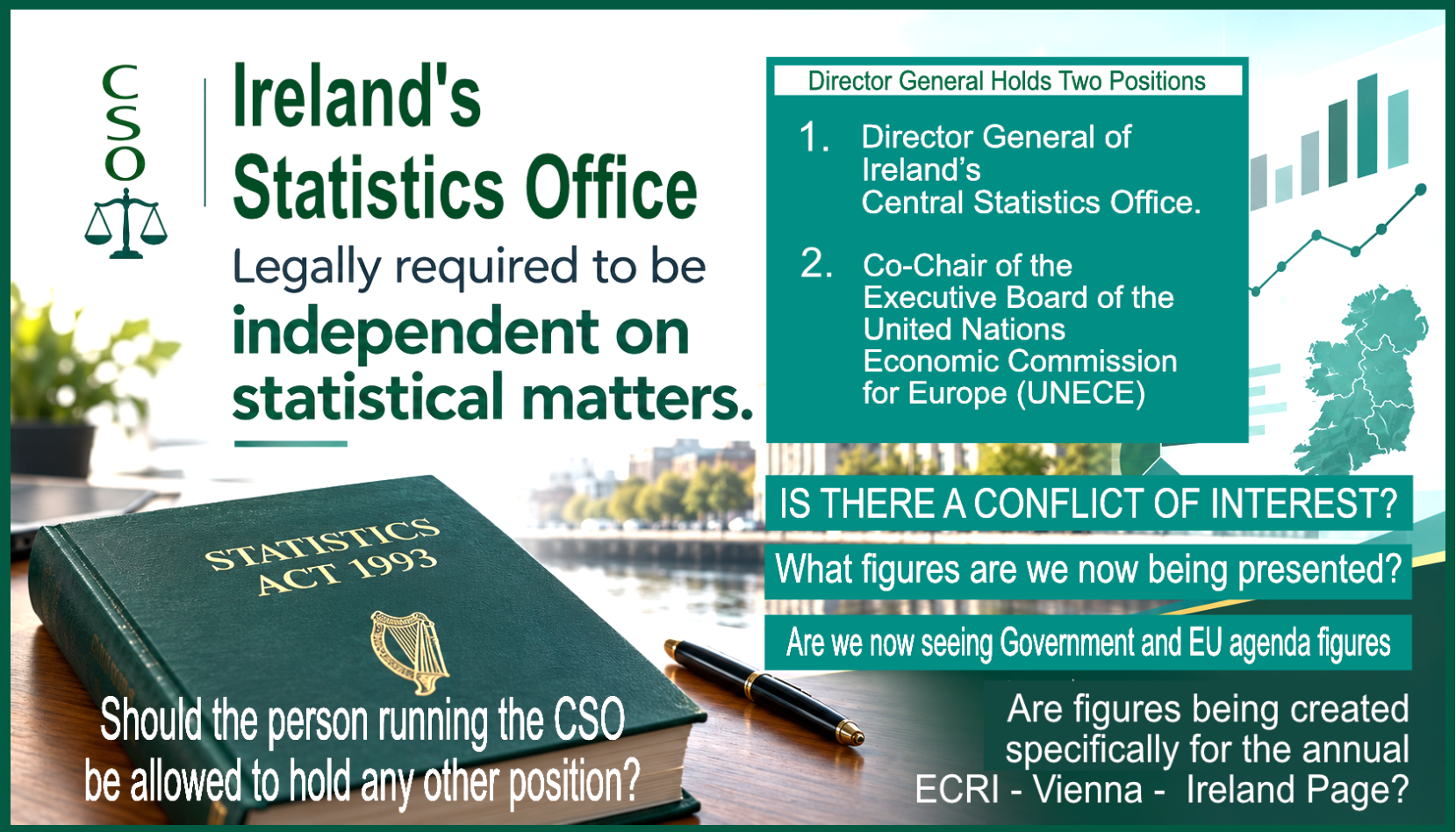
“Under Section 13 of the Statistics Act 1993, the Director General of the CSO is required to be independent in exercising responsibility for statistical methodology, professional standards, the content of statistical publications, and the timing and methods of dissemination.”
Who Is Ireland’s Statistics Office Answerable To?
Jennifer Banim is the Director General of Ireland’s Central Statistics Office. She is also co-chair of the Executive Board of the United Nations Economic Commission for Europe (UNECE) High-Level Group on the Modernisation of Statistics.
That is not speculation—the Irish Government confirms both positions.
https://www.gov.ie/en/central-statistics-office/biographies/jennifer-banim
Statistics Act 1993
The Statistics Act 1993 gives its Director General sole responsibility for statistical methodology, professional standards, the content of statistical publications and the timing and method of their release. The CSO itself repeatedly describes independence, objectivity and integrity as core values.
A national statistics office should tell the country what the data shows, not tell the country what someone wants the data to show.
CSO figures for a country should, fundamentally, describe what is actually happening in that country based on transparent, objective and professionally sound statistical methods.
They should represent:
1. The population and society as they actually are – including population size, demographics, births, deaths, migration and household composition.
2. The economy as it actually performs – employment, wages, prices, income, business activity, GDP and other economic indicators.
3. Clearly defined concepts – with transparent explanations of who or what is included and excluded.
4. Consistent methodology – so figures can be compared over time and meaningful changes identified.
5. Independence from political or policy objectives – the figures should not be adjusted to produce a preferred political narrative.
6. Transparency – the public should be able to understand where the numbers came from, what assumptions were used and what limitations apply.
7. Professional statistical standards – rather than being designed to support a predetermined conclusion.
Outside Interference:
This is becoming even more difficult to dismiss when we look at the CSO’s Social Connections Survey 2026. The CSO openly states that this survey is being undertaken as part of a UNECE taskforce on measuring relations between groups. The survey includes questions on values, connections between groups, fairness, discrimination and grievances.
Is this direct institutional overlap?
THE GOVERNMENT’S OWN WEBSITE RAISES THE QUESTION
Jennifer Banim was appointed Director General of the Central Statistics Office on 31 May 2024. The Government biography, which was updated on 17 February 2026, states that she is also “currently co-chair” of the Executive Board of the United Nations Economic Commission for Europe (UNECE) High Level Group on the Modernisation of Statistics. (Government of Ireland)
What Now: Legal position to be fully examined and determined
That raises a fundamental question about the independence of Ireland’s national statistical authority: has that independence been compromised? And if so, should Jennifer Banim be expected to resign from one or potentially both of these positions?
The issue is not simply that she holds, or has held, two senior positions. It is also about what has been permitted to develop under her leadership in those roles. If external agencies, whether domestic or international, are able to influence the design of surveys, the questions being asked, the methodologies used or the categories by which Irish society is measured, then serious questions must be asked about whether the CSO is still operating as a genuinely independent national statistical authority.
Until the legal position is fully examined and determined, the public is entitled to demand transparency: who is commissioning these surveys, who designs them, who determines the questions and methodology, and whether any external organisation is influencing the production or presentation of Ireland’s official figures for the purpose of advancing a particular policy agenda.
Consultancy Companies Carry Out Independent Surveys
What is the Central Statistics Office? The Central Statistics Office (CSO) Ireland: is the national statistical agency responsible for collecting, analyzing, and disseminating statistics about the economy, society, and general conditions in the Republic of Ireland.
So why is the CSO involved in conducting surveys at all?
Private research and consultancy firms exist specifically to design and conduct surveys, gather public opinion and undertake social research. Why, therefore, is Ireland’s national statistical authority itself undertaking surveys?
The CSO’s core function is to produce Ireland’s official statistics.
There is a legitimate question as to whether conducting surveys on attitudes, social connections, values, discrimination and similar matters extends beyond the role or remit of a national statistical office and into the territory of social research and public opinion research.
If such research is required for Government or policy purposes, why is it not commissioned from independent research organisations whose specific purpose is to conduct this type of work?
____________________________
How many CSO surveys are developed, coordinated, funded, directed or otherwise influenced by international or external bodies, including the UN, UNECE, EU institutions, the ECB or domestic organisations? What is the legal basis for such involvement, and what safeguards ensure that the CSO’s statutory independence is not compromised?
It is therefore legitimate to ask :
Has Ireland’s Central Statistics Office, established to provide independent, objective and reliable national statistics, now moved beyond its statutory purpose and remit, leaving the public to question whether Ireland still has a truly independent, trustworthy source of national figures?
Who is responsible?
Surveys
Who benefits from continually defining Ireland through the language of discrimination, grievance, division, social cohesion, fairness and distrust and why has this negative framing become such a constant and persistent feature of Ireland’s statistical programme?
When this messaging is repeated year after year through surveys, and surveys and more surveys and reports and reports and more reports and international forums, the cumulative effect cannot simply be dismissed as harmless data collection.
Has anyone seriously considered the reputational and social damage this relentless, psychological, stress, causes to Ireland and its people?
Ireland is not an inherently prejudiced or hostile nation, and its people should not be continually subjected to an institutional narrative that suggests otherwise.
At what point does legitimate measurement become relentless negative framing and why has it not been stopped?
The Irish public deserves to know who is driving this agenda, why it continues, who benefits from its continuation, and why there appears to be no equally persistent effort to measure the strengths, solidarity, contribution and achievements of Irish society.
Why is our CSO Office involved in carrying out these surveys?
This relentless survey cycle needs to stop.
| Survey | Year / period | What it covers | External/international connection |
|---|---|---|---|
| Social Connections Survey | 2026 | Social connectedness, solidarity, trust, values, relationships between groups, fairness, discrimination and grievances | UNECE taskforce on measuring relations between groups (Central Statistics Office) |
| Equality and Discrimination Survey | 2024 | Experiences of discrimination, including race, religion, disability, gender, Traveller community, etc. | Based on Irish equality legislation; 7,852 respondents (Central Statistics Office) |
| Household Finance and Consumption Survey | 2023 | Wealth, income, assets, liabilities, debt and financial behaviour | European Central Bank / Eurosystem HFCN programme (Central Statistics Office) |
| Trust in Government and Public Services Survey | 2023 / 2025 | Public trust and confidence in government/public services | CSO survey; 2025 version is also listed in CSO’s past/current survey material (Central Statistics Office) |
| Survey on Income and Living Conditions (SILC) | Annual | Income, poverty, deprivation and living conditions | EU statistical framework |
| Labour Force Survey (LFS) | Quarterly/continuous | Employment, unemployment and labour-market characteristics | EU statistical framework |
| Household Budget Survey (HBS) | Current cycle | Household expenditure and consumption patterns | EU/international statistical framework |
| Irish Health Survey | Recent cycles / 2026 | Health, health behaviours and healthcare utilisation | EU/international statistical framework |
| ICT Household Survey | Annual | Internet use, digital technology and ICT | EU statistical framework |
| Structure of Earnings Survey | Periodic | Earnings and employment characteristics | EU framework |
| Growing Up in Ireland | Ongoing cohorts | Children’s development, families, education and wellbeing | National longitudinal study, involving multiple public/research bodies |