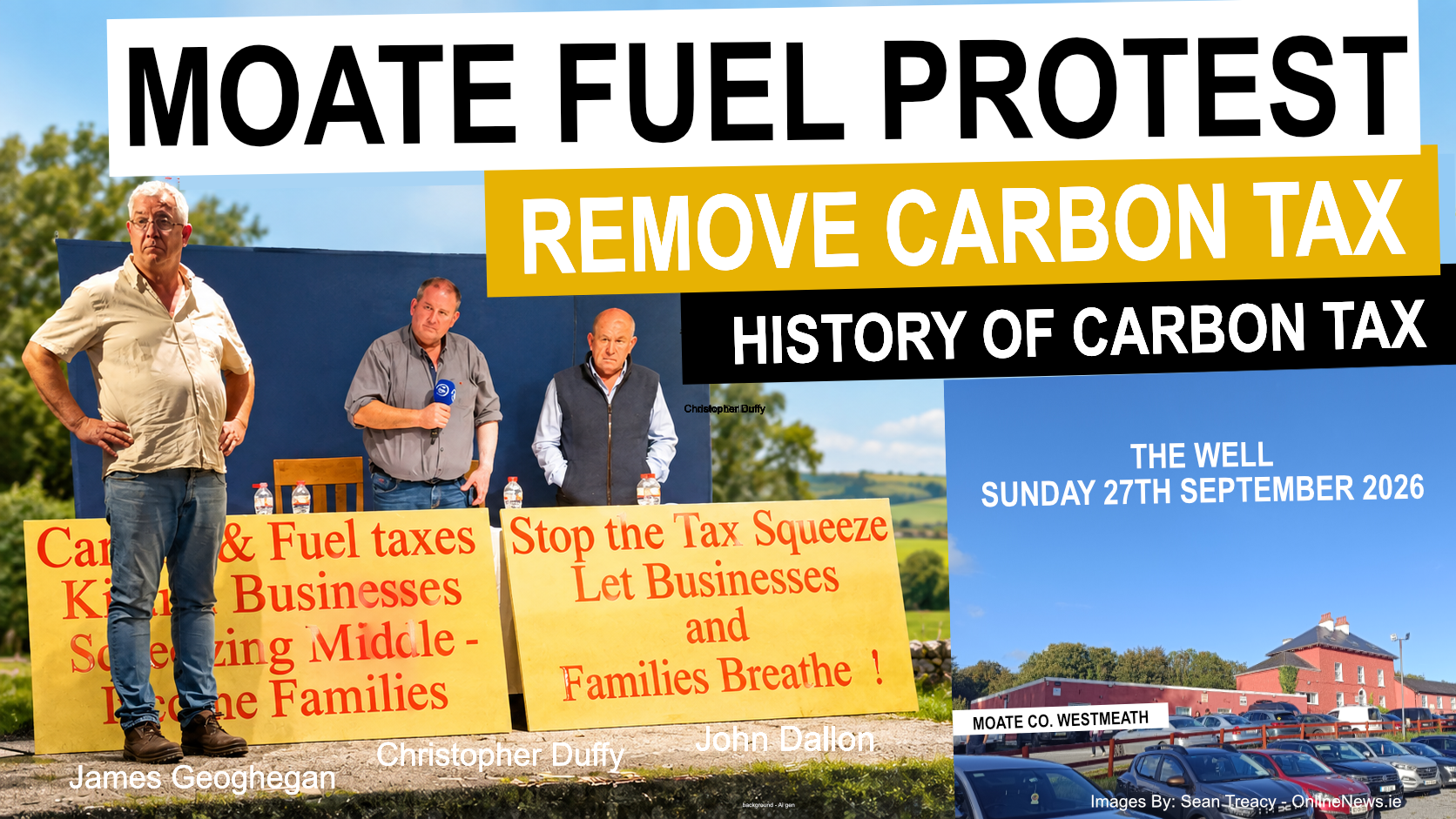
I attended the Fuel Prostest on Sunday 27th Sept 2026 in The Well, Moate, Co. Westmeath. People from all over the country were in attendance. A meeting for the most part focused on fuel prices, the cost of living, and the concerns facing ordinary people.
I also spoke to Christopher Duffy by phone Wednesday 30th Sept 2026. He told me he was literally exhausted after months of campaigning on fuel prices and the wider cost-of-living crisis.
According to Christopher Duffy, for several months before the Moate meeting the group had attempted to engage with Simon Harris in an effort to discuss the escalating cost of fuel and other issues affecting farmers, contractors, hauliers and rural communities. However, he said that despite those efforts, no meeting with Harris had been forthcoming.
With repeated attempts to secure a meeting with the Tánaiste apparently yielding no result, Christopher Duffy said the group decided to take matters into their own hands.
They purchased tickets for a Fine Gael public breakfast meeting in Navan, advertised at €30 per person, where they saw an opportunity to put their concerns directly to senior Fine Gael representatives.
According to Christopher Duffy, the group presented Simon Harris with a preliminary submission setting out their concerns over fuel prices and the wider pressures facing farmers, contractors, hauliers and rural communities.
The Fine Gael Breakfast event was understood to have attracted a significant attendance of Fine Gael TDs and other party representatives. For the protest organisers, it provided a rare opportunity to place their concerns directly in front of senior political figures after months of unsuccessful attempts to secure a meeting.
Rather than waiting for an invitation, they had to actually pay for a seat at the table.
His account gives an important insight into the frustration that ultimately contributed to the organisation of the national fuel and cost-of-living meeting in Moate.
The Meeting
The top table consisted of three of the main organisers of the fuel protests:
James Geoghegan — Westmeath farmer and agricultural contractor
John Dallon — Kildare farmer
Christopher Duffy — Meath agricultural contractor
___________________________
Some speakers and in attendance:
Sean McNamara
Eamon Corley
Gavin Pepper
Malachy Steenson
Micheál Carrigy
Richard O’Donoghue
Padraic Brady
Peadar Tóibín
Joanne Collins,
Michael Fitzmaurice
Michael Collins
___________________________
Some of the Issues aired at the meeting:
No one in government is listening. Rip Off Ireland
1.2 Billion Spent, 2025 on IPAS and Asylum Accommodation
Money provided to Ukraine
The state of the HSE
Data Centres,
Electricity PricesThe ban on the exploration of oil and gas in Irish waters,
Taxation of the family home.
Irish Fisheries
Remove Carbon Tax:
This was voted on unanimously at the meeting.
However, on 29 September 2026, Simon Harris said that abolishing carbon tax entirely would mean Ireland losing its derogation from the EU’s ETS 2 system and potentially having to pay billions to the EU instead.
“A large cheque would need to be sent to Brussels”.
He argued that the Government could not simply abolish the tax without considering those EU obligations.
The real question here is how did the Irish Government get Ireland into this ridiculous position in the first place, who was responsible?
It seems we handed over control of numerous tax prices to the EU a long time back.
So what are the implications of that?
So lets look at the road that took us to here:
Ireland is now constrained in how far it can reduce certain fuel taxes, there is a history stretching back to the early 1990s. In July 1992, Ireland’s then Minister for Finance, Bertie Ahern, represented the Reynolds Government at an ECOFIN meeting where agreement was reached on EU minimum rates of excise. The resulting directives were formally adopted later that year and implemented in Irish law, with the new arrangements taking effect from 1 January 1993.
I traced this back through the Oireachtas record, the 1992 Joint Committee report, the EU Council record and the Irish implementing legislation.
Ireland did not in 1992 hand over control of all taxation to Brussels.
What happened was more specific: Ireland, together with the other Member States, agreed EU rules establishing minimum excise rates and common structures for certain excise taxes, particularly mineral oils, alcohol and tobacco. Those rules subsequently constrained the range within which an Irish Government could set certain excise rates.
Who was responsible in Ireland?
The Irish Government in July 1992 was the Albert Reynolds Fianna Fáil–Progressive Democrats government.
The Minister who represented Ireland at the crucial 27 July 1992 ECOFIN meeting was Bertie Ahern, Minister for Finance. The contemporary Council record specifically lists:
Ireland: Mr Bertie Ahern — Minister for Finance.
The meeting agreed almost all of the outstanding issues concerning the excise arrangements.
So, to answer a question:
“Which Irish Minister was sitting at the table when the July 1992 agreement was reached?”
The answer is Bertie Ahern.
There is an important qualification: this was not a unilateral Irish decision by Ahern. The agreement was negotiated through ECOFIN and the Council of Ministers, involving the governments of the then 12 Member States. (Archive of European Integration)
What exactly did they agree?
This is where the history becomes particularly interesting.
The original European Commission proposal had actually been more ambitious. In 1987 the Commission proposed common rates of excise. That proved politically unacceptable.
In 1989 the proposal was changed: instead of immediately imposing identical rates, Member States would have minimum rates, together with proposed “target rates” towards which national rates would gradually converge.
But the target-rate concept was subsequently abandoned.
The Irish Oireachtas Joint Committee recorded that:
- agreement on some minimum rates was reached at ECOFIN in June 1991;
2. further agreement was reached at ECOFIN on 27 July 1992;
3. the concept of target rates was abandoned. (Oireachtas Archive)
That distinction: Ireland was not agreeing to one single EU-wide tax rate. It was agreeing to a system under which national governments could set their rates, but could not go below specified EU minimums in the areas covered.
For mineral oils, the Oireachtas report gives the actual figures agreed at the July 1992 ECOFIN meeting. For example, the agreed minimum for diesel was £189 per 1,000 litres, compared with Ireland’s rate of £223 at the time. Heavy fuel oil was particularly significant: Ireland was charging £7.60 while the agreed Community minimum was £9.50. (Oireachtas Archive)
The Oireachtas itself warned about loss of fiscal autonomy
The Joint Committee on the Secondary Legislation of the European Communities published its report on 23 September 1992, just weeks after the July ECOFIN agreement.
And the Committee was remarkably explicit about the implications.
It said the removal of fiscal barriers, even without uniform EU-wide tax rates, would “remove what is now an important instrument of fiscal autonomy.”
It went further, warning that alongside Economic and Monetary Union, this would constrain other aspects of Ireland’s fiscal independence and leave Ireland more dependent on Community transfers. (Oireachtas Archive)
Official Oireachtas report from 1992.
The Committee was also concerned about what would happen through market pressure.
It predicted that, even though the EU was only establishing minimum rates, the abolition of frontier controls would put pressure on Ireland to bring its relatively high excise rates down towards rates elsewhere in Europe.
The Committee described the process as potentially happening without an overt EU decision to force Ireland’s rates down. (Oireachtas Archive)
The Committee actually opposed the direction being taken
The report is particularly revealing because the Committee did not simply endorse what the Government had negotiated.
It stated that Ireland was unusually dependent on excise taxation: excise represented about 21% of total Government tax revenue, according to the figures used by the Committee, making Ireland more dependent on excises than any other Member State at that time. (Oireachtas Archive)
It was concerned about the effect on the Exchequer.
The Committee noted that earlier Commission proposals involving convergence towards average European rates could have cost the Irish Exchequer hundreds of millions of pounds. It recorded an estimate of approximately £560 million in potential revenue losses under one scenario. (Oireachtas Archive)
It therefore recommended that the Government pursue financial compensation from the Community for the costs imposed on Ireland by the removal of fiscal barriers. (Oireachtas Archive)
The really striking passage
It said:
“the removal of fiscal barriers will remove what is now an important instrument of fiscal autonomy.”
It then connected this with Economic and Monetary Union, saying that the combination would constrain other aspects of Ireland’s fiscal independence. (Oireachtas Archive)
In other words, the concern about losing fiscal discretion was being explicitly discussed inside the Oireachtas in 1992.
This wasn’t something discovered decades later.
What happened to the agreement afterwards?
The political agreement at ECOFIN in July was followed by the formal adoption of the relevant EU directives.
For mineral oils, the key legislation was:
Council Directive 92/81/EEC — harmonisation of the structures of excise duties on mineral oils.
And:
Council Directive 92/82/EEC — approximation of the rates of excise duties on mineral oils.
Both were adopted on 19 October 1992. Directive 92/82 specifically required Member States to apply minimum rates to the relevant mineral oils by 1 January 1993. (EUR-Lex)
There were corresponding directives for alcohol and alcoholic beverages. (EUR-Lex)
Ireland then put the arrangements into Irish law
The Oireachtas record says that Directive 92/12/EEC, concerning the general arrangements for excise goods, was implemented in Ireland through the Finance Act 1992, sections 103–119. (Oireachtas Archive)
Then, after the October 1992 EU directives were formally adopted, the Minister for Finance made the European Communities (Customs and Excise) Regulations 1992.
Those regulations expressly state that they were made by the Minister for Finance to give effect to the EU directives, including Directives 92/12/EEC, 92/83/EEC and 92/81/EEC. They came into operation on 1 January 1993. (Irish Statute Book)
So the chain is:
EU Commission proposals → ECOFIN negotiations → Bertie Ahern representing Ireland → July 1992 agreement → formal EU directives in October 1992 → Irish Finance Act/Regulations → EU minimum excise framework operating from 1 January 1993.
And Ireland’s lack of discretion was demonstrated very quickly
In January 1994, Bertie Ahern was again Minister for Finance.
In his Budget statement he announced that Ireland was increasing the duty on heavy fuel oil specifically “in order to respect the EU minimum rate requirement.”
The increase was 85p per 1,000 litres. (Oireachtas)
The Irish Minister for Finance himself told the Dáil that the tax was being increased because of the EU minimum-rate requirement.
So who “gave away” the power?
The Irish Government participated in negotiating and agreeing the EU framework. Bertie Ahern was the Irish Minister for Finance representing Ireland at the crucial July 1992 ECOFIN meeting. The Reynolds Government subsequently implemented the resulting arrangements through Irish legislation.
The Oireachtas
The 1992 Joint Committee examined what was happening and explicitly warned that the process would reduce an important element of Ireland’s fiscal autonomy. It nevertheless recognised that the broader Single Market programme was being pursued and recommended that Ireland seek compensation and use the future review process to protect its interests. (Oireachtas Archive)
And there’s an interesting historical irony: the Committee actually wanted the EU to go further in one respect, it preferred single Community-wide rates because it believed that would make the Single Market work more effectively and provide a clearer basis for Ireland to seek compensation. (Oireachtas Archive)
Ireland agreed to a system of EU-level constraints on certain excise taxes, and Irish parliamentarians in 1992 explicitly recognised that this would diminish an important element of Ireland’s fiscal autonomy.
Summary:
What is particularly significant is that the loss of fiscal discretion was not merely a concern raised retrospectively. In September 1992, an Oireachtas Joint Committee examining the new excise arrangements warned that the removal of fiscal barriers would “remove what is now an important instrument of fiscal autonomy”. The Committee also expressed concern about the consequences for the Irish Exchequer and recommended that the Government seek compensation from the Community.
The practical effect became clear within two years. In his 1994 Budget, Bertie Ahern, still Minister for Finance, announced an increase in the duty on heavy fuel oil specifically “in order to respect the EU minimum rate requirement”. The historical record therefore shows that Ireland did not surrender control over taxation in general, but it did accept EU rules that placed legally significant limits on its discretion over certain excise duties.
More Articles:
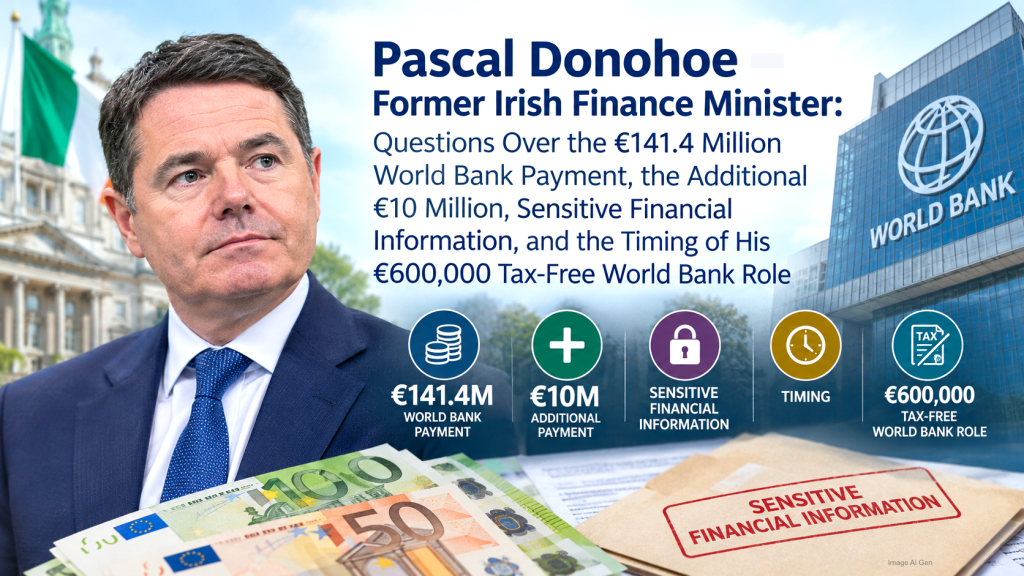
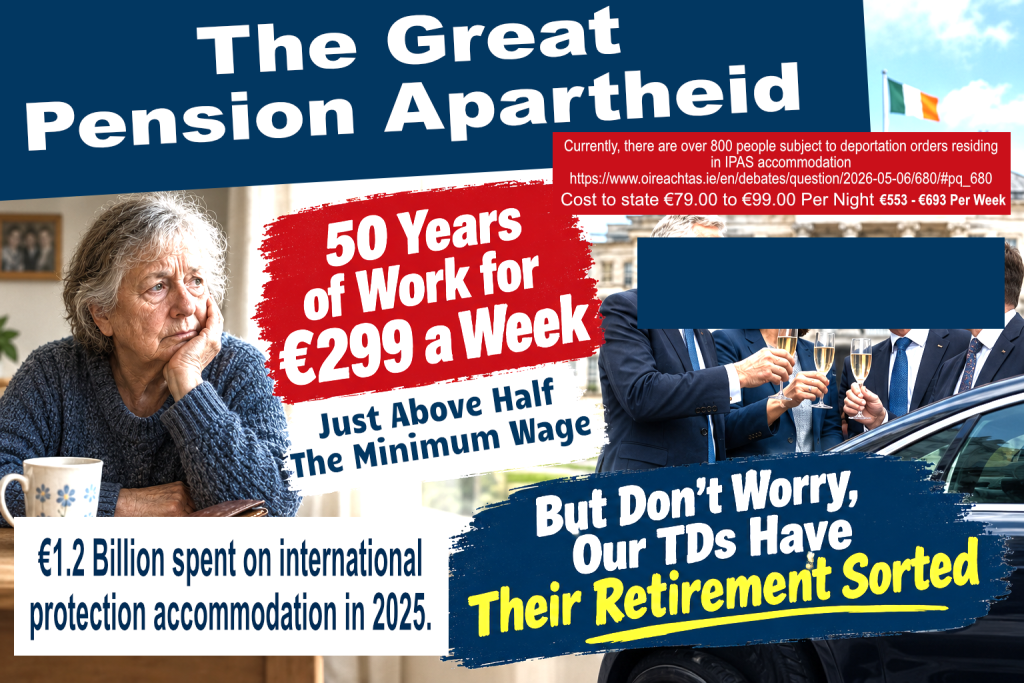
Ordinary Citizens Pension Contributory Ireland – Annual €15.548
Some TD’s Pensions in Comparison – Annual
Simon Coveney: €294.143.40 – FG
Approximately 19 times higher

Leo Varadker: €271.383.91 – FG

Eamon Ryan: €239.723.31 – Green Party

Seán Haughey: €242.404.00 – FF

This is just a few read this article for more.