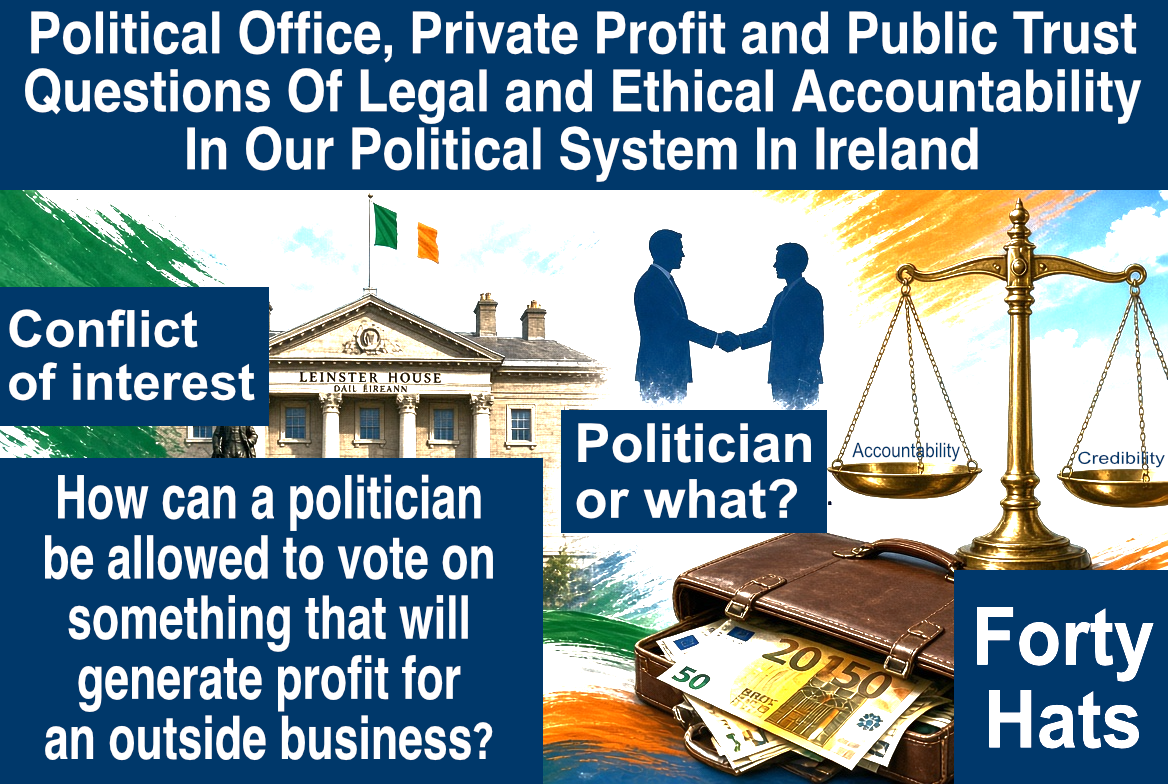
Is it lawful for a person to use political office to generate income beyond their legitimate State salary and allowances?
Political Office, Private Profit and the Legal Limits
Can an elected representative legally use their political position to obtain a private financial advantage?
There is no general prohibition on a TD having private income, owning property, receiving rent, holding shares or operating a business. Such interests are subject to the disclosure and ethics requirements applying to members of the Oireachtas.
The legal issue arises when a private financial interest becomes connected to the exercise of public office.
If a politician chooses to run or have significant interest interests in businesses outside of the Dáil, a very basic question has to be asked: how can they possibly give a full-time public position the time, attention and commitment it deserves while simultaneously managing other commercial interests?
These are highly paid positions, funded by the taxpayer, and elected representatives have a responsibility to the public first. They cannot reasonably be expected to serve two masters if their outside business interests demand substantial time and attention.
People should seriously consider this when voting in the next election. Why are they running for election?
There is also a more serious question that needs to be answered: are publicly funded, or government paid expenses, used for transport, offices facilities or staff ever being used, directly or indirectly, to assist with the running of private businesses or outside commercial interests?
If public resources are being used, how is this monitored? Where is the clear line between legitimate parliamentary work and activity that benefits a politician’s private business interests?
And, more importantly, how can the public be confident that the distinction is actually being enforced?
If you already have other jobs and business interests, why bother being in the Dáil at all? I mean, clearly being a TD isn’t demanding enough to keep you busy.
Unless, of course, there’s another benefit to having a seat in the Dáil like getting a vote on funding, policies and decisions that could potentially affect your other business interests. Surely that couldn’t possibly be the reason… could it?
Transparency and accountability should not be optional when public money and public office are involved. If politicians want to operate private businesses alongside their parliamentary roles, they should be required to demonstrate clearly that those interests do not interfere with their duties and that not one cent of public resources is being diverted to support them.
Under the Criminal Justice (Corruption Offences) Act 2018, a person commits an offence where, among other things, they corruptly request, accept or obtain, directly or indirectly, a gift, consideration or advantage as an inducement to, reward for, or otherwise on account of, an act relating to their office, employment, position or business.
Therefore, it would be incorrect to say that any income earned by a politician beyond their State salary is automatically illegal.
The more precise legal question is:
Has a financial advantage been obtained improperly because of the person’s political office, influence, actions or information?
That could potentially raise issues involving:
- corruption;
2. an undisclosed or improperly managed conflict of interest;
3. misuse of confidential information;
4. improper influence; or
5. breaches of the statutory ethics and disclosure requirements.
The Oireachtas ethics framework specifically requires members to disclose various interests, including occupations, shares, directorships, land, gifts, remunerated positions and certain contracts. Members are also subject to rules concerning declarations of interests in proceedings and specified acts.
Consequently, owning rental property is not, in itself, evidence of corruption. Nor is voting on legislation that may have an indirect effect on the value of a politician’s property.
It is extremely concerning and difficult to justify that this situation is permitted under the current rules. Allowing an individual to participate in a voting process when they could potentially benefit personally from the outcome represents a serious and unacceptable conflict of interest.
This policy must be reviewed and changed immediately. Individuals with a potential personal or financial interest in the outcome should be prohibited from participating in the vote. Clear safeguards must be put in place to prevent conflicts of interest and ensure the process remains fair, transparent, and impartial.
This is particularly important where significant public expenditure is involved, including immigration, accommodation, procurement and State-funded services. Government and Council Contracts.
Public office is a position of trust. The law does not prohibit legitimate private wealth; it is supposed to prohibit and regulate the improper use of public position for private advantage.
Where there is an allegation that an improper or corrupt advantage has been provided, the matter may potentially have criminal implications and should therefore be subject to appropriate and independent oversight. This raises the question of whether adequate oversight exists in practice and, if so, whether it is sufficiently transparent and visible to the public.
There is a recurring perception that party leaders and ministers are willing to publicly defend those who face such allegations, sometimes for prolonged periods, until the matter gradually loses momentum and eventually fades from public attention. While those accused are, of course, entitled to due process and the presumption of innocence, there must also be confidence that allegations involving those in positions of power are investigated independently and impartially.
It was absolutely sickening to watch this situation unfold, particularly since 2022, when we have seen some landlord-politicians become multimillionaires and in some cases, members of their extended families while ordinary people have struggled with soaring rents and the rising cost of living. The sheer scale of it has been deeply disturbing.
How can the Irish public stop this from continuing and demand the establishment of a genuinely independent regulator that operates completely outside government control?
The entire situation has gone far beyond what should be acceptable in a functioning democracy. We cannot keep expecting the same political system that is part of the problem to somehow regulate itself.
What makes this even more concerning is that so many political parties, and to some extent even independents, appear to be participating in or enabling the situation. That makes it incredibly difficult for ordinary people to have confidence that meaningful change will come from within the existing system.
Ireland needs real accountability, genuine independence, and a regulator that cannot be influenced or controlled by the very people and institutions it is supposed to oversee.
If we genuinely want change, then the public needs to take action:
1. Contact your TDs and Senators.
Ask them directly whether they support the creation of a genuinely independent regulator and demand a clear, written response.
2. Contact your local councillors.
Put the issue on the local political agenda and ask them to publicly support independent oversight.
3. Organise locally.
Talk to neighbours, community groups and others who share the concern. A coordinated public voice is far harder to ignore than individuals speaking alone.
4. Make the issue public.
Use social media, local newspapers, radio and public meetings to keep attention on the demand for genuine independent regulation and accountability.
5. Demand transparency.
Ask elected representatives to explain exactly what they are doing to support independent oversight and keep a record of who responds and who refuses to.
6. Remember it at election time.
If politicians refuse to support meaningful independent oversight, voters should consider that when deciding who deserves their vote.