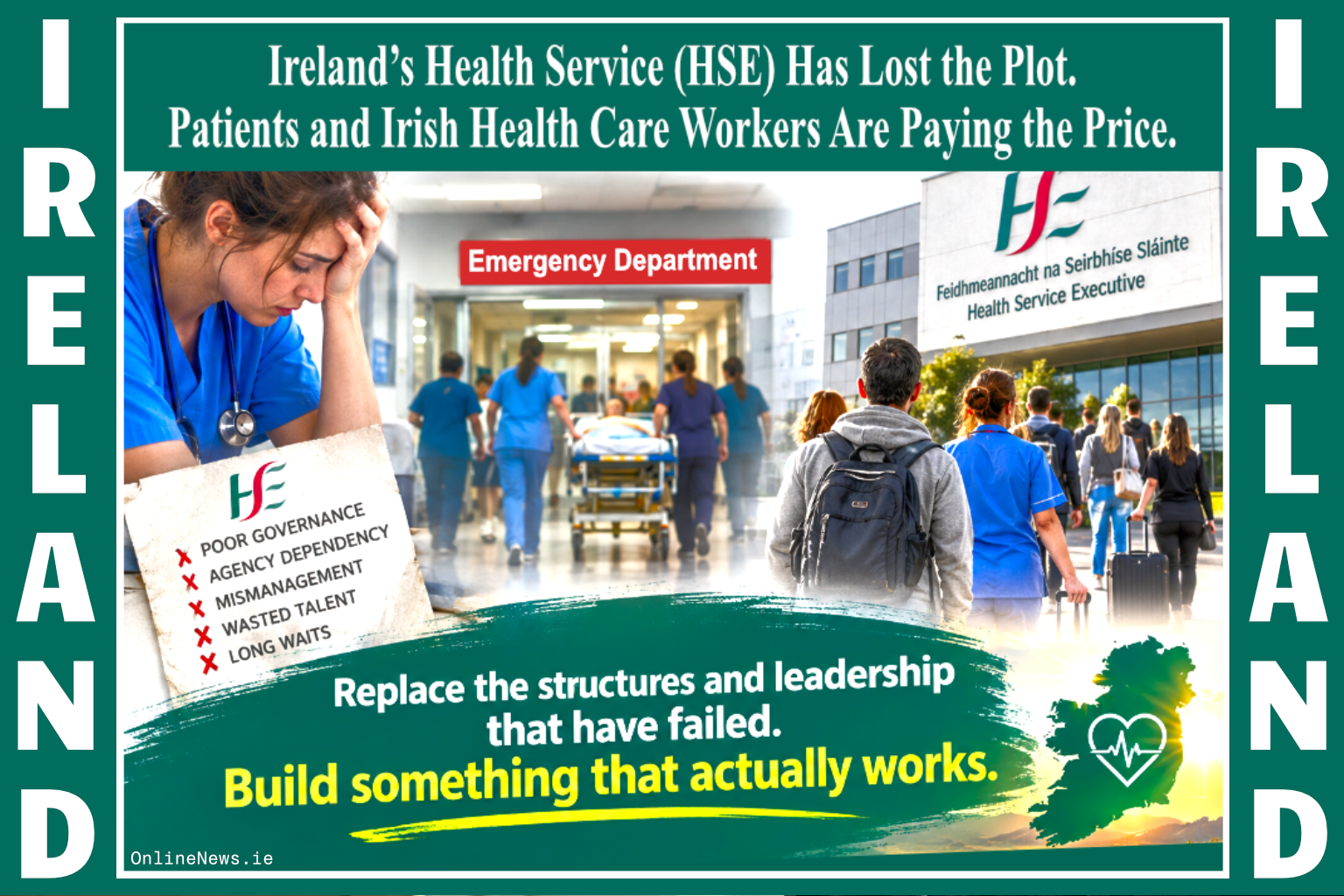
Replace the structures and leadership that have failed. Build something that actually works.
By: Sean Treacy – OnlineNews.ie
There comes a point when the word reform is no longer enough.
Ireland’s health service does not need another glossy strategy document, another reshuffle of titles or another promise that things will improve. It needs accountability and it needs a serious examination of whether the people currently responsible for running the system are actually capable of running it.
Contradictions have become impossible to ignore.
Young Irish nurses train in Irish hospitals, qualify, and expect to begin their careers serving the patients they have spent years preparing to care for. Yet we have now seen the extraordinary situation in Cork University Hospital (CUH) where graduate nurses were offered positions and subsequently told those offers had been made in error. The HSE has acknowledged the mistake.
The issue was also evident in Galway. On 14 September 2026, the Irish Nurses and Midwives Organisation (INMO) reported that, one week before the University of Galway graduation, hardly any graduating nurses or midwives had been offered positions within the HSE West and North-West Region, despite significant vacancies. The INMO specifically identified University Hospital Galway, which it said had 23 vacant midwifery posts, and stated that failure to fill these vacancies could result in a curtailment of community midwifery services in Galway.
International recruitment programmes
At the same time, the HSE openly operates international recruitment programmes and even provides relocation assistance to people coming to Ireland to work in the health service. It also specifically operates a “Return to Ireland” recruitment programme aimed at Irish healthcare professionals who have emigrated.
This comes at a time when the HSE has introduced tighter recruitment and headcount controls in response to overspending, including restrictions on recruitment to certain posts. At the same time, agency staffing has not been stopped altogether; the HSE continues to use agency staff where direct employment does not meet service requirements, while also seeking to convert some agency workers to permanent positions. The result is a situation in which newly qualified nurses and midwives are seeking permanent employment while restrictions on recruitment are being tightened, even as services continue to require temporary and agency staffing.
During previous periods of recruitment restriction, hospitals relied heavily on agency staffing and international recruitment to keep services functioning. The HSE’s own records show that recruitment controls were introduced after funded recruitment targets were exceeded, while exemptions were maintained for overseas nurses and new graduates.
Many would consider returning
Many would consider returning if there were proper permanent opportunities, decent workforce planning and confidence that the jobs they were offered would actually exist when they arrived.
Anti – Compeitive jobs market for Irish Health Care Workers
The result has been a system where agency expenditure, overtime and international recruitment, leaving Irish-trained healthcare workers struggling to secure the permanent positions they expected.
Ireland has created a revolving door.
Why are Irish nurses who want to come home being asked to navigate a system that sometimes appears incapable of making room for them?
The agency staff bill in both finance and culturally has been enormous.
In 2026, the HSE reported that it was almost 6,000 staff below its permitted workforce level, while simultaneously reporting significant expenditure pressures from agency staffing and overtime.
This is not a shortage of people.
It was a failure of workforce planning.
Or was it?
Intended outcome of government and health-service policies.
In my opinion, such a significant disparity in the composition of hospital staff, with Irish staff becoming a very small minority, could not have happened without deliberate and sustained planning. It is important that we understand how this situation developed, what policies and decisions contributed to it, and what the underlying objectives were.
When I visited a relative in CUH some time ago, I was struck by what I saw on the ward: An Irish nurse told me she was only one of two out of forty-four staff members on at that present time.
This is repeating in most hospitals and care home facilities now in Ireland.
It is not a long term viable situation for our Irish workforce.
A health system in shambles
Over One Million People On Waiting List
Meanwhile, Ireland’s hospital waiting lists have exceeded one million patients, while emergency departments continue to face severe and persistent overcrowding. Patients are being left waiting for prolonged periods for assessment, admission and treatment, placing sustained pressure on patients, families and healthcare staff. Yet, despite the scale and persistence of these pressures, the public continues to be told that meaningful reform is coming. It is not coming it is getting worse and worse.
The Data Protection Commission has fined the HSE €645,000 following an investigation into the handling and storage of paper medical records.
Doctors recruited from outside the EU
More recently, an HSE internal audit found shortcomings in checks surrounding doctors recruited from outside the EU, including failures to document certain requirements such as English-language competency and occupational-health clearance. Those findings raise legitimate questions about recruitment governance and patient safety.
The issue is management.
The HSE have created an organisation that can spend heavily on agency workers, recruit internationally, advertise incentives for emigrants to return, and yet still leave Irish-trained professionals wondering where they fit.
That is an extraordinary failure of leadership.
And now the HSE is undergoing another major structural transformation. Six health regions have been established, with new regional executives and a central HSE structure supposedly designed to improve accountability and integration.
But changing the organisational chart does not change organisational culture.
Replace the structures and leadership that have failed and build something that actually works.
Because the HSE is not a private corporation experimenting with an unsuccessful business model. It is responsible for people’s lives.
A patient waiting twelve or twenty-four hours in an overcrowded emergency department does not care which executive is responsible.
We all want a health service that works and not discriminating against Irish workers.