New Questions Emerge as Public Demands Answers
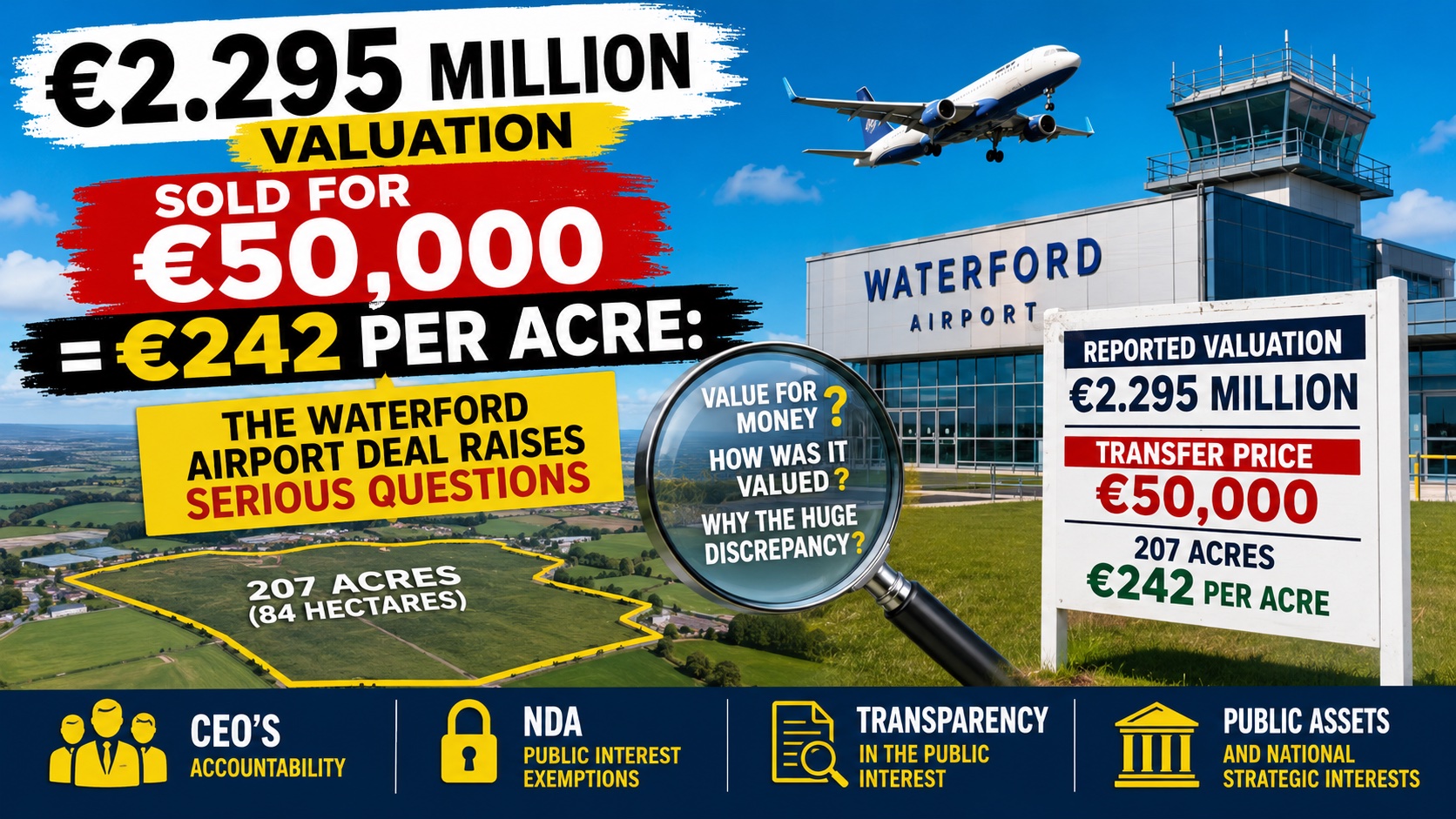
How did a publicly connected airport asset, valued at €2.295 million, end up transferred for €50,000 — and did the people of Waterford get the full story before the decision was made?
This Statement:
“Serious Misgivings”SPECIAL COUNCIL MEETING HELD ON 20th OCTOBER 2025
Cllr. O'Riordan stated that he had "serious misgivings" about the substance of the investment proposal. He noted that €3.4 million had already been spent, that the land was valued at €2.3 million, that rates would be capped at €10,000 per annum, and that the Council had committed a further €400,000 towards road works. Most significantly, he described it as "appalling that we have to go into a contract with an unknown entity."
Key Questions Regarding the Transfer of the Airport Lands
- Was the true value of the lands fully assessed before a public asset valued at approximately €2.295 million was transferred for €50,000?
- Did the valuation consider future development potential, strategic importance, and long-term economic value?
- Was any assessment carried out regarding possible underlying geological or mineral value in the area?
- Were all potential future uses of the lands fully examined before ownership was transferred?
- Was the possible strategic, security, or defence significance of the airport lands properly assessed?
- Were the implications for Ireland’s neutrality and national interests considered?
- Why was public ownership or a financial stake not retained to protect future community benefit?
- Were councillors given all relevant information and expert advice before approving the deal?
- Why was the identity of the purchaser withheld from elected representatives and the public, before the vote, especially as the land was being sold to someone from outside the state?
- Why was a non-disclosure agreement used in these circumstance, did it prevent proper public scrutiny of a major public asset transaction?
- Who decided that confidentiality was necessary, and what public interest justification supported that decision?
- How could a vote to surrender this valuable asset have been taken with so much secrecy from the people of Waterford?
- Why was this decision not taken at nation level?
- Why did our Government refuse to fund this project and preserve what appears to be such a valuable national asset, while seemingly having no hesitation in spending millions on other initiatives?
- Why was this project considered such a low priority?
A public asset with a national role
Waterford Airport is not simply a regional airport waiting for commercial flights. It is also home to one of Ireland’s four Coast Guard search-and-rescue aviation bases.
Along with Shannon, Sligo and Dublin, Waterford plays a vital role in Ireland’s 24-hour emergency response network.
So the question becomes:
Why was a public authority prepared to accept terms that would be extraordinary for a private owner?
Did those making the decision fully understand the long-term value of the asset before it was transferred?
Transparency in Waterford Airport Land Deal Process
The decision to allow the Chief Executive of Waterford City & County Council to enter into a non-disclosure agreement in relation to the proposed Waterford Airport land deal has raised serious concerns about transparency, accountability, and public confidence. While confidentiality agreements can have a role in commercial negotiations, this matter concerns publicly owned land and a decision of major significance for the people of Waterford.
The fact that elected representatives were asked to approve a substantial transaction while key details, including the identity of the proposed investor, remained undisclosed has inevitably led to questions about whether the process allowed for proper democratic scrutiny.
Identity Later Disclosed
The identity was later disclosed publicly, and the project has moved forward: contracts signed, an EGM in April 2026 to finalize the takeover, and construction/groundbreaking activity underway or imminent as of mid-2026, with commercial flights eyed for 2027.
rte.ie
The foreign investment question
The controversy has also intensified because of the involvement of U.S. businessman Kelcy Warren.
Kelcy Warren - Wikipedia
What will this airport be used for in the long term?
What exactly have these councillors signed Ireland up for?
Would they have voted for this if they knew who the investor was?
Waterford County Council Meeting 20th October 2025
https://waterfordcouncil.ie/app/uploads/2025/11/1b-Minutes-Special-Meeting-20th-October-2025.pdf?
Voted in favour (28)
- Joeanne Bailey (SF)
- Declan Barry (Independent)
- Donal Barry (Independent)
- Liam Brazil (FG)
- Catherine Burke (SF)
- Declan Clune (Independent)
- Sandra Conway (Independent)
- Tom Cronin (FF)
- Kate O’Mahoney (SF)
- David Daniels (Independent)
- Jim D’Arcy (FG)
- Pat Fitzgerald (SF)
- Damien Geoghegan (FG)
- Jim Griffin (SF)
- Blaise Hannigan (Independent)
- John Hearne (SF)
- Joe Kelly (Independent)
- Donnchadh Mulcahy (SF)
- Jason Murphy (FF)
- Pat Nugent (FG)
- Niamh O’Donovan (FG)
- John O’Leary (FF)
- Lola O’Sullivan (FG)
- Thomas Phelan (Labour)
- Seanie Power (FG)
- John Pratt (Labour)
- Eamon Quinlan (FF)
- Frank Quinlan (FG)
- Mary Roche (Social Democrats)
- Seamus Ryan (Labour)
- Adam Gary Wyse (FF)
(Note: the official roll call lists 28 “in favour”; the names above are the councillors recorded as voting yes, excluding the abstention and absences.)
Voted against (0)
- None.
Abstained (1)
- Joe O’Riordan (Independent) — he was the only councillor not to support the resolutions, abstaining because of concerns including the anonymous identity of the investor and the terms of the land transfer.
Absent (3)
- Cllr Niamh O’Donovan (FG)
- Cllr Blaise Hannigan (Independent)
- (The minutes’ roll call records three absences in total; Hannigan and O’Donovan were listed among apologies, with the third absence reflected in the vote totals.)
So, in simple terms: there were no “No” votes; Joe O’Riordan was the sole councillor who did not vote in favour.
Update:
Will there be a Legal Challenge
I met with residents in Waterford City on Friday 17th / 07 / 2026, they have highlighted a significant concern: Of particular concern was the fact that only two people, from a group of approximately 60 I spoke to people were not aware of the land sale.
The people seemed genuinely surprised and shocked by the news of the Waterford Airport land sale.
Importance involving public assets
Residents may seek access to relevant documents, meeting, valuations, council records and decision making processes to determine what the process was.
Of particular interest here will be initial meetings that took place with
William Bolster in 2024.The first with TD James Lawless
who was the minister for state for transport and then following that William Bolsters meeting with Kelcy Warren.
What happened at those meetings?Why did the Irish government choose to not fund this airport opting to sell this very important asset instead?
What ongoing funding does Kelcy Warren now get as part of this amazing deal.
Special Council Meeting held on 20th October 2025
Councillors appear to have been asked to vote on the proposal without knowing the investor’s identity.
Based on the minutes, councillors were effectively asked to enter into an agreement with an unnamed entity. Given the scale of the project, was it an underhanded attempt to secure approval without full disclosure?
The minutes also suggest that there was no discussion of future funding opportunities. This is significant because reopening the airport could potentially have unlocked access to a national funding programme worth €45 million over five years.
July 2020 – Planning application and EIAR submitted.
https://www.pleanala.ie/en-ie/case/307528?
The Waterford Airport deal raises a fundamental question about who benefits and who pays. The State declined to invest in securing this strategic asset for the public, yet the taxpayer now faces the prospect of providing future grants, supports and infrastructure funding to a privately owned airport while receiving no ownership stake or financial return.
Cllr. Burke said the Government's failure to invest in our airport has forced us to rely on private investors. The Search and Rescue base is vital and said Government neglect puts this essential service and the safety of our communities at risk.
The State declined to invest directly in Waterford Airport as a public asset, considerable effort went into facilitating a private ownership model.
Why was €30 million not committed to developing Waterford Airport and strengthening Ireland’s regional infrastructure, while €125 million was allocated overseas? To many, the Government’s priorities appear disconnected from the immediate needs of communities across Ireland.

___________________________

Additional:
State awarded the new Irish Coast Guard aviation service contract to Bristow Ireland Limited.
The Coast Guard and Bristow connection
The contract is valued at approximately €816 million over 10 years.
Bristow Ireland Limited is owned by Bristow Group Inc., a U.S.-based helicopter and aviation services company headquartered in Houston, Texas. Bristow Ireland is a wholly owned subsidiary of Bristow Group.