By: Sean Treacy – OnlineNews.ie – 04 / 07 / 2026
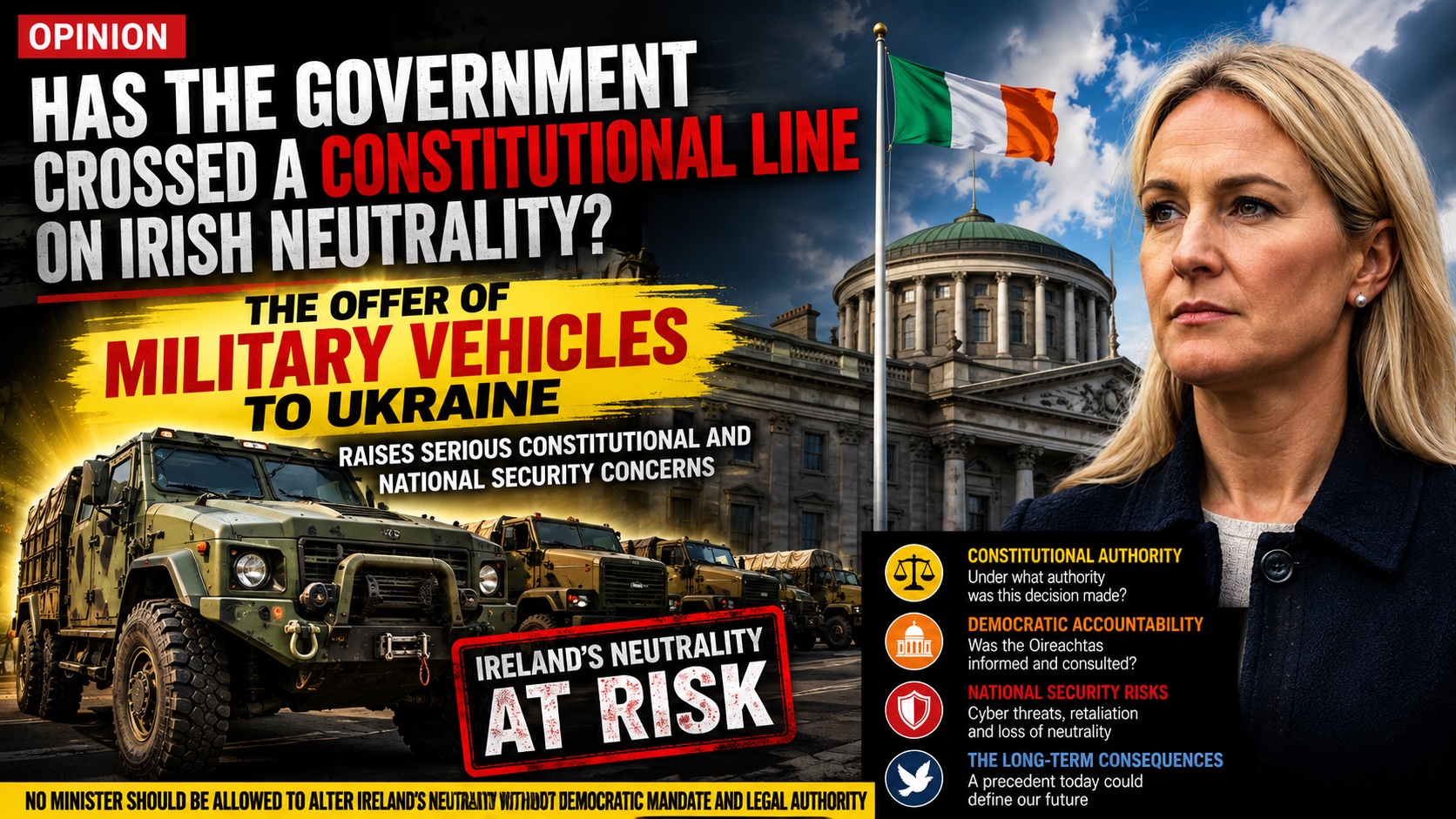
There are moments in the life of a nation when a single political decision has consequences far beyond the immediate headlines. The reported offer of Irish military vehicles to Ukraine is, in my view, one of those moments.
This is not simply another foreign policy announcement. It raises profound constitutional, legal and democratic questions that strike at the heart of Ireland’s identity as a militarily neutral state.
For over a century, Ireland has sought to distinguish itself by pursuing an independent foreign policy founded on diplomacy, peacekeeping and non-alignment in military conflicts between other sovereign nations. That position has earned Ireland considerable respect internationally and has enabled this country to act as a credible advocate for peaceful resolution and humanitarian engagement.
However, the provision of military vehicles to a nation actively engaged in war is fundamentally different from humanitarian assistance or United Nations peacekeeping operations.
Military vehicles are military assets. Their purpose is to enhance the operational capability of one of the parties engaged in an active armed conflict. Whatever political justification is advanced, this represents material military support to one side of a war.
That reality cannot simply be ignored because the cause is considered just.
The constitutional issue is not whether one supports Ukraine or condemns Russia’s invasion. Most reasonable people recognise the tragedy of the conflict and the suffering of the Ukrainian people.
The constitutional question is far more fundamental.
Who has the authority to alter Ireland’s long-standing position of military neutrality?
Was this decision authorised in accordance with the Constitution?
Was it approved collectively by the Government as required under Article 28?
Article 28 of the Constitution – the Government exercises executive power, but ministers cannot act outside powers granted by the Constitution and statute.
Article 29 – Ireland’s international relations and its commitment to the peaceful settlement of disputes. Whether supplying military vehicles represents a significant change in Irish foreign policy requiring fuller democratic scrutiny.
Whether the decision was one for the Government collectively or whether a single minister exceeded her authority.
Whether the decision complied with the relevant statutory framework governing the disposal or transfer of State-owned military equipment.
Whether the decision is compatible with Ireland’s long-established policy of military neutrality.
Whether such a policy shift should have been debated by the Oireachtas or even put to the people by referendum (this is a political argument rather than a settled constitutional requirement).
Was the Oireachtas given an opportunity to scrutinise such a significant policy shift before commitments were made?
Were the Irish people consulted before military assets belonging to the State were offered to one of the belligerents in an active international conflict?
These questions have yet to receive satisfactory public answers.
The consequences extend well beyond Ukraine.
Every significant departure from neutrality establishes a precedent.
Future governments may point to previous decisions as justification for progressively deeper military involvement in overseas conflicts. What begins as the transfer of military vehicles today could become weapons systems tomorrow, followed by operational support, intelligence cooperation or participation in wider military structures in years to come.
Constitutions exist precisely to prevent profound changes in national policy from occurring without proper democratic accountability.
Executive power is not unlimited.
Government ministers derive their authority from the Constitution and from legislation enacted by the Oireachtas.
They are not free to redefine Ireland’s international position without legal authority, parliamentary scrutiny and political accountability.
If decisions capable of fundamentally altering Ireland’s foreign policy can be made without meaningful democratic oversight, then every Irish citizen should be concerned, regardless of their views on the war itself.
There are also practical national security considerations. Once Ireland is perceived internationally as supplying military equipment to one side of an active conflict, the State inevitably assumes greater strategic risk.
That may include increased cyber-attacks against Irish infrastructure, greater intelligence activity directed at the State, diplomatic retaliation, economic consequences and the loss of Ireland’s reputation as an impartial nation capable of acting as an honest broker in international affairs.
Whether these risks ultimately materialise is almost beside the point. Responsible governments are expected to assess them before taking decisions that could expose the State to new security challenges.
The Irish public has yet to see any comprehensive explanation of those assessments.
This is why transparency matters.
If the Government has acted entirely within the Constitution and within Irish law, it should have no hesitation in publishing the legal basis upon which these decisions were made.
If detailed constitutional advice was obtained, the Government should explain the legal principles relied upon.
If the Government obtained constitutional advice before offering military vehicles to Ukraine, it should publish the legal reasoning relied upon. Irish citizens are entitled to understand how such a significant departure from traditional neutrality is considered compatible with Article 28 of the Constitution.
If national security assessments were conducted, the public deserves reassurance that Ireland’s long-term interests were fully considered before commitments were made.
If these safeguards were absent, then serious constitutional questions inevitably arise.
In my opinion, this matter deserves independent legal examination.
Not because any conclusion has already been reached, but because constitutional government depends upon accountability.
No minister should exercise powers that fundamentally alter Ireland’s international posture without being able to demonstrate the constitutional and statutory authority for doing so.
This debate is not ultimately about one minister. Nor is it solely about Ukraine.
It is about whether the gradual erosion of Irish neutrality can occur through executive decisions without the informed consent of the Irish people.
Once constitutional precedents are established, they are rarely reversed.
The decisions made today may shape Ireland’s foreign policy, national security and international identity for decades to come.
That is precisely why they deserve the highest level of legal scrutiny, parliamentary oversight and public debate.
The Irish people are entitled to know not only what decisions have been made in their name, but also whether those decisions remain faithful to both the letter and the spirit of the Constitution.
In a constitutional democracy, no question of such importance should ever be considered beyond examination.