There was a time when communities knew who organised their local festivals. People knew the committee members. They knew who chaired the meetings. They knew who made the decisions. If something went wrong, there was someone to ask.
Today, in too many cases, that transparency appears to be disappearing.
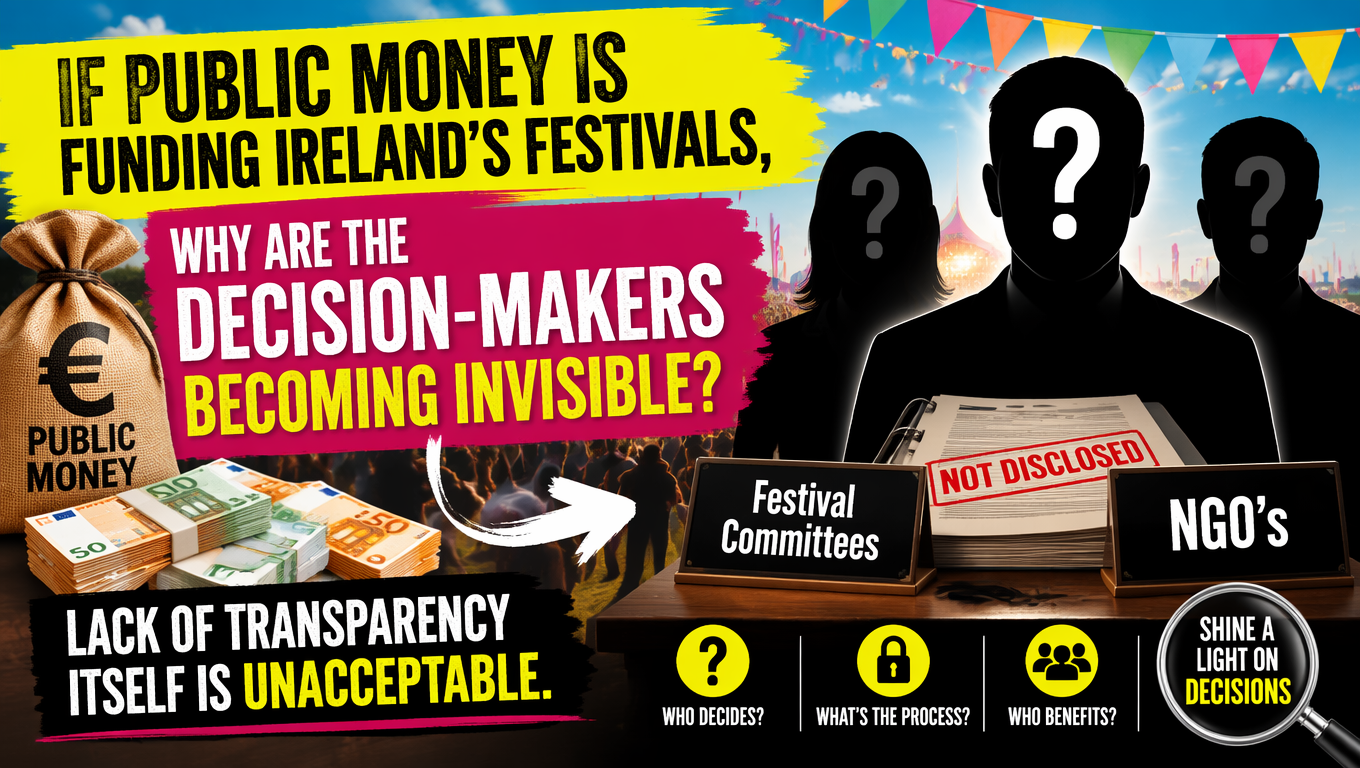
Across Ireland, festivals receive millions of euro in public funding through local authorities, government agencies, sponsorships and grants. These events are promoted as community festivals, yet many members of the public would struggle to identify the people responsible for governing them.
That should concern everyone.
Transparency is not optional when public money is involved. It is the foundation of public accountability.
If decisions are being made about funding, contracts, suppliers, sponsorship, licences or commercial opportunities, the public has every right to know who is making those decisions.
Thousands of people give their time freely to support festivals and deserve recognition for their work. They are seemingly just used for the occasion.
It is about accountability.
When governance becomes difficult to identify, public confidence inevitably suffers.
Communities begin asking questions.
Who selected that contractor?
Who decided which businesses would be included?
Who approved the expenditure?
Who declared conflicts of interest?
Who is responsible when concerns are raised?
These are not unreasonable questions. They are the basic questions that should accompany any organisation handling public resources.
Unfortunately, finding answers is not always straightforward.
Some festivals provide only limited information about their governance.
Others direct enquiries through generic email addresses with no indication of who ultimately makes decisions. In some cases, committee structures have been replaced by corporate or organisational models that are less visible to the communities the festivals are intended to serve.
Whether this reflects administrative change, privacy concerns or something else, the effect is the same: the public sees fewer names and less accountability.
That should be reversed. Transparency protects everyone. It protects taxpayers.
It protects businesses by demonstrating that contracts are awarded fairly. And it protects festivals themselves by building public trust.
Good governance should not be hidden behind organisational structures or difficult-to-find documents.
If a festival receives public funding, the public should be able to easily identify:
- who governs the organisation;
- who makes strategic decisions;
- how conflicts of interest are managed;
- how procurement decisions are made; and
- how concerns can be independently reviewed.
None of this should require a Freedom of Information request, hours of online research or specialist legal knowledge.
Public confidence is built through openness, not obscurity.
Ireland’s festivals are among the country’s greatest cultural assets. They deserve governance that is as open and visible as the celebrations themselves.
The question is no longer whether transparency is important.
The real question is this:
If there is nothing to hide, why has it become so difficult to see who is making the decisions?