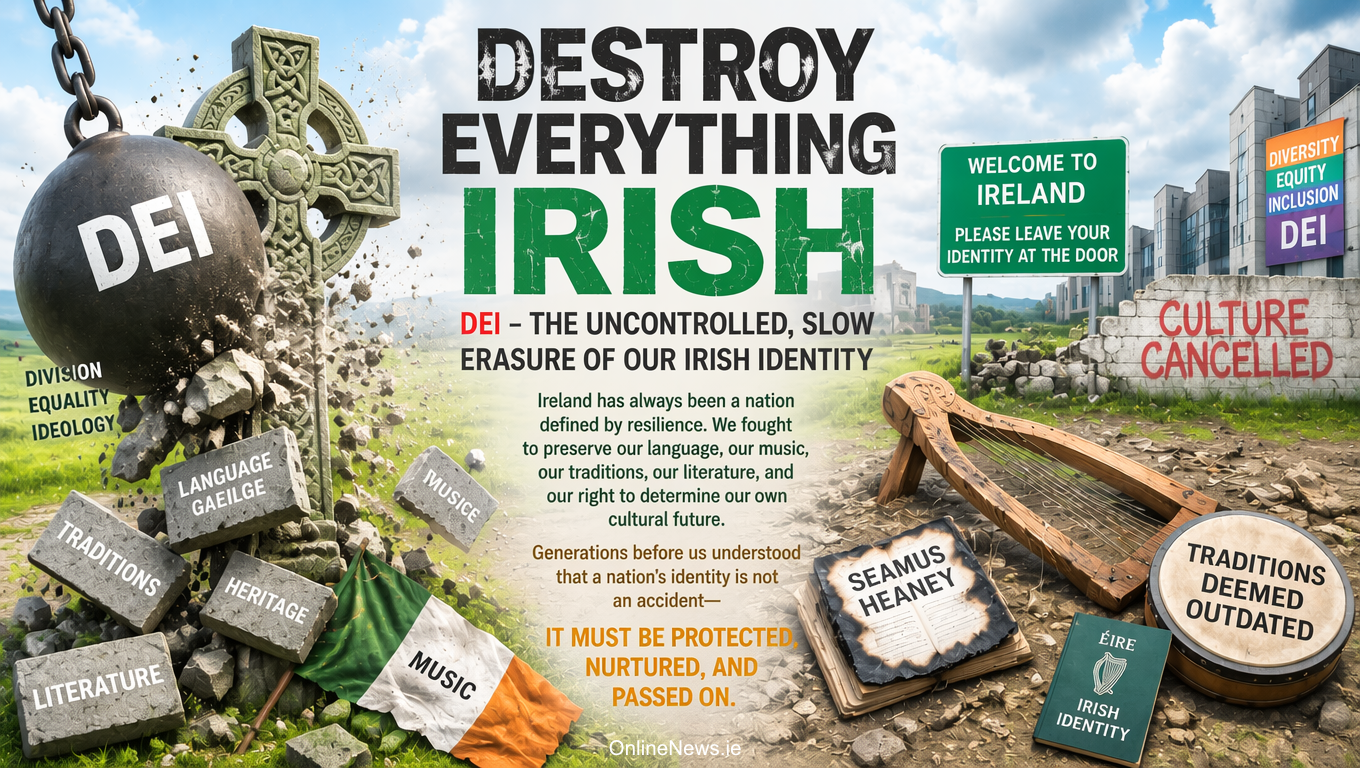
One must seriously question whether the adoption of DEI based ideological models, largely originating from U.S. universities and global corporations, is compatible with Ireland’s unique constitutional, cultural, and historical identity.
Ireland has always been a nation defined by resilience. We fought to preserve our language, our music, our traditions, our literature, and our right to determine our own cultural future. Generations before us understood that a nation’s identity is not an accident, it must be protected, nurtured, and passed on.
Today, however, many people are asking a different question: is Ireland’s cultural identity being quietly displaced, not by military conquest or economic collapse, but by this imported ideological framework that increasingly shapes public institutions and publicly funded cultural organisations?
That framework is Diversity, Equality and Inclusion (DEI).
To be clear, few reasonable people object to fairness, equal opportunity, or treating every person with dignity.
However, we have lived in Ireland all our lives, respecting our fellow citizens, legal immigrants, and tourists in accordance with these principles. These values have long been embedded in Irish society and Irish law, and are deeply rooted in the Constitution of Ireland (Bunreacht na hÉireann).“
In Summary:
Enduring Values Bunreacht na hÉireann balances:
- Individual dignity and rights with the common good.
- Popular sovereignty with stable democratic institutions.
- National identity and unity with peaceful, consensual approaches and international cooperation.
- Ethical principles (justice, charity, prudence) rooted in a Christian worldview, adapted to a pluralist, secularising society.
Money Over Ideology
As multinationals expanded into Ireland, they insisted these initiatives were driven by the expectations of global investors. But the longer this has gone on, the harder it is to believe ideology is the real motivation. Profit and Cheap Foreign labour is.
If the corporate winds shifted tomorrow, they’d change course just as quickly.
Bunreacht na hÉireann directly contradicts the agenda of DEI.
Article 40.1 mandates that “All citizens shall, as human persons, be held equal before the law,” permitting distinctions only for differences in capacity and social function not identity based preferences to engineer group outcomes.
DEI’s core demand for equity requires the State and employers to discriminate in favour of selected groups to achieve proportional representation, violating this explicit guarantee of individual equality and the Constitution’s foundational commitment to personal dignity and the common good.
Such policies subordinate citizens to collective statistics, repudiating the very principle of equal treatment that defines Irish constitutional order. Fidelity to Bunreacht demands rejection of DEI’s equity doctrine.
When government bodies, businesses, and publicly funded groups judge success by DEI checklists instead of merit, excellence, or true cultural value.
This approach clashes with our Constitution, which demands equal treatment for every citizen as an individual, not special treatment for favoured groups.
Politicians have a duty to uphold Bunreacht na hÉireann and safeguard our culture not to weaken with divisive ideology.
This is a real threat to the nation they are sworn to serve.
The consequences may not be obvious overnight. They emerge gradually.
It should also be possible to ask whether imported ideological models many developed within American universities and multinational corporations are appropriate for Ireland’s unique cultural landscape.
- Ireland has its own history.
2. Its own traditions.
3. Its own social fabric.
4. Its own constitutional values.
We should not automatically assume that every international policy trend improves Irish society simply because it has become fashionable elsewhere.
Every hour spent promoting generic ideological messaging is an hour not spent preserving Irish folklore, supporting traditional musicians, restoring historical archives, encouraging the Irish language, or investing in community traditions that connect generations.