Have You Heard of Stellantis?
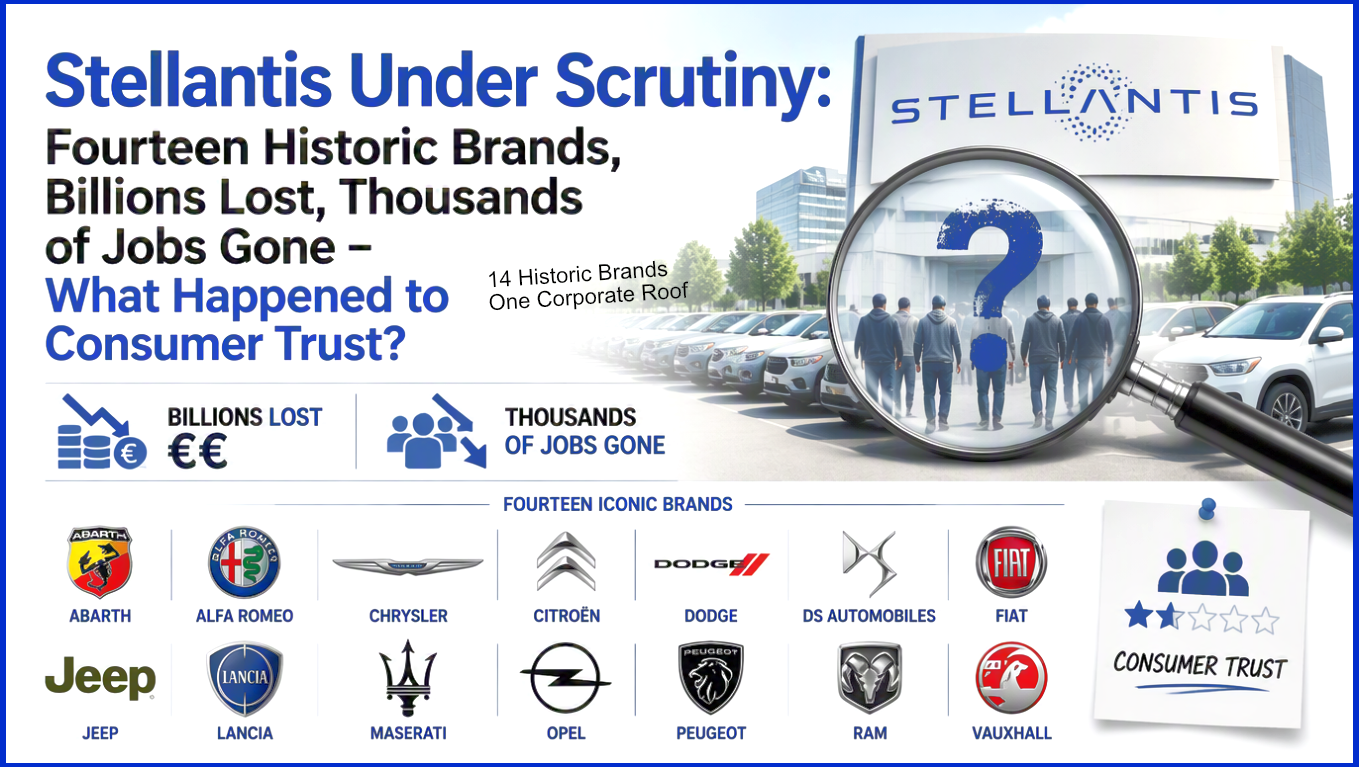
Stellantis N.V. was created in 2021 through the merger of Fiat Chrysler Automobiles (FCA) and France’s PSA Group. Today, one corporation owns fourteen of the world’s best-known automotive brands:
Abarth, Alfa Romeo, Chrysler, Citroën, Dodge, DS Automobiles, Fiat, Jeep, Lancia, Maserati, Opel, Peugeot, Ram and Vauxhall.
For generations these were independent manufacturers, each with its own engineering philosophy, management and identity. Today, while the badges and heritage remain, they all operate under one corporate owner: Stellantis.
Are Consumers Fully Aware?
When customers buy a Peugeot, Fiat, Vauxhall, Citroën, Jeep or Alfa Romeo, many still associate those vehicles with the independent companies that originally built their reputations. Today, however, the engineering strategy, warranties, recalls, after-sales support and long-term direction of all fourteen brands are ultimately controlled by Stellantis.
That raises a simple question: are consumers given enough information to understand who they are really buying from and who is responsible for their warranties?
Trust Under Pressure
Since its formation, Stellantis has faced a series of challenges that have raised questions about its leadership and long-term strategy.
The company reported a €20.1 billion net loss in the second half of 2025, largely linked to writedowns associated with its revised electric vehicle strategy.
source: RTE.ie
It also closed the historic Vauxhall manufacturing plant in Luton after more than 120 years, resulting in the loss of over 1,100 jobs.
source: www.bbc.com/news
Pure Tech
At the same time, the company has faced legal challenges over its PureTech 1.0 and 1.2-litre engines. Claimants allege that premature deterioration of the wet timing belt led to engine failures, costly repairs and financial losses. Stellantis has since introduced an extended warranty and compensation programme for eligible vehicles, while legal proceedings continue.
source: https://www.stellantis.com/en/contacts/puretech-compensation-platform
Taken together, these events have prompted many consumers to question whether financial pressures have begun to outweigh engineering excellence, customer care and the values that originally built these historic brands.
Different Cars or Different Badges?
Most buyers recognise the badge on the bonnet, trusted for generations. However, recent conversations with car owners suggest that far fewer recognise the corporate group now behind that badge.
Each brand still carries its own badge and history, but beneath the surface many now share the same corporate foundations, technology and development strategies.
Models Equipped with the 1.2-litre PureTech Petrol Engine
The 1.2-litre PureTech petrol engine was fitted to a wide range of Stellantis (formerly PSA Group) vehicles manufactured between approximately 2012 and 2023. Depending on the model year, specification and market, these included:
- Citroën: C3, C3 Aircross, C3 Picasso, C4, C4 Cactus, C4 X, C4 Picasso, Grand C4 Picasso, C4 SpaceTourer, Grand C4 SpaceTourer, C5 Aircross, C5 X, Berlingo and C-Elysée.
- Peugeot: 208, 301, 308, 408, 508, 2008, 3008, 5008, Partner and Rifter.
- Opel/Vauxhall: Corsa, Astra, Crossland, Crossland X, Grandland, Mokka and Combo.
- DS Automobiles: DS 3, DS 3 Crossback, DS 4 and DS 7 Crossback.
- Jeep: Avenger.
- Fiat: Doblò.
- Toyota: Proace City and Proace City Verso (petrol models developed in partnership with PSA/Stellantis).
Important: Every effort has been made to ensure the accuracy of this information at the time of publication. However, vehicle specifications, engine variants and eligibility for warranty extensions or compensation may vary by model year, production date and country. Readers should verify the information relating to their specific vehicle directly with Stellantis before relying on this list.
We strive for accuracy. If you believe any information in this article requires correction, please contact our editorial team using the contact form.
Increasingly difficult to tell one model from another.
One thing that struck me recently was how similar so many new cars have become. Walk through any car park today and it’s increasingly difficult to tell one model from another.
While each badge has its own styling and identity, many vehicles today are built on the same corporate foundations. Even the colour choices have become increasingly similar uninspiring, with mostly black, grey, dark green, white and other muted shades dominating showrooms, replacing the beautiful vibrant reds, blues, yellows and other colours that once gave cars real personality.
Electric vehicles: some are absolutely huge, bland and indistinguishable, with designers relying on oversized light bars, thin blinding LED strips across the rear or elaborate brake light signatures to create identity, rather than producing truly distinctive shapes.
From the first practical motor car in 1885 to the vibrant designs of the 1960s, 1970s and 1980s, the automobile evolved into a symbol of engineering, individuality and style.
Today, more than 140 years after Karl Benz built the first petrol-powered car, many enthusiasts argue that modern vehicles have become increasingly similar in appearance, with distinctive character giving way to corporate platforms, shared technology and conservative design.
In my opinion:
Today’s cars are:
Functional
Uninspiring
Efficient, but lacking character
Technically advanced (Surveillance Units)
Visually forgettable
Predictable
Too quiet
Simply boring
Admittedly some earlier year car designs were boring as well but we seem to have hit a completely new low when it comes to vehicle design.