What began as a young Irish mother’s search for a school place for her four-year-old child has evolved into a challenge that could have profound implications for Ireland’s education system, parental rights and cultural future.
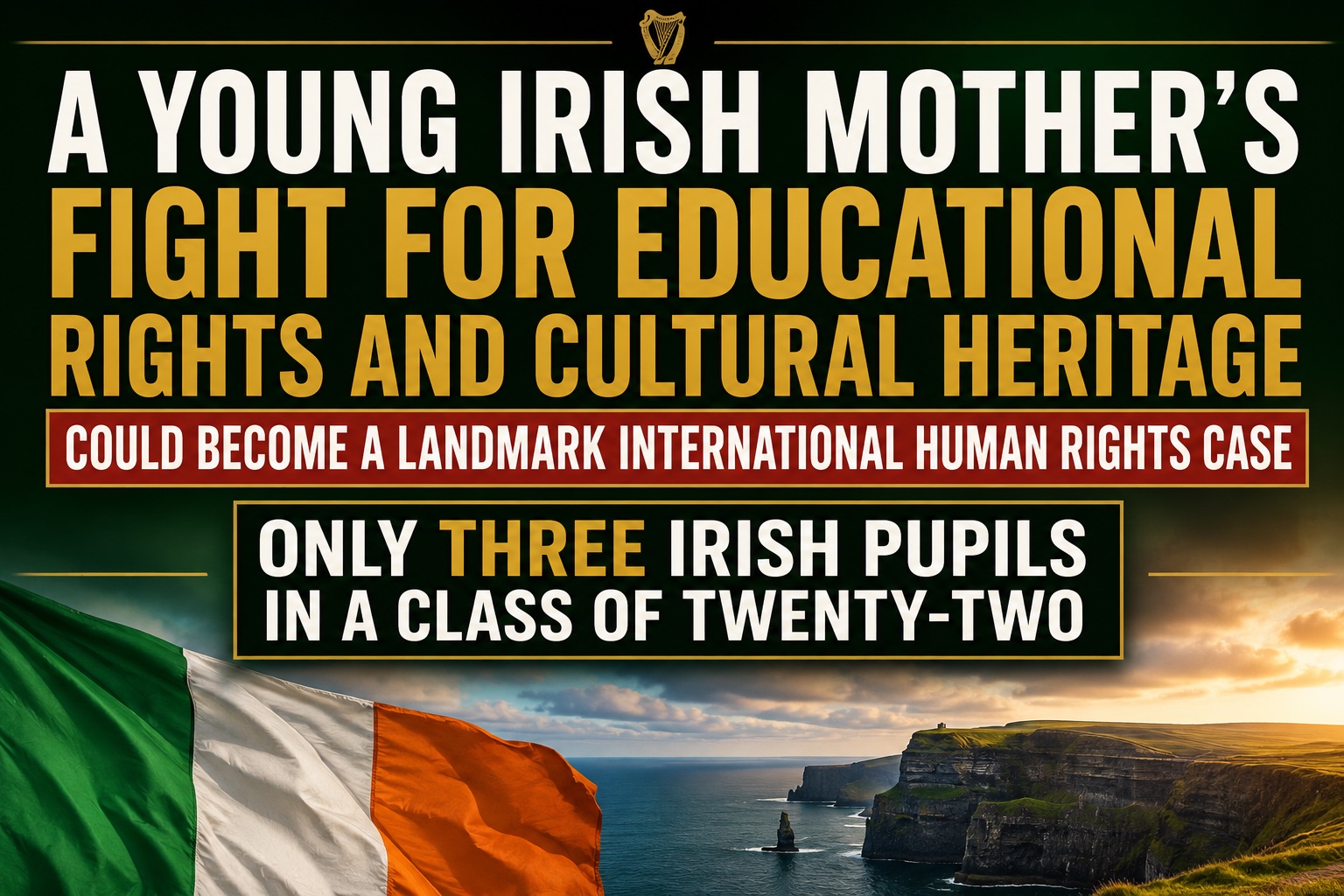
According to the mother’s account, she secured a place for her child in a local pre-school only to discover upon arrival that just three of the twenty-two pupils in the classroom were Irish. She further claims that many of the remaining pupils required additional English-language support, placing significant demands on classroom resources and requiring additional teaching assistance.
For this mother, the experience was a nightmare. What should have been a proud milestone in both her life and her child’s life became a source of shock, distress and lasting trauma.
She believes that her child was failed by those entrusted with protecting the educational rights of Irish children and that no Irish family should ever be forced to remove their child from school in order to secure what they believe is a suitable education. In her view, the situation represents a profound failure of duty, planning and accountability at the highest levels of government.
The mother alleges that when she attempted to raise concerns about the situation, she was met with resistance rather than meaningful engagement. She maintains that both she and her child experienced significant distress and that her concerns regarding educational standards, parental choice and cultural continuity were effectively ignored.
Ultimately, she made the difficult decision to withdraw her child from the school and begin homeschooling.
The Department of Education directed schools to integrate thousands of newly arrived pupils, including more than 15,600 Ukrainian (Update: The Department of Education can confirm that 17,501 Ukrainian pupils have been enrolled 2026)
At the same time, schools were also accommodating growing numbers of asylum-seeking and other newly arrived children. As enrolment pressures intensified throughout 2024 and 2025, many parents, teachers and school communities argued that the education system was being stretched beyond its capacity.
Growing number of parents
Her experience has become a focal point for a growing number of parents who argue that Ireland’s education system is struggling under pressures that were never properly anticipated or planned for. They contend that teachers and schools have been placed in an impossible position, expected to meet increasingly complex educational, linguistic and social demands while operating within limited budgets and constrained resources.
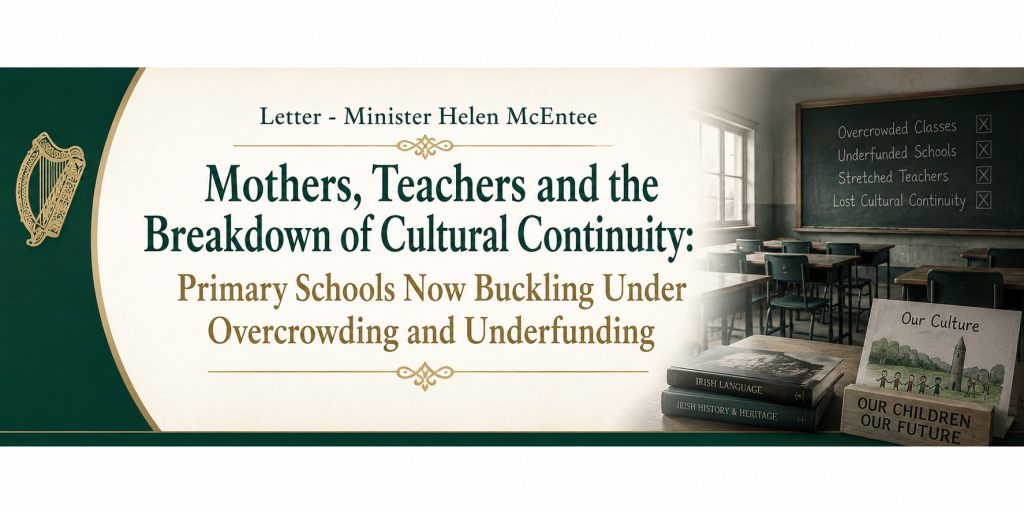
Many parents argue that the issue extends beyond overcrowding or funding alone. They believe that schools are not merely institutions of learning but are also central to the preservation and transmission of Ireland’s cultural heritage, traditions, values and identity. They fear that when schools are overwhelmed by challenges for which they have not been adequately prepared, their ability to fulfil this role is weakened.
They question whether adequate planning took place before schools were expected to absorb significant numbers of pupils requiring additional educational and language supports.
They also question whether the rights of existing school communities and families were given sufficient weight in decision-making processes.
At the centre of the emerging debate is the question of educational rights. Parents are increasingly asking whether every child is receiving equal access to an educational environment capable of meeting their needs. They are also asking whether parents have been afforded meaningful participation in decisions that directly affect their children’s educational experience.
This mother’s case is now being viewed by some campaigners as potentially significant beyond her own personal circumstances. They argue that her experience reflects concerns being voiced by families across the country. While the precise number of potential legal challenges remains uncertain, supporters believe that many parents may seek legal redress.
Fundamental duty to protect the educational rights of Irish children.
The wider significance of the debate cannot be ignored. For many Irish families, this is no longer simply a discussion about school places. It has become a question of whether the State has fulfilled its fundamental duty to protect the educational rights of Irish children and to preserve the cultural heritage that schools have traditionally helped to transmit from one generation to the next.
This young mother’s case has therefore become symbolic of a much larger question: what happens when citizens believe that their children’s educational rights have been subordinated to policy decisions over which they had no meaningful input and little opportunity to challenge?
Supporters of legal action argue that accountability must now be established. They contend that if public authorities implemented policies that fundamentally altered the educational environment without ensuring sufficient capacity, resources and safeguards for existing school communities, those decisions deserve close legal scrutiny. They further argue that where parents believe their rights, or the rights of their children, have been adversely affected, access to legal remedies is not only appropriate but necessary.
Whether one family’s challenge ultimately develops into a wider series of legal actions remains uncertain. However, what is becoming increasingly clear is that many parents believe the issues raised extend far beyond a single classroom or a single school. They concern educational access, parental rights, government accountability and the future direction of Irish education itself.
The mother describes her experience as nothing short of a nightmare. In her view, what she encountered was not merely a failure of educational planning but a shocking indictment of ruthless government policy failure and ministerial oversight.
In her opinion, the consequences have extended beyond the classroom, affecting the entire cultural, social and educational fabric of communities across Ireland.
Supporters of her position argue that the issues raised go to the heart of the relationship between citizens and the State. They contend that questions of educational access, parental rights, cultural continuity and government accountability deserve the highest level of scrutiny. Some campaigners believe that if widespread failures can be demonstrated, the matter could raise serious legal and human rights questions requiring examination by both domestic and international bodies.
For this Irish mother, however, the issue remains deeply personal.
Behind the policy debates, statistics and legal arguments is a child whose educational journey was disrupted and a family who believe they were left without meaningful support. It is this personal experience that continues to drive her determination to seek answers, accountability and, ultimately, international justice.
There are reports now that in one Irish schools, up to 85% of pupils are now from non-Irish backgrounds, this is an absolutely shocking statistic.

.