Was this political failure or a failure to meet the State’s legal obligations?
The housing crisis was already firmly established in 2020.
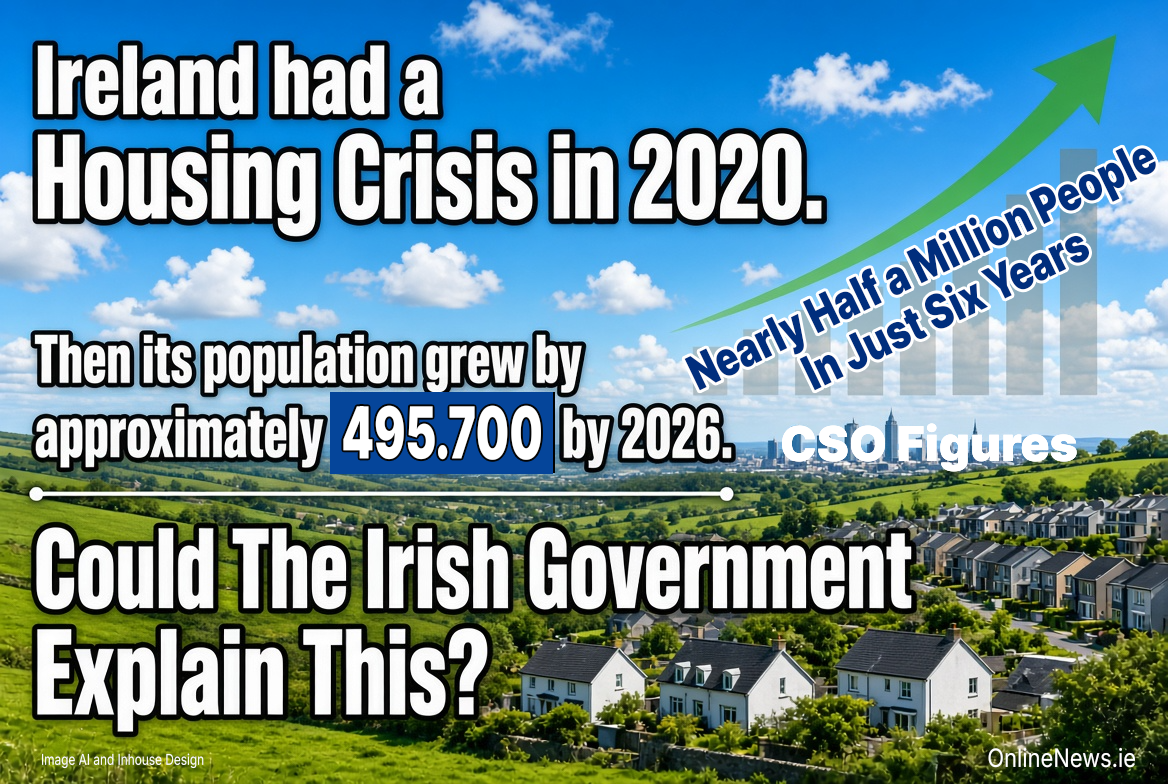
The Irish government cannot dismiss the housing crisis as an unfortunate market problem. The crisis was already firmly established in 2020. The State knew that housing affordability, homelessness and inadequate supply were serious problems. Yet between April 2020 and April 2026, Ireland’s population grew by a staggering 495,700 people. CSO figures
April 2020: 5,029,900 people
April 2026: 5,525,600 people
Actual increase: 495,700 people
Percentage growth: 9.9% over just six years.
Fifth successive 12-month period where over 100,000 people immigrated to Ireland.
Where was the plan?
The consequences are clear: unaffordable rents, prolonged housing insecurity and families struggling to build stable lives, job losses, inevitable forced emigration. This raises serious questions about government competence, the use of public resources and whether the State fulfilled its responsibilities to the people living here.
How can the Irish Government justify allowing the population to grow by almost half a million between 2020 and 2026 while a severe housing crisis was already well in progress?
What did the Government know, and why were ordinary people left to bear the consequences of uncontrolled population growth, an escalating housing crisis, mounting pressure on public services and the growing cost to taxpayers?
This goes beyond political mismanagement and raises serious questions about possible gross negligence in the discharge of public responsibilities. Were statutory duties breached?
There is already a documented precedent: in 2017, the European Committee of Social Rights found that Ireland had failed to take sufficient and timely measures to ensure adequate housing for a number of families in local-authority housing. Council of Europe
Political accountability is unavoidable. Legal accountability must also be examined wherever the evidence supports it.
Then there is the shameful issue of homelessness.
If the Irish State was able to rapidly mobilise accommodation for thousands of people fleeing Ukraine, does this raise the question of whether it failed to fulfil its legal obligations to those who were already experiencing homelessness? And, if so, could those individuals now pursue legal action for breaches of their rights?
This is the question the Government must answer. When people from Ukraine arrived in Ireland in 2022, the State mobilised accommodation and public resources to meet an urgent humanitarian need.
The people homeless here, for some reason, didn’t qualify for this urgent humanitarian need, or did they, that is the question?
Shamefully thousands of people already living in Ireland remained homeless, including families with young children.
If accommodation could be magically found, why had so many people been left without a home in the first place? What had prevented the State from acting with the same urgency to address the existing homeless in Ireland?
The Big Financial Bonanza
While ordinary Irish people were left homeless, the influx from Ukraine created a new financial bonanza for private landlords and accommodation providers benefiting from State-funded contracts.
One stands out: Donie Cassidy, a former TD and party VICE-PRESIDENT of Fianna Fáil , is a particularly important figure in examining the links between political influence, hotel ownership and State-funded accommodation. His hotel interests, including the Great Denmark Hospitality company associated with Barry’s Hotel, appear in published State payment records for Ukrainian accommodation.
Here you have a political party in power and one of their top officials running the party is now getting sweet contract deals worth millions.
Some others we now know were actually sitting in the Dáil Chambers, and some contract recipients were party members, family member, and political associates. It became a free for all, it has been like the wild west.
Who benefited, how were these arrangements approved, and were elected representatives involved in decisions from which they or their associates stood to gain financially?
With almost 20,000 people in 2026 now reported homeless in Ireland, the contrast is stark.
If this is humanitarian policy, where are the transparency, accountability and equal concern for the Irish people left without a home?
Did the Irish Government properly discharge its responsibilities to people already living here while making decisions that placed additional demands on an already overstretched housing system.
A state in the middle of a serious, severe housing crisis.
In Ireland, 10,321 people were counted as homeless on Census Night, 3 April 2022
Central Statistics Office
The monthly figures for people in State-funded emergency accommodation show the situation as the Ukrainian arrivals began:
| Period in 2022 | People homeless in emergency accommodation |
|---|---|
| March | 9,825 |
| April | 10,049 |
| December | 11,632 |
Sources:
RTÉ
+1
Meanwhile, CSO figures show 12,250 Ukrainian arrivals had been allocated PPS numbers by 27 March 2022, rising to 26,369 by 24 April. These are cumulative administrative figures, not a count of how many people the State itself housed.
Data.gov.ie
The Government must explain how it planned for both needs and whether it fulfilled its existing legal responsibilities to people who were already homeless.
- Did the State fulfil its statutory duties towards homeless people?
2. Were their rights adequately protected?
3. And if public authorities breached legal obligations owed to identifiable individuals, could those affected seek justice and compensation?
Ireland has already faced a finding by the European Committee of Social Rights that it breached a housing-related obligation towards families in local-authority accommodation. The question now is whether particular failures in the continuing homelessness crisis also give affected people grounds to seek a legal remedy.
Homeless Today
By August 2026, 17,885 people including 5,830 children, were living in emergency homeless accommodation in Ireland. The official figure does not capture everyone experiencing homelessness. The Government must explain how this crisis has been allowed to persist and whether its legal responsibilities to those affected have been met.
Ukrainians
As of 23 June 2026, of the 122,636 PPSNs issued to Beneficiaries of Temporary Protection (BoTPs) from Ukraine, 2026- CSO.
https://www.cso.ie/en/releasesandpublications/fp/p-aui/arrivalsfromukraineinirelandseries19
IPAS
As of the latest government figure I found, over 31,800 people seeking international protection were being accommodated by IPAS in Ireland, across 297 centres. This was reported in a parliamentary answer on 29 September 2026
https://prelive.oireachtas.ie/en/debates/question/2026-09-29/594
Irish People Taxed To The Hilt
Cost to Irish Tax Payers
IPAS
€1.005bn
Ukraine
€1.164bn
Source: Committee of Public Accounts, 19 February 2026. The IPAS figure here is the reported accommodation-spend figure; other accounts may classify capital and related expenditure differently.
data.oireachtas.ie
So lets get some answers