Micheál Martin met CUH chief executive Jennifer Kearney and senior hospital management on Monday, 23 November 2026
Anne O’Connor became HSE CEO in March 2026. The board has now ended her tenure. Was she the scapegoat for exposing the HSE‘s, Micheál Martins and the Minster for Health’s failures? More on this in the next article.
The figures are alarming:
- 1,059 staff short: CUH Chief Executive Jennifer Kearney warned that the hospital was short of more than 1,000 staff.
- 348 funded vacancies: Posts for which funding was already secured remained vacant.
- 172 priority positions: CUH requested urgent approval to fill these posts.
- Only 7 approved: The HSE initially approved just seven of those 172 positions.
- 12% increase in demand: Patient demand at the hospital has increased significantly.
These are not minor administrative problems. They directly concern patient care and safety.
€12m to recruitment firms in 2020 and 2021. 2020–2021: Major periods of lockdown and travel restrictions.
There is another issue that needs scrutiny:
The enormous cost of agency and temporary staffing across the HSE, which the Minister has acknowledged approached €1 billion last year.
Irish workers should be recruited, trained and retained wherever possible, and that overseas recruitment should not become a substitute for investing in Ireland’s own workforce.
There is also a cost argument: permanent direct employment may reduce reliance on expensive agency arrangements.
Could those shifts have been filled by permanent Irish-based staff at lower cost?
CUH: Micheál Martin Must Answer. Why Are We Not Putting Irish Workers First?
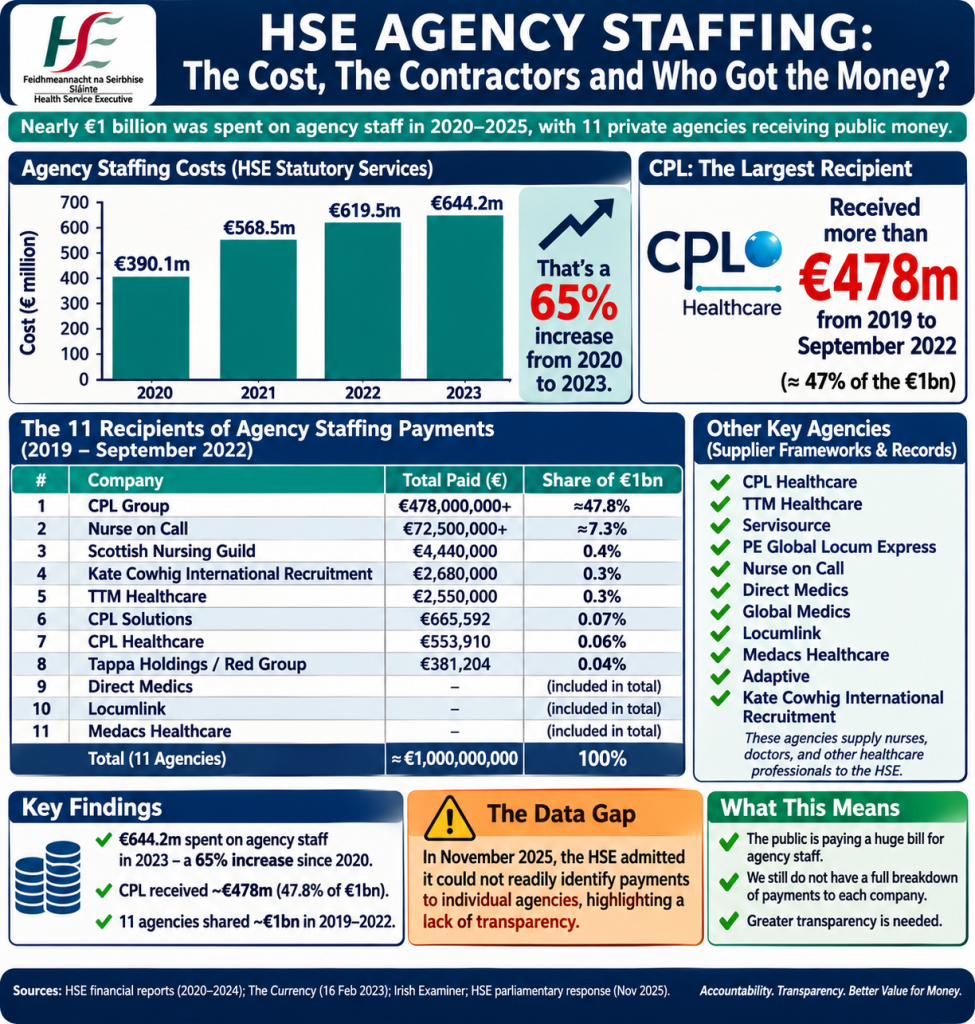
Why are we relying so heavily on agency staff being brought into Ireland by foreign own companies, CPL, Scottish Nursing Guild – TA / Independent Clinical Services Limited, and so on.
Permanent employment could certainly offer better continuity, employment structure, local on call staff, and potentially better value for taxpayers and local money invested back into the economy?
The HSE spent almost €1 billion on agency staff last year alone, according to figures discussed in the Dáil.
- How many Irish-trained healthcare professionals are currently seeking employment but cannot secure suitable HSE positions?
- How many overseas-trained staff are being recruited into CUH, how is their certification verified?
- Why are temporary agency contracts being used instead of offering permanent positions wherever possible?
- What is the Government doing to prioritise Irish graduates and retain experienced Irish healthcare workers.
This is about putting proper long-term Irish workforce planning in place, giving Irish-trained professionals a fair opportunity and ensuring taxpayers get value for money.
Irish patients deserve a properly staffed hospital, Irish healthcare workers deserve opportunities at home.
During the previous recruitment restrictions, including the COVID period, temporary staffing and international recruitment continued.
Are we now about to repeat the same approach?
I believe there is another important issue that is not being adequately addressed in mainstream media: the value of having healthcare staff who understand Irish patients, their language, culture and local communities. Clear communication is essential in a hospital setting. Patients must feel understood, listened to and confident that they can communicate their symptoms and concerns effectively. This is particularly important for elderly and vulnerable patients. Good communication is not a luxury; it is a fundamental part of safe, compassionate patient care.
I have encountered this situation on several occasions. I have experienced difficulties communicating with some members of staff whose spoken English was not sufficiently clear for me to understand important information.
In a hospital environment, clear communication is essential. Patients must be able to understand medical staff, and staff must be able to accurately understand patients. Miscommunication or incorrect information recorded on medical reports, patient records or admission forms could have serious consequences, potentially affecting patient safety and treatment.
I believe adequate English-language communication skills are a fundamental requirement for anyone working in a patient-facing healthcare role. This is ultimately about patient safety, not nationality.
Furthermore: it is fundamentally a cultural thing. I believe, it is respected in every country.
I want to make it clear that I recognise there are many highly qualified overseas healthcare professionals working in our health service. I have met some excellent staff who communicate very well in English and provide patients with professional, compassionate and respectful care.
In fact, I recently attended a hospital for a minor procedure. Most of the staff I encountered were Irish, while one member of staff was from overseas. Her English was excellent, and she was extremely professional and respectful. I had absolutely no issue with this.
However, I have also experienced the opposite. On another hospital visit, I encountered serious communication difficulties and was treated in an unacceptable manner by a nurse because I could not understand what was being said to me. I consider this experience to have been abusive, and I have documented evidence of what happened.
My concern is that every patient, regardless of their background, deserves to be treated with dignity, respect and understanding in their own country. Clear communication is essential in healthcare, where misunderstandings can have serious consequences.
I am not questioning people’s nationality. I am questioning standards, accountability, recruitment practices and the basic right of patients to receive respectful care in Ireland.
What to expect:
Are we heading towards another employment embargo, is this to be followed by an increased reliance on temporary overseas recruitment? Is this the direction Micheál Martin and the Government are taking us once again?
Meanwhile, enormous cost-cutting measures are being imposed on essential public services, while billions of euro appear to be squandered elsewhere.
How can this be justified? Why are our own workers and frontline services being left to carry the burden? We need accountability, transparency and a clear commitment to putting Irish workers and public services first.
Did Martin and Harris pull a fast one with the unions with no mention of an employment embargo?
Why was Ireland issuing thousands of medical employment permits and paying millions to recruitment agencies during Covid lockdown, while thousands of people had volunteered to help through the national campaign? How many Irish-trained healthcare professionals were overlooked, and why? 4,490 permits were issued.
€12m to recruitment firms in 2020 and 2021. 2020-2021: Major periods of lockdown and travel restrictions. What was going on here, someone need to answer for this?
The Examiner Reported: The HSE’s Be on Call for Ireland campaign attracted approximately 73,000 expressions of interest from people willing to help during the pandemic. By June 2020, only around 100 had been employed through the initiative, according to figures reported at the time.
https://www.irishexaminer.com/news/arid-40853510.html
Article info sources:
Sources: The Irish Times – CUH staffing shortage · The Echo – Only seven of 172 posts approved · RTÉ – HSE recruitment and agency spending.
Disclaimer
The information presented in this article is based on publicly available sources and previously reported material. If any information is inaccurate or requires clarification, please bring it to my attention so that it can be corrected.
My comments regarding healthcare staffing and recruitment represent my personal experiences, opinions and concerns. They should not be taken as representing the views of the Irish public as a whole.
More in my next article.
Micheál Martin met CUH Chief Executive Jennifer Kearney and senior hospital management on Monday, 23 November 2026.
Anne O’Connor became HSE Chief Executive in March 2026. The HSE Board has now ended her tenure.
But was she really the problem or was she made the scapegoat for exposing failures within the HSE, and the failures of Micheál Martin and the Minister for Health?
Did Martin’s meeting address the substance of CUH’s warnings, or did the attention shift to the departure of the HSE chief executive?
Was her departure about accountability, or silencing uncomfortable questions?