OnlineNews.ie
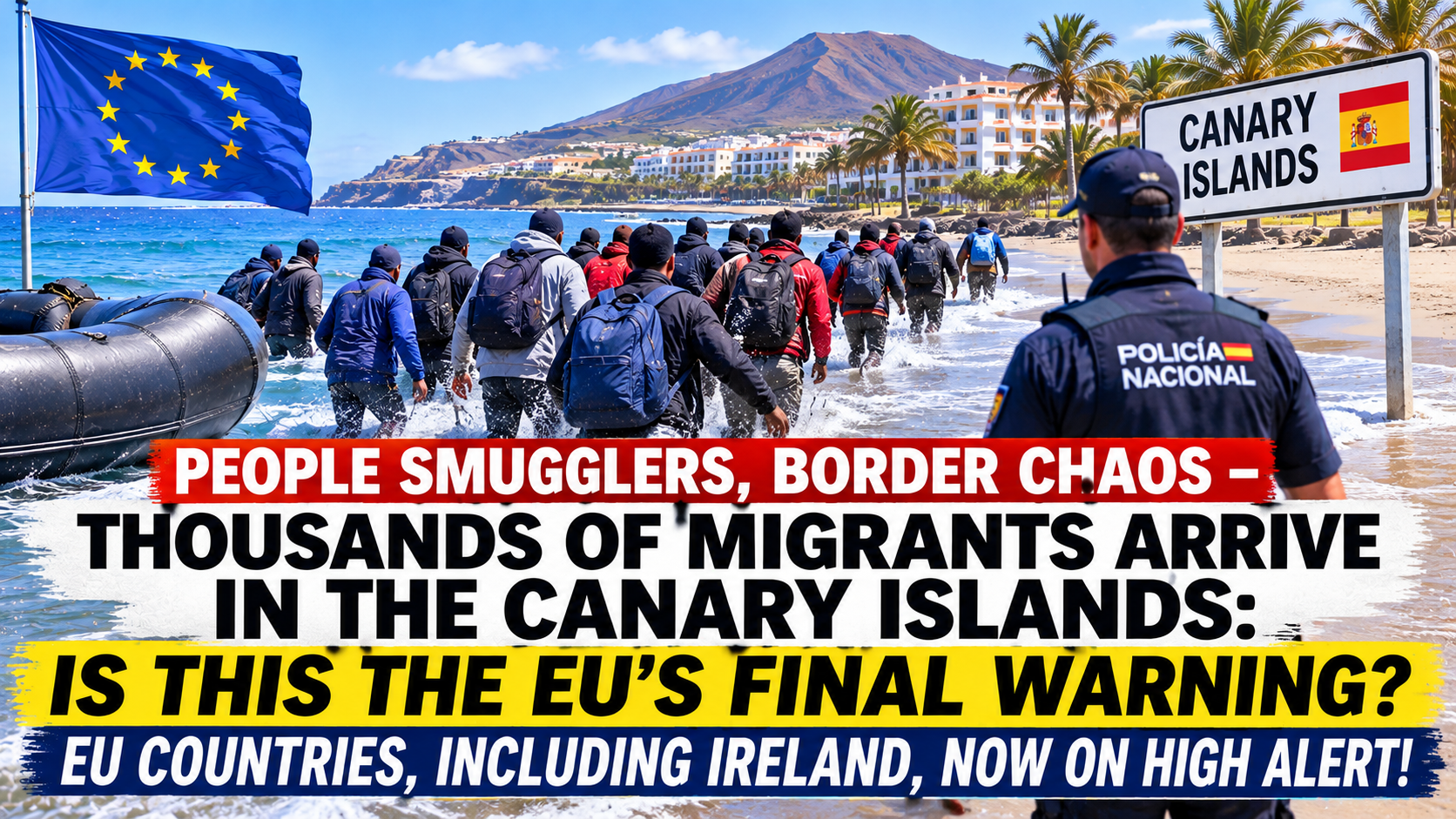
Record numbers of migrants arrive in Canary Islands
How does this effect Irish visitors to the Islands
Many Irish people will have been deeply disturbed by the scenes of disruption and the fear experienced by local communities in destinations that have long been familiar, welcoming and much loved by Irish holidaymakers.
Over many years, a strong connection has developed between Ireland and these islands, reflected in the many Irish pubs, traditional Irish music and the unmistakable sense of Irish culture, friendship and hospitality that has become part of their character.
However, the activities of ruthless people-smuggling networks are placing enormous pressure on these islands, raising serious concerns about the long-term consequences for the communities who live there, their sense of security and the tourism industry on which so much of their economy and livelihoods depend. It is important that these concerns are recognised and addressed before the very qualities that have made these destinations so attractive and welcoming to visitors are undermined.
What does the significant increase in migration to the Canary Islands mean for the people of Ireland?
With direct flights connecting the Canary Islands to Ireland, concerns are growing among the Irish public about the onward movement and eventual destination of undocumented migrants arriving in the islands.
Irish people are increasingly asking what measures are in place to monitor and manage this movement, whether Ireland could become a direct destination from the airports, and what safeguards exist to ensure that immigration procedures, border controls and national security obligations are properly maintained.
Would you go there now?
According to UNODC
Unite Nations Office on Drugs and Crime Migrant Smuggling is now a very profitable business for criminal networks with an estimated annual turnover of over EUR 5 billion . Smugglers use land, sea and air routes to facilitate irregular migration both into and within the EU. They are also increasingly using digital technologies and platforms to facilitate their criminal activities.
CRIMINAL JUSTICE (SMUGGLING OF PERSONS) ACT 2021
Criminalises intentional assistance to unlawful entry, transit or presence where the required knowledge or reasonable grounds exist.
However: Section 5(2): Excludes the ordinary provision of goods or services in the course of business, trade or profession from assisting a person’s presence.
The exclusion in Ireland’s Criminal Justice (Smuggling of Persons) Act 2021 means that providing ordinary commercial accommodation does not, by itself, constitute the specific offence of assisting a person’s unlawful presence under that section.
The more forceful legal question is:
How can legislation exclude ordinary commercial accommodation from the offence of facilitating unlawful presence when accommodation may form part of the infrastructure exploited by organised people-smuggling and human-trafficking networks? This is my understating.
- A landlord or accommodation provider does not commit the people-smuggling offence merely by renting a property or providing accommodation to someone, even if they know that person is unlawfully present.
- The provision is intended to protect ordinary commercial activity and ensure that people are not denied basic services because of their immigration status.
- It does not mean that accommodation providers have immunity from every criminal offence, or that knowingly participating in trafficking, exploitation or a smuggling operation is lawful.
In my opinion, you should not introduce or apply a law in a way that allows criminal activity to go unpunished, regardless of the circumstances or the individuals involved. No policy, commercial arrangement or legal exemption should ever provide a shield for criminal conduct. If a law creates a loophole through which criminal activity can be facilitated or concealed without accountability, that raises a serious question about whether the law is consistent with the principle of equal justice and the rule of law.
Why did the Oireachtas consider it necessary to expressly exempt ordinary commercial service providers from potential liability when accommodating or providing services to individuals who may be directly or indirectly connected to migrant-smuggling offences? Does this not risk allowing businesses to knowingly facilitate, or financially benefit from, activities linked to organised criminal networks while operating under the protection of that exemption?
- Wilful blindness: A person deliberately avoids making enquiries because they do not want to discover information that might expose criminal activity.
- Negligence or Omission: A person fails to carry out a duty imposed by law or contract, or ignores a risk they are legally required to address.
Under Section 5(2) of Ireland’s Criminal Justice (Smuggling of Persons) Act 2021, ordinary commercial services, including accommodation, are excluded from the offence of assisting unlawful presence under Sections 6 and 7. The legislation does not, however, provide immunity from other criminal offences. Law Reform
There is also a revealing point in the legislative history: when introducing the Bill, the Minister specifically referred to landlords and explained that the commercial-services exclusion was intended to prevent ordinary business activities from being criminalised. Seanad Éireann
Is it therefore acceptable for the State to pay private operators to house undocumented individuals without requiring meaningful due diligence into the circumstances of their arrival or whether organised criminal smuggling or trafficking networks were involved?
Where accommodation is publicly funded, what specific legal obligation requires providers to conduct due diligence into whether their services are being exploited by organised criminal networks?
Is this not effectively creating a legal environment in which commercial operators can accommodate individuals whose journeys may have involved organised people-smuggling or human trafficking, accept public money and provide ongoing services without any specific obligation under this legislation to establish how they arrived or whether criminal networks were involved? Where does legitimate commercial activity end and wilful blindness or ignorance begin?
Government and Responsibility
Surely the law must hold accountable not only those who actively participate in criminal operations, but also those who deliberately turn a blind eye to the possibility that their business activities are being exploited by organised criminal networks, as well as governments that fail in their duty to protect the public from these networks and prevent their activities from taking hold in our communities.
https://revisedacts.lawreform.ie/eli/2021/act/42/revised/en/html
An Garda Síochána has a specialist Human Trafficking Investigation and Co-ordination Unit (HTICU), which coordinates investigations nationally and supports local Gardaí.
However, if the State allows publicly funded accommodation to house people who may have been trafficked, without requiring checks or a clear route for reporting suspicions, how can the HTICU effectively identify victims, investigate traffickers or locate people being exploited?
This is a completely ridiculous situation to put The Human Trafficking Investigation and Co-ordination Unit (HTICU) into, it practically renders their agency handcuffed.
On 28 November 2023 – The Global Alliance to Counter Migrant Smuggling
On 28 November 2023, the European Commission launched the Global Alliance to Counter Migrant Smuggling, with the stated objective of strengthening international cooperation and tackling the criminal networks responsible for migrant smuggling.
Three years on, the scale of the problem remains a serious concern, escalating if anything, with growing questions about the effectiveness of the measures introduced and the results actually achieved.
What tangible progress has been made?
- How many organised criminal networks have been dismantled?
2. How many people-smuggling operations have been disrupted?
3. What protections have been put in place to prevent EU member states from inadvertently sustaining the very system these criminal networks profit from?
It is not enough to target criminal networks at the point of departure while ignoring the conditions and systems they rely upon at the point of arrival. If there were no perceived benefits or favourable outcomes at the destinations, the financial incentive for organised criminal networks to facilitate these journeys would be zero.

Surely, an effective strategy must address both ends of the operation, including the factors that create demand and make people smuggling a profitable business in the first place.
Governments Interconnected. One cannot operate without the other.
Are the activities of organised criminal networks and the policies of destination governments interconnected?
In the sense that the latter provide the infrastructure and support that make the movement and arrival of people sustainable.
Organised criminal networks profit from moving people into Europe, while governments in destination countries, such as Ireland, provide the accommodation, financial assistance and public services that support them once they arrive.
While governments continually emphasise their legal and humanitarian obligations towards migrants, what about their equally important legal responsibilities towards people and the countries bearing the consequences of these organised criminal networks? Should governments and elected representatives not also be held accountable for the foreseeable consequences of policies and decisions that may be exploited by criminal organisations for financial gain?
Where is the balance between fulfilling humanitarian obligations, protecting the interests and welfare of receiving countries, and ensuring that government policies do not inadvertently enable, sustain or facilitate organised criminal activity?Ultimately, where does the state’s responsibility to those arriving end and its responsibility to protect its own citizens and institutions begin?
Migration has become a highly organised and profitable business. Europol has documented criminal networks operating across countries, with recruiters, organisers, transporters, guides, document providers and money handlers working together. These are not simply individuals making spontaneous journeys. They are often part of networks coordinating journeys from beginning to end and making substantial profits from people seeking to reach Europe.
When people reach Ireland and sign on they can immediately access accommodation and a vast range of supports while their applications are processed, the Government must consider whether those arrangements influence the choice of destination for people traffickers.
Without destinations gifting all these free facilities, would there be any mass immigration like we are now seeing?
We are witnessing a modern-day version of Prohibition-era America. But instead of alcohol bootlegging, the criminal trade is now the organised trafficking of people into Europe. It is a lucrative, ruthless industry operating across borders, and its consequences are devastating. The Canary Islands are now on the frontline, while a small country like Ireland is being left to absorb enormous pressures on its communities, services and national identity. The escalation has been relentless, and governments have failed to bring it under control.
No Veto
Do you remember: Leo Varadker made the statement on Sunday, 7 January 2024, during an interview on RTÉ Radio 1’s This Week programme. “Nobody in a free society, nobody in a democracy has a right to exercise a veto on who moves into their area or community“. https://www.rte.ie/news/2024/0107/1425149-immigration/
However, it is worth noting that shortly after making that statement about communities having no veto over who moves into them, Leo Varadkar left office as Taoiseach in early 2024 amid significant political pressure, following major referendum defeats and growing criticism of his Government.
Leo Varadkar’s assertion that communities have no veto over who comes to live among them must be considered against the officially recognised threat documented by the United Nations Office on Drugs and Crime (UNODC), which identifies migrant smuggling as a highly profitable criminal enterprise generating billions of euros annually and affecting countries across Europe. This is no longer an unknown or hypothetical risk; it is a recognised international criminal problem.
The question is no longer whether communities have a veto; it is whether those who imposed this system will ever be held accountable for its consequences which are now becoming visible.
The UNODC’s findings make it impossible for European authorities to claim that the threat is unknown or unforeseen. They cannot deny communities a voice, ignore an officially recognised criminal threat and then evade accountability when the consequences fall on ordinary people.
The EU Migration Pact | Contradiction.
Where Does National Sovereignty and Accountability Fit In?
There is another significant question to which people deserve answers. Under the EU Migration and Asylum Pact, member states are required to participate in a mandatory solidarity mechanism, with the option of accepting asylum applicants through relocation arrangements or being forced to make financial contributions, calculated using a reference amount of €20,000 per relocation shortfall. As we know, the people of Ireland got no say in this and were refused a referendum.
Is the EU Migration and Asylum Pact creating a system in which member states are legally obliged to participate in the management, relocation, accommodation and financial support of people arriving through migration routes that are also exploited by organised criminal networks?
The criminal business is not hypothetical.
The European Commission’s published information, drawing on the UNODC estimate, confirms that migrant smuggling generates an estimated annual turnover of more than €5 billion for criminal networks. It also recognises links between smuggling networks and other serious organised crime. European Commission
The European Parliament has also reported that more than 90% of irregular migrants reaching the EU use smugglers’ services, either for part or all of their journey. European Parliament
So the question is not whether organised criminal networks exist. Their existence and profitability are officially recognised.
Legal Protections
What legal protections exist for countries and their people against being drawn into operations that may facilitate or sustain illegal people smuggling and human trafficking? If this system is demonstrably creating conditions that support or enable these criminal activities, does this not raise serious questions about the legal accountability and potential complicity of those governments, institutions and individuals responsible for designing, implementing and enforcing these policies?
At what point does participation in such a system become more than an administrative or political responsibility and potentially give rise to legal liability?
If governments and elected representatives insist that communities have no say over who is placed among them, then they must accept full responsibility for the consequences, including the risks posed by organised criminal networks exploiting migration routes. The UNODC’s findings make it impossible for European authorities to claim that the threat is unknown or unforeseen. They cannot deny communities a voice, ignore an officially recognised criminal threat and then evade accountability when the consequences fall on ordinary people.