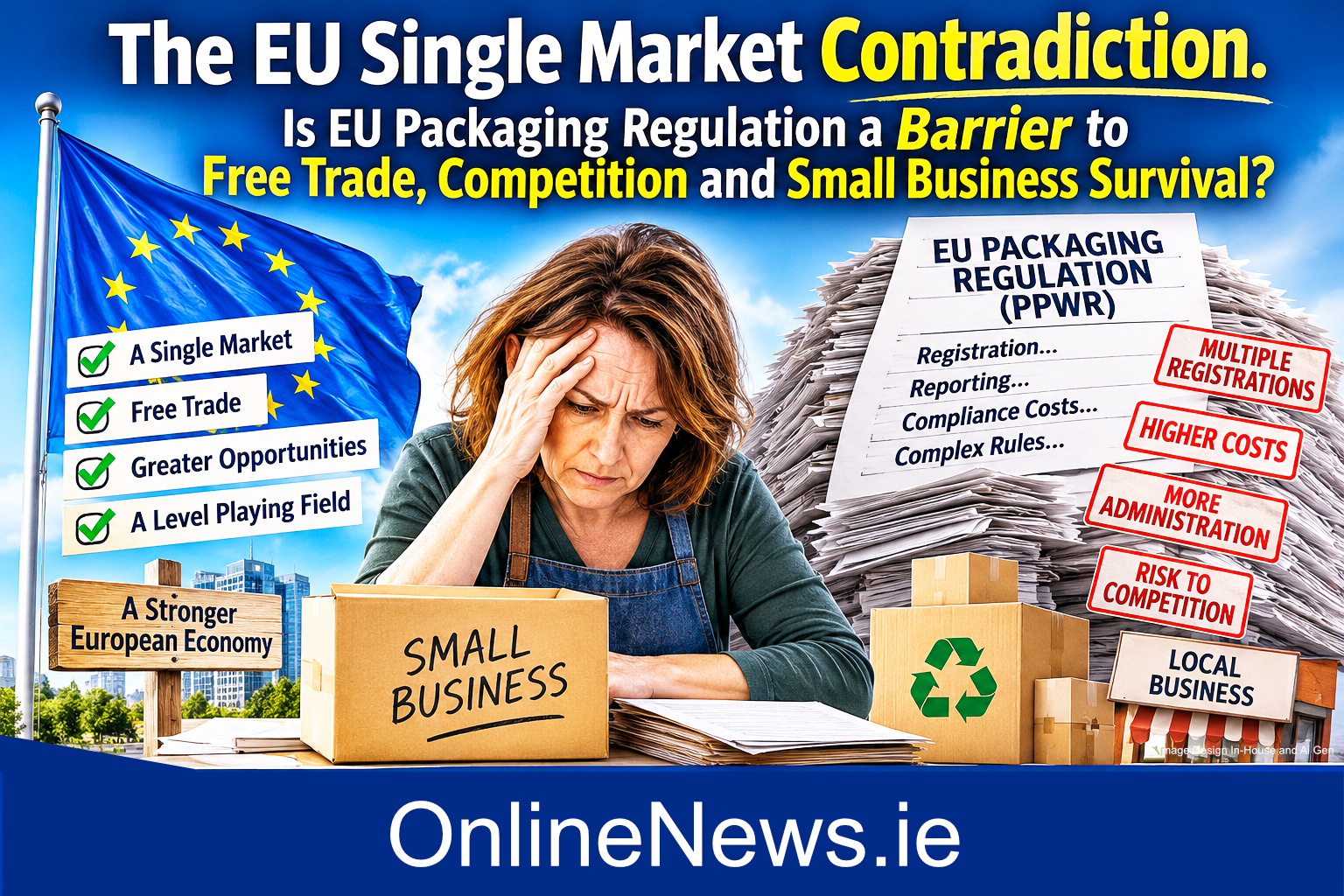
Is EU Packaging Regulation a Barrier to Free Trade, Competition and Small Business Survival?
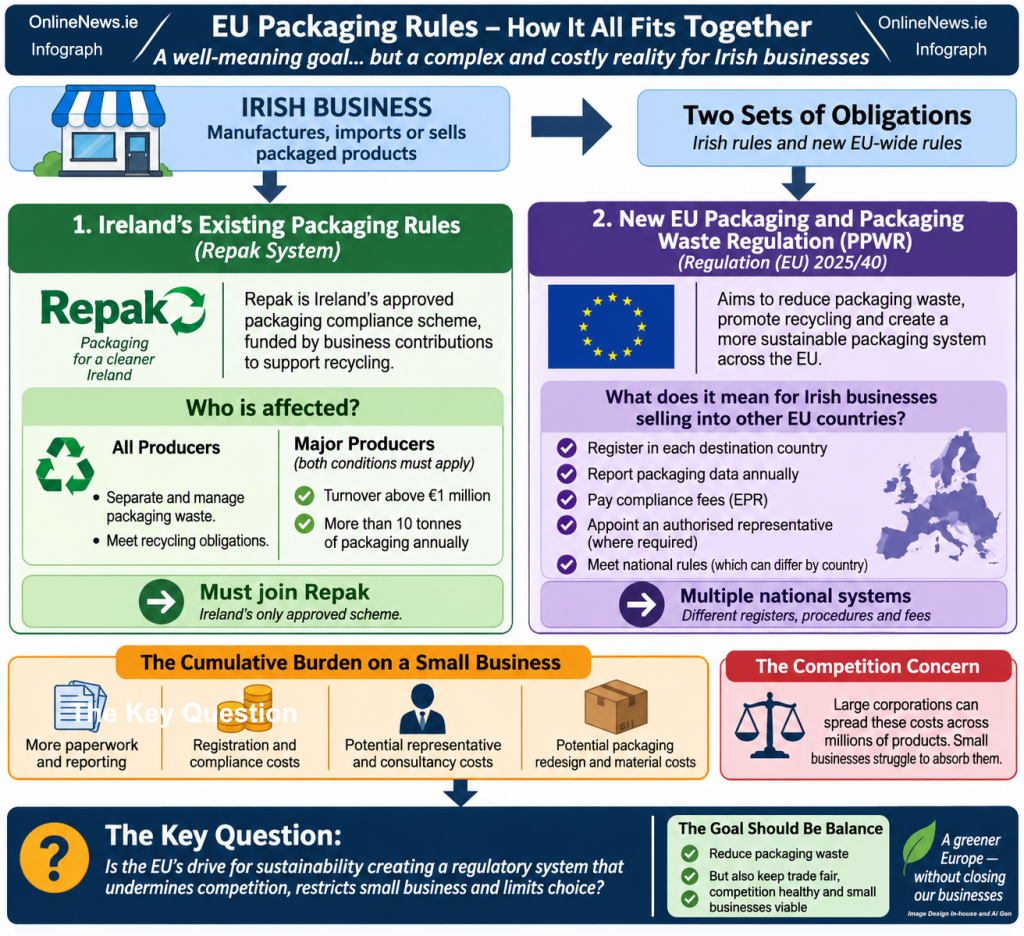
The new EU Packaging and Packaging Waste Regulation (PPWR), Regulation (EU) 2025/40, which began applying on 12 August 2026, is intended to reduce packaging waste, promote recycling and create a more sustainable packaging system. But in reality it is completely unworkable or affordable for most small businesses. Madness in fact.
https://rm.coe.int/CoERMPublicCommonSearchServices/DisplayDCTMContent?documentId=090000168064c45d
The EU says it wants to reduce the amount of packaging waste, make packaging easier to recycle and encourage businesses to use less packaging.
Under the new rules, you may have to:
- Change your packaging: Make sure boxes, bags, wrapping and other packaging meet EU requirements.
- Use recyclable materials: Packaging must meet specific recyclability standards.
- Reduce unnecessary packaging: You may have to eliminate excess packaging or empty space in parcels.
- Provide information: You may need to supply details about the materials and quantities of packaging you use.
- Register and report: Depending on the applicable requirements, you may have to register with packaging compliance schemes and report packaging placed on the market.
- Pay additional fees: Extended producer responsibility (EPR) schemes can mean additional charges for the packaging you use.
Why are small businesses concerned?
Consider the difference:
| Large corporation | Small business |
|---|---|
| Has compliance departments | Owner handles the paperwork |
| Can negotiate packaging costs | Often buys smaller quantities |
| Has legal and administrative teams | May need to pay consultants |
| Can spread costs across millions of products | Must absorb costs from much smaller sales |
The environmental objective may be worthwhile, but the financial and administrative burden on small business can be very different depending on the size of the business.
When does it apply?
The regulation is Regulation (EU) 2025/40. Its general application date is 12 August 2026, although individual requirements have different implementation dates and some exemptions apply.
The issue in one sentence
The EU wants businesses to change how they package their products, but many small businesses fear that the cost of complying with the new rules will make it harder, more expensive or even impossible for them to compete.
Extended Producer Responsibility (EPR), how it works in Ireland, what businesses pay for, and the potential impact on small businesses.
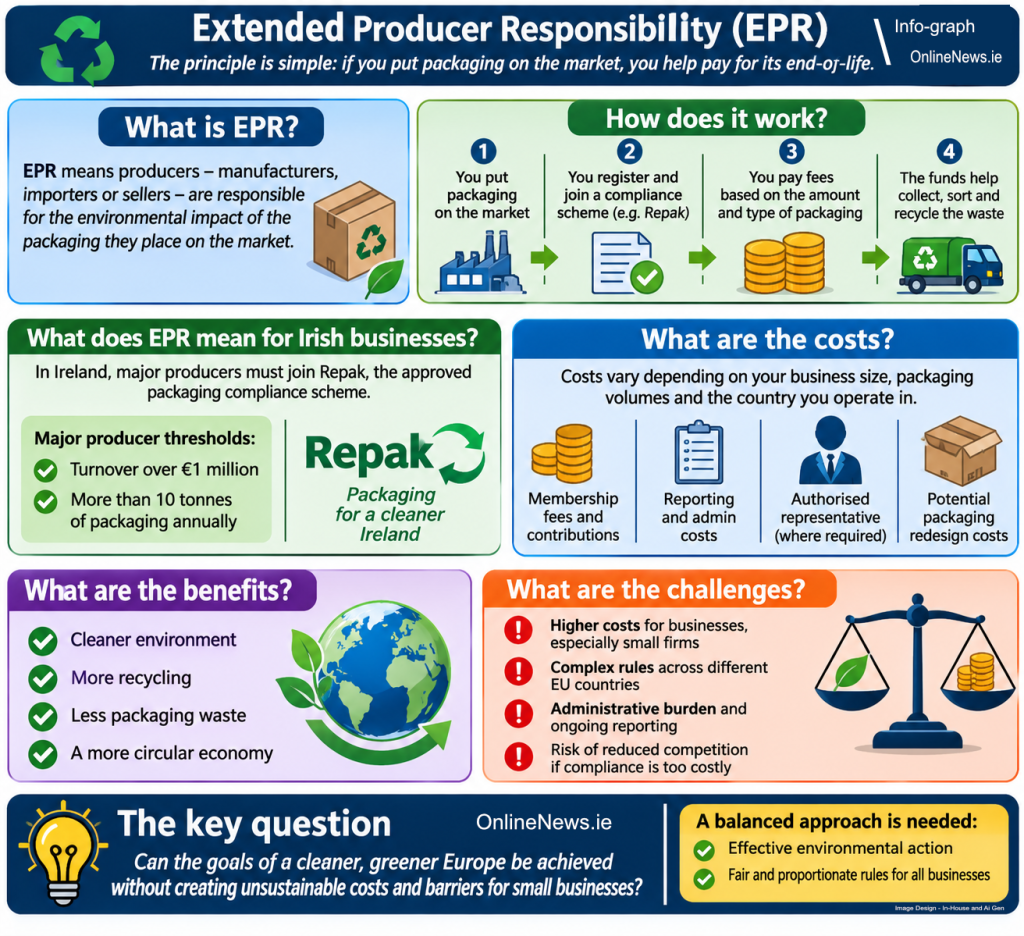
The whole issue in plain English
A small business owner wants to make and sell products.
Instead, they may have to spend time:
- Counting and weighing packaging.
- Understanding different national rules.
- Registering in different countries.
- Completing paperwork.
- Paying recycling and compliance fees.
- Keeping up with changing legislation.
What about the cost?
A small business could potentially face:
| Expense | What it covers |
|---|---|
| Registration | National producer registration |
| Recycling contributions | Cost of managing packaging waste |
| Representatives | Local authorised representatives where required |
| Administration | Preparing reports and records |
| Packaging changes | Altering materials or designs to meet requirements |
There is no single EU annual charge. Costs vary by country and packaging volume.
My question would be: how much time and money should a small business have to spend on administration before it can simply get on with making and selling its products?
You may benefit from special conditions
Member States and Producer Responsibility Organisations (PROs) must ensure that producers who only make small amounts of packaging available in their Member State do not face disproportionate burdens.
And that is the real question: Are we creating a more sustainable economy, or are we creating a regulatory system that smaller businesses simply cannot afford to operate within?
We were led to believe many things when Ireland joined the EU. We were promised greater opportunities, free trade, less bureaucracy and a level playing field for businesses.
Large corporations have compliance departments, legal teams and financial resources to absorb additional costs. Small independent businesses do not. When compliance costs are disproportionate to turnover and profit margins, the result is predictable: smaller businesses withdraw from markets, stop trading or close altogether.
Complete EU Bureaucratic Madness
Consider a small online business selling handmade products or specialist goods. A customer in another EU country places an order. The seller may then face registration requirements, packaging declarations, material-weight reporting, national compliance fees and, depending on the circumstances, the appointment of an authorised representative in every state, multiply this across 27 Member States and the administrative burden can become enormous.
For a multinational corporation, these requirements may be absorbed by dedicated legal, environmental and compliance departments. For a micro-business run by one or two people, they can become an insurmountable financial and administrative obstacle. In some cases, the cost of complying with the rules can exceed the profit made from the sale itself.
Who designed a system in which selling a small parcel to a customer in another EU country can potentially require navigating a maze of separate national compliance arrangements?
The question is not whether businesses should contribute to recycling and environmental protection. They should. The question is whether the regulatory machinery is proportionate, practical and compatible with the very principles on which the European Single Market was founded.
Free Trade Contradiction:
Article 26 of the Treaty on the Functioning of the European Union (TFEU) establishes the internal market, while Articles 34–36 address the free movement of goods. Article 5(4) of the Treaty on European Union establishes the principle of proportionality: EU action should not go beyond what is necessary to achieve its objectives. These principles deserve serious consideration when regulatory requirements create substantial obstacles for the smallest market participants.
Anti – Competitive
There is also a question of fair competition. Large companies can spread compliance costs across millions of transactions. Small independent sellers cannot. A system that imposes similar administrative structures on businesses of radically different sizes risks placing smaller competitors at a structural disadvantage.
The EU says it has recognised the need for simplification and certain concessions for smaller businesses. However, simplified reporting or reduced fees do not necessarily solve the underlying problem of having to navigate different national systems. A simplified bureaucratic burden is still a burden when it must be repeated across multiple countries.
Who came up with this?
The PPWR was not invented by an individual official. It emerged from the European Commission’s legislative proposal, negotiations involving the European Parliament and the Council of the European Union, and the subsequent adoption of Regulation (EU) 2025/40. National EPR implementation and compliance arrangements also involve individual Member States.
But that does not make the consequences any less worthy of scrutiny. Those responsible for designing, negotiating and implementing these rules must explain how they expect a small business to operate commercially across Europe without being overwhelmed by compliance costs and administrative complexity.
What needs to change?
Make the system workable.
Small businesses need a genuine EU-wide registration mechanism, one simplified annual declaration, a centralised payment system, proportionate fees based on actual packaging placed on each market, and meaningful exemptions for micro-enterprises below reasonable thresholds. They should not have to navigate 27 separate administrative systems simply to serve customers across the European Single Market.
The EU cannot simultaneously encourage entrepreneurship, digital commerce, cross-border trade and competition while creating regulatory structures that make those activities economically unviable for the smallest businesses.
A Single Market should open doors, not create 27 new administrative obstacles.
Environmental sustainability and small-business survival are not opposing objectives. Good regulation should make it possible to achieve both. If the cost of complying with the rules effectively excludes small businesses from cross-border trade, then the system needs urgent reconsideration.
The European Union must ask itself a fundamental question: are its packaging regulations helping create a sustainable Single Market, or are they unintentionally turning that market into a privilege that only larger businesses can afford?
The requirement has not yet been suspended.
One important legal update: the Commission has already acknowledged the problem. On 10 December 2025 it proposed suspending the authorised-representative requirement for EU-established businesses until 2035. On 21 October 2026 the Council agreed its negotiating position on that proposal. The requirement has not yet been suspended. This makes the argument particularly compelling: the regulatory burden has been recognised by the very institutions responsible for the legislation.
- Who is responsible? The European Commission proposed the PPWR; the European Parliament and Council negotiated and adopted it. National authorities administer their own EPR systems.
- The 10-tonne threshold: This is not a blanket exemption from packaging EPR. Article 44(8) provides for simplified information requirements for certain producers below that threshold. EUR-Lex
- The 27-country problem: The Commission itself confirms that national EPR systems remain the responsibility of individual Member States, despite the new EU regulation. RedmapL3
Official references for publication are:
- Regulation (EU) 2025/40 – the full PPWR legislation.
- European Commission proposal COM(2025) 982 – suspension of authorised representative obligations.
- Council announcement, 21 October 2026.
- European Commission’s response on micro-enterprises and the PPWR, 6 October 2026.
- Article 5 TEU – proportionality principle.
_____________________________________
Disclaimer: This article is intended for general information and discussion purposes only. It is not legal, financial or regulatory advice. Packaging obligations and costs may vary depending on the nature, size and location of the business. Readers should verify the applicable requirements with the relevant authorities or professional advisers.