Ireland’s Triple Lock: proposed changes and calls for a referendum
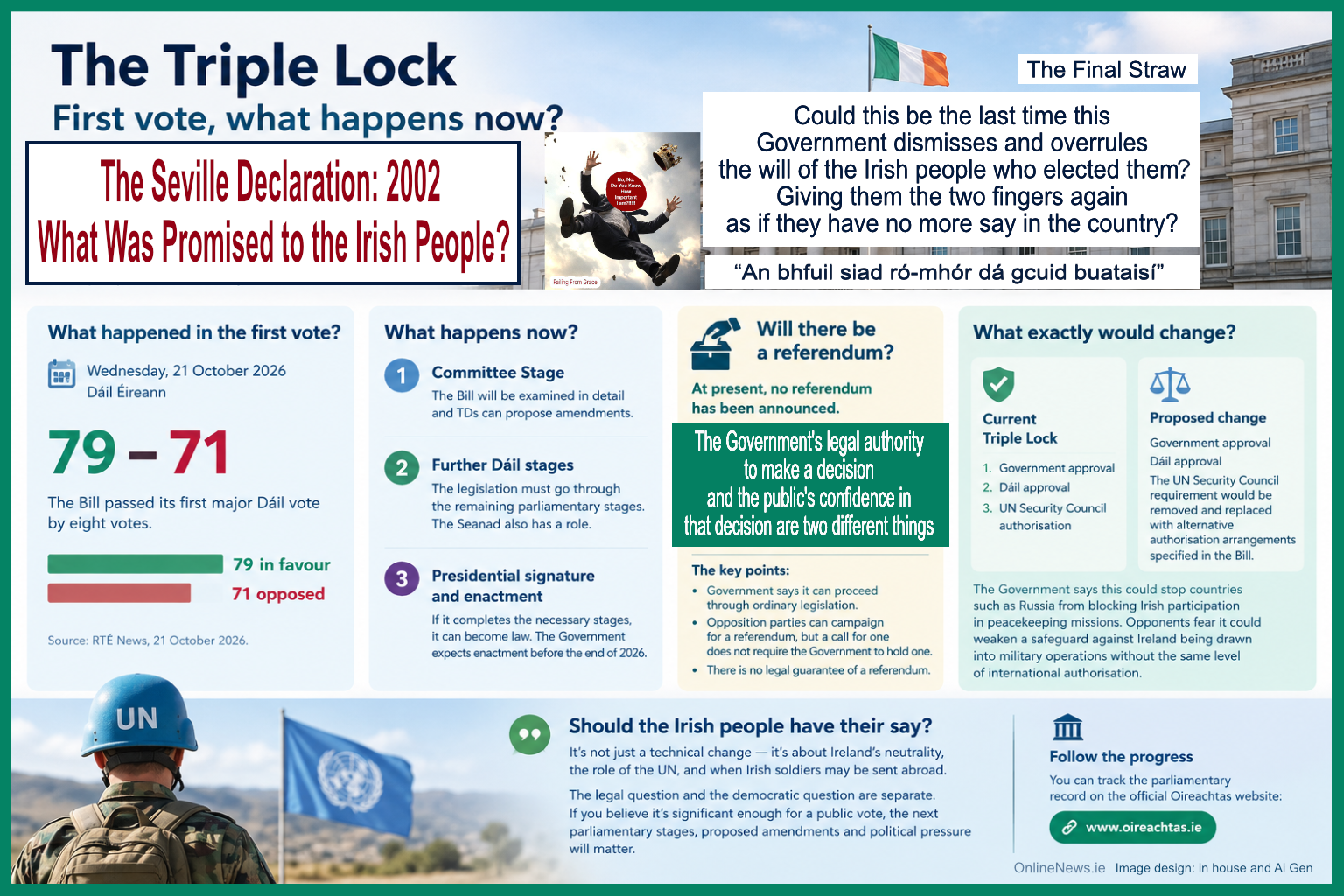
Ireland’s Triple Lock is a legal mechanism governing the deployment of more than 12 members of the Defence Forces overseas. Under the current system, three conditions must be met: approval by the Government, approval by Dáil Éireann and a mandate from the United Nations Security Council.
The Government, led by Taoiseach Micheál Martin, is seeking to remove the requirement for a UN Security Council mandate through the Defence (Amendment) Bill 2026. It argues that the Security Council’s political deadlock can prevent Ireland from participating in international peacekeeping missions, even when Ireland wishes to contribute. The Government says that changing the law would preserve Ireland’s ability to participate in peacekeeping while maintaining its policy of military neutrality. [Source: RTÉ, 21 October 2026.]
Opposition parties have strongly criticised the proposal, arguing that removing the UN requirement would weaken a key safeguard protecting Ireland’s military neutrality. They warn that the change could permit Irish troops to be deployed on overseas missions without a UN Security Council mandate. They have therefore called for a referendum, giving the Irish people a direct say in any changes that could affect the country’s neutrality.
The referendum proposal is separate from the Government’s legislation. Ireland’s military neutrality is not currently constitutionally defined by the Triple Lock itself, which is a statutory mechanism. Therefore, the Government argues that removing the Triple Lock does not legally require a constitutional referendum.
On 21 October 2026, the Bill passed its first major Dáil vote by 79 votes to 71. It is now expected to undergo further parliamentary scrutiny, including committee stage, before proceeding through the remaining legislative stages. The debate over the Triple Lock raises two central questions: how Ireland can continue contributing to international peacekeeping, and what safeguards should govern decisions to deploy Irish troops overseas.
The final outcome will depend on the Bill’s progress through the Oireachtas and whether any amendments are accepted. A separate referendum would require its own formal process and has not been scheduled.
The Seville Declaration: 2002 – What Was Promised to the Irish People?
The Seville Declaration of June 2002 was agreed during the European Council meeting in Seville, Spain, following concerns about Irish neutrality during the debates over the Nice Treaty. It reaffirmed Ireland’s traditional policy of military neutrality and stated that Ireland would not be bound by a mutual defence commitment. Crucially, Ireland’s National Declaration also reaffirmed the three requirements for deploying Irish Defence Forces personnel on overseas operations: United Nations authorisation, agreement by the Irish Government, and approval by Dáil Éireann.
The official European Council document is also available here.
The declaration matters because these assurances were given in the context of persuading the Irish public that European integration would not undermine Ireland’s military neutrality. Today, the Government argues that the Triple Lock can be changed through ordinary legislation because it is not explicitly written into the Constitution. Critics argue that removing the requirement for United Nations authorisation weakens a key safeguard and raises serious questions about the assurances given to the public.
It make a clear commitment to a referendum on a move to common EU defence or a future treaty that would involve Ireland departing from its traditional neutrality. This leaves an important democratic question: even if the Government believes it has the legal authority to change the law, should a change to such a significant safeguard be decided by politicians alone, or should the Irish people be given the opportunity to vote?
What are the proposals for a referendum?
There are two distinct issues in the debate.
Proposal A:
Hold a referendum on Irish neutrality
Opposition politicians, including Sinn Féin leader Mary Lou McDonald, have called for the public to vote on the proposed changes. Some supporters of a referendum want Ireland’s policy of military neutrality to receive explicit constitutional protection. This would require a separately drafted constitutional amendment, rather than simply voting on the Government’s ordinary legislation.
Irish Examiner
Proposal B:
Change the Triple Lock through legislation
The Government proposes removing the requirement for a UN Security Council mandate while retaining approval by the Government and the Dáil, alongside the Bill’s other legal conditions. It argues that this is a change to the law, not a change to the Constitution, so a referendum is not required.
Important: As of 22 October 2026, a referendum has been proposed politically, but no referendum date has been announced. The proposal has not itself triggered a referendum process.
What happens next? All the stages explained
There are two possible routes to follow: the progress of the Triple Lock Bill, and the separate process that would be needed to hold a constitutional referendum.
Route 1 — The Triple Lock legislation
1
Second Stage — completed
Passed 21 October 2026
TDs debated the general principles of the Bill and voted 79 in favour and 71 against. This allows the Bill to proceed; it does not mean that it has become law.
2
Committee Stage — next major step
TDs examine the Bill in detail, section by section. They can propose amendments, including changes to the safeguards surrounding overseas deployments. The Government and Opposition will have an opportunity to argue for their respective positions.
3
Report Stage
The Dáil considers the Bill again after committee scrutiny. Further amendments may be proposed and voted on, subject to parliamentary rules.
4
Final Stage in the Dáil
TDs consider the Bill in its final form and vote on whether it should pass the Dáil. If it passes, it moves to the Seanad, the Irish Senate.
5
Seanad Éireann
Senators examine the Bill and may propose amendments. If the Seanad changes it, the Dáil may need to consider those changes. The two Houses must complete the required legislative process.
6
President signs the Bill
Once the constitutional legislative requirements are satisfied, the President signs the Bill into law. Its provisions then take effect according to the commencement arrangements set out in the legislation.
The Government has indicated that it hopes to enact the legislation before the end of 2026. That is a target, not a guaranteed completion date.
Route 2 — If a referendum is pursued
A referendum would follow a separate constitutional process. The stages would be:
These are the established constitutional referendum procedures described by Ireland’s Electoral Commission.
- A formal proposal is developed. The Government or a participating group of legislators would need to settle the proposed constitutional wording and the scope of the change.
- A Constitutional Amendment Bill is introduced in the Dáil. It must set out the proposed change to the Constitution. A political call for a referendum is not enough on its own.
- Both Houses consider the Bill. The Dáil and Seanad must pass the constitutional amendment legislation before the referendum can be held.
- A polling date is set. The relevant Minister makes an order specifying the referendum date once the legislative requirements have been met.
- The public receives official information and votes. The Electoral Commission provides impartial information about the proposal. Eligible voters decide whether to approve the constitutional amendment.
- The result is finalised. If a majority votes in favour, and no petition challenging the result is presented to the High Court within seven days of publication, the President signs the Bill and the Constitution is amended. If a majority votes against, the proposed constitutional change does not proceed.
What should be watched for now?
The immediate milestones are:
Committee Stage: whether amendments or additional safeguards are accepted.
Further Dáil votes: whether the Bill retains sufficient support to proceed.
Seanad scrutiny: whether Senators seek changes to the legislation.
Referendum developments: whether a formal constitutional amendment proposal is introduced, rather than the issue remaining a political demand.
Final enactment: whether the Bill becomes law before the Government’s stated end-of-year target.
The key distinction now following the vote is that the Triple Lock Bill can continue through Parliament without a referendum, whereas a constitutional change protecting neutrality would require the separate referendum process.
The referendum proposal
On 7 October 2026, Seanad Éireann debated a motion calling for a referendum on Irish neutrality and protection of the Triple Lock.
The motion was amended and carried.
Referendum on Irish Neutrality and Protection of the Triple Lock:
Motion Carried
Seanad Éireann – 07 October 2026
Tá (29 votes cast)
Níl (16 votes cast)
https://www.oireachtas.ie/en/debates/vote/seanad/27/2026-10-07/1
Disclaimer:
This article is intended for general information purposes only and reflects information available as of 22 October 2026. Every effort has been made to ensure accuracy, but details concerning legislation, parliamentary proceedings, political proposals and referendum arrangements may change. Some developments described may remain subject to confirmation or further decisions by the Government or the Oireachtas. Readers are encouraged to consult official sources, including the Oireachtas, the Irish Government and the Electoral Commission, to verify the latest information. This article should not be treated as legal advice or as an official statement of government policy.