Democratically Elected EU Government
The EU’s Official Self-Image as a Champion of Democracy.
Where is the democracy?
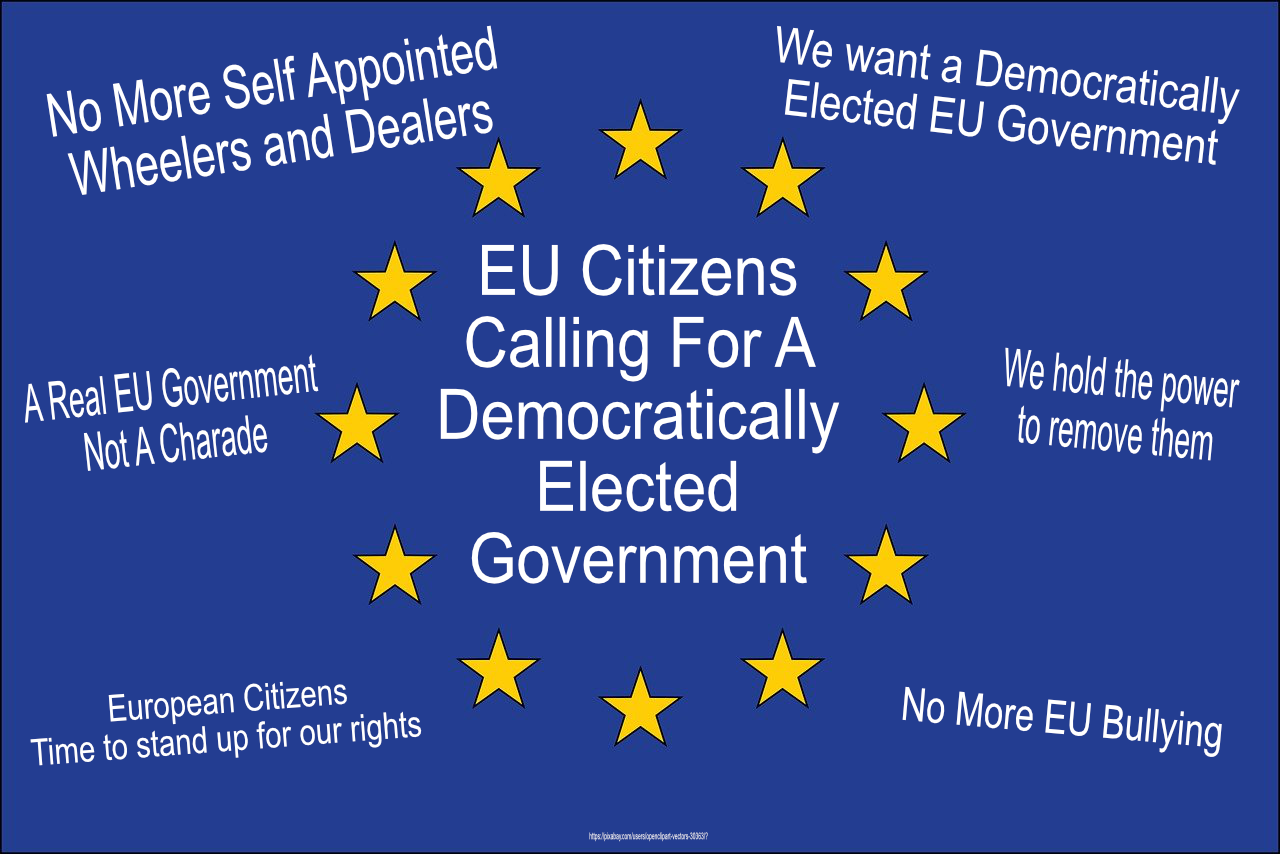
It is non stop at loggerheads with member states. Conversely the Commission holds a near-monopoly on legislative initiative and significant enforcement powers. Yet it’s not directly elected. It is not structured like a national parliamentary democracy. Moreover, EU Citizens all over Europe are now calling for a full Democratically Elected EU Government – No more unelected executive dominance. In fact, EU Citizens are Calling For A Full Democratically Elected Government – No more unelected executive dominance is becoming a central demand across member states.
Treated as Second Order – Even Lower Than National Ones
The European Parliament, while elected, cannot fully initiate laws (unlike national parliaments)- No more unelected executive dominance – this flaw undermines true democracy. Furthermore, the movement of EU Citizens are Calling For A Full Democratically Elected Government – This is gaining momentum as a response to these institutional shortcomings.
Respect, Freedom, Democracy, Equality, Rule of Law
The European Union is officially founded on a set of core values, prominently including democracy, as enshrined in Article 2 of the Treaty on European Union (TEU). According to the EU’s official sources, these foundational values are:
- Respect for human dignity
- Freedom
- Democracy
- Equality
- The rule of law
- Respect for human rights, including the rights of persons belonging to minorities
These values are described as common to the Member States in a society in which pluralism, non-discrimination, tolerance, justice, solidarity, and equality prevail. Specifically on democracy, the EU emphasizes that its functioning is founded on representative democracy. Except there is actually no democracy as the people trying to enforce these laws are not elected themselves. Clearly, EU Citizens want these values strengthened by empowering elected representatives rather than unelected officials.
Internal erosion and citizen disillusionment
You only have to look around our EU countries now to see the destruction this double standards: of prioritizing migration control, economic interests, or geopolitical alliances over consistent human rights advocacy, undermining credibility.
The EU is waving around in the wind from pillar to post trying to assert dominance, with no trust. This usually ends up very bad and could certainly lead to confrontation and even internal EU conflict. These are symptoms of structural EU failure.
No one likes a bully or being bullied.
The EU’s Structure Remains Fundamentally Undemocratic in Key Ways
Persistent ambivalence toward full democratization: The EU claims to be founded on democracy. Given these challenges, EU Citizens Calling For A Full Democratically Elected Government – No more unelected executive dominance is a necessary step for true reform.
Structural flaws that mimic but don’t deliver real democracy:
- The Commission retains monopoly on legislative initiative—unelected technocrats drive policy, not a directly accountable body.
- The Parliament, while elected, lacks full initiation powers and often functions as a secondary chamber; turnout remains mediocre, and elections are “second-order” (national issues dominate).
- Power concentrates in intergovernmental bodies (Council/European Council), where national leaders negotiate behind closed doors with limited direct citizen input.
- No unified European “demos”—fragmented public mean representation feels distant, fueling low trust and populism.
Ultimately, the EU is a union where states voluntarily limit their sovereignty for collective gains, which is really very dangerous—but the undemocratic tilt means smaller members like Ireland often experience this as delegation without equivalent democratic return. The structure protects shared values in theory. However, in practice, it perpetuates a system where true democratic control feels diluted or outsourced.
The time has come to change this system for good, we are just fed up with this charade of bullying.
Calling all EU Citizens to now stand against this unelected executive dominance.
The real question here is: Why do the 720 directly EU elected Members of the European Parliament (MEPs) from the 27 EU countries permit heads of state or government—who are elected at the national level—to take major EU-level decisions, rather than reserving those powers for the EU’s directly elected body? Isn’t his what people all over Europe voted for.
If they are not doing this they have no real purpose and should resign.
Key Takeaways
- The EU’s structure lacks a fully democratically elected government, causing frustration among EU Citizens.
- While the European Parliament is elected, it cannot initiate laws, undermining true democracy.
- The EU promotes core values of democracy, yet its unelected officials drive policy, leading to disillusionment.
- Calls grow for a fully democratically elected EU government to balance power and enhance citizen representation.
- The time has come for EU Citizens to oppose unelected executive dominance and demand real democratic reforms.
- If elected EU MEP’s are not willing to do what they were elected for they have no real purpose and should resign.