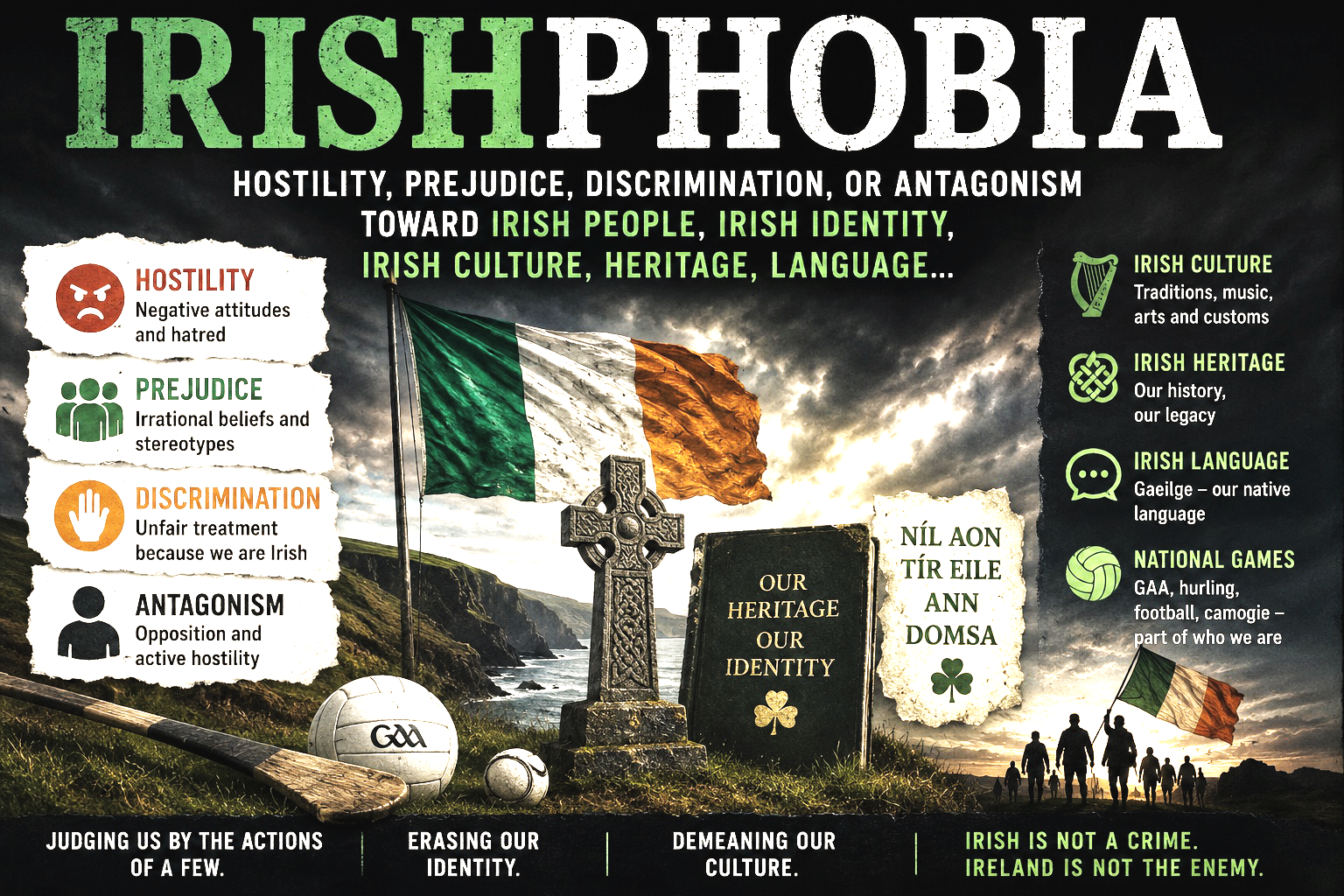
“IrishPhobia” prejudice, hostility, discrimination, and antagonism directed at Irish people, Ireland, and Irish identity has become an increasingly serious issue in modern Ireland.
What was once occasional stereotyping or dismissive commentary has evolved into a sustained pattern of hostility toward Irish culture, heritage, traditions, language, national identity, games, schools and workplace.
Over the last four years, we have witnessed an unprecedented campaign of criticism, vilification, and collective blame. Irish citizens have frequently found themselves labelled, stereotyped, and judged not as individuals, but as representatives of an entire people.
Accusations that would be challenged if directed at other national or cultural groups are often made about the Irish with little objection.
IrishPhobia commentary has become a very useful political tool.
Harsh accusations, sweeping generalisations, and inflammatory labels are deployed to score political points, silence opposition, and cultivate support among activist networks, NGOs, and other interest groups.
Rather than fostering unity, this approach has deepened division and resentment. Many Irish people feel they have been cast as convenient scapegoats in debates where complex problems are reduced to simplistic narratives and collective blame.
For those who experience it, IrishPhobia is not an abstract concept. It is the experience of seeing Irish identity continually questioned, Irish culture belittled, Irish concerns dismissed, and Irish people portrayed in ways that would be considered unacceptable if directed at many other communities.
A society that genuinely opposes prejudice must be prepared to confront IrishPhobia with the same determination and consistency that it applies to every other form of discrimination.
IrishPhobia is every bit as hurtful as racism, xenophobia, antisemitism, or Islamophobia.
Behaviors include these categories but are not limited to:
- Anti-Irish prejudice – negative stereotypes, hostility, or bias against Irish people.
- Anti-Irish discrimination: – refusing to house, or provide services to someone because they are Irish.
- Emploment Discrimination – refusing to hire – Government – creating unfair competition in the workplace – issuing too many work visa’s for foreign workers.
- Cultural prejudice – contempt for Irish language, traditions, sports, music, heritage, or customs.
Examples would include:
- Prioritising – Non Irish
- Refusing employment solely because someone is Irish.
- Refusing housing because a person is Irish.
- Refusing school places because a person is Irish.
- Mocking or attempting to suppress the use of the Irish language.
- Expressing hatred toward Irish culture, history, or traditions such as Gaelic games.
- Using negative stereotypes about Irish people as a group.
- Allowing unregulated immigration to put unprecedented pressure on villages, towns, and cities, making it increasingly difficult to preserve the character, traditions, and cultural identity of local communities.”
A person displaying IrishPhobia may also express:
Negative attitudes toward Irish identity, make derogatory remarks about Irish people, oppose the recognition or preservation of Irish culture, or treat Irish individuals unfairly because of their Irish background.
Place adds online or print to specifically exclude Irish people from applying.
It may also appear in personal interactions, workplaces, institutions, public discourse, or other social settings.
Imposing ideological agendas upon Irish society without meaningful public consent, often disregarding Ireland’s cultural traditions, national identity, and the concerns of ordinary citizens.
Unfamiliar ideologies imposed upon us.
“Foreign ideological doctrines imposed without public consent.”
“Social and political ideologies introduced with little regard for Irish traditions, values, or public opinion.”
“A succession of ideological agendas that many Irish people neither sought nor endorsed.”
“Doctrines and belief systems that have been promoted at the expense of Ireland’s cultural identity and traditions.”
Every Irish person has the fundamental right to live in peace, security, and dignity within their own country.
These principles are reflected in international human rights instruments, including the Universal Declaration of Human Rights and the European Convention on Human Rights, which recognise the rights of individuals and communities to enjoy their culture, express their identity, and participate fully in the life of their nation without fear of discrimination, hostility, or exclusion.
Irish people are entitled to the same protections.
The right to cherish Irish heritage, celebrate Irish traditions, speak the Irish language, support Irish national institutions, and express Irish identity should never be treated as controversial or suspect.
A healthy democracy respects the identity, culture, and legitimate concerns of its own people while extending respect to others, but in no way having to extend priority to be exclusive of Irish people.
We have a legitimate and fundamental right to preserve our culture, protect our national identity, and remain the primary stakeholders in the future of our own country without being subjected to prejudice, hostility, or discrimination for doing so.
The pursuit of social harmony must never come at the expense of the rights, dignity, or cultural inheritance of the Irish people in their own homeland.
IrishPhobia: prejudice, hostility, discrimination, or antagonism directed towards Irish people, Irish identity, and Irish culture—must be recognised, challenged, and ultimately eradicated wherever it occurs.
No society can claim to uphold equality while tolerating the stereotyping, ideologies, collective blaming, or demeaning of one section of its population. If Irish people are to enjoy the full protection of their human rights, then anti-Irish prejudice must be addressed with the same seriousness, consistency, and determination applied to every other form of discrimination.
Respect for Irish identity is not a privilege to be granted or withheld; it is a fundamental right that warrants full recognition and protection in a democratic society governed by fairness, equality, and mutual respect.
Don’t forget when you get a knock on your door again.
Evaluate elected officials based on their record in office. Past statements, actions, voting records, and public positions when they seek re-election.
“IrishPhobia”
“Being IrishPhobic”
No Longer Accepted.