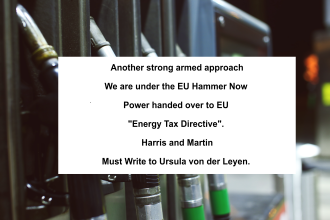
Video By: onlinenews.ie: Fuel Protest at Shannon Vale, Roundabout, Ringaskiddy / Carrigaline, Co. Cork, 8th / 04 / 2026
I am hearing years of frustration now flowing out onto the streets.
Accumulated anger over how Irish people, particularly in rural areas, farming, and small transport businesses and communities, have been ignored and mistreated by money squandering politicians in Ireland for years.
Issues include:
- Repeated tax hikes on fuel and energy
- Policies seen as out of touch with the realities of making a living in Ireland
- A sense that governments (across coalitions) have failed to protect working and middle-income families from rising costs while continuing high levels of public expenditure
Protesters argue they have tried quieter channels before, but feel ignored until they take direct action that forces attention.
Signs like “Can’t Afford to Move” capture the raw reality: many say they are not out to cause chaos for its own sake, but because staying silent means businesses closing, jobs lost, and families unable to heat homes or get to work.
The government has criticised the disruption as “wrong” and not in the national interest, pointing to a recent €250 million package of temporary excise cuts and rebates. However, many on the ground view this as insufficient given the scale of the problem and the broader pattern of spending choices.
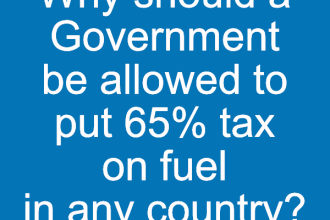
Protesters argue that while fuel prices (diesel over €2 per litre) make it hard for them to operate trucks, tractors, or heat homes, the state continues to extract high taxes from them.
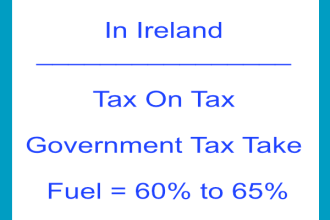
Record fuel tax takes reached €4.3 billion last year, including a carbon tax haul of €1.17 billion — an 80% rise in just five years. Yet the government plans another carbon tax hike in May 2026, adding roughly 2c per litre to fuels.
The “Can’t Afford to Move” fuel protests have highlighted a deep and growing sense among many Irish people that the government consistently puts the needs of others — foreign countries, international commitments, climate agendas, and various domestic spending priorities — ahead of ordinary Irish workers, farmers, hauliers, families, and rural communities.
Many see this as part of a broader pattern of years of frustration: governments (across coalitions) appear to prioritise everyone and every cause with the Irish taxpayer footing the bill.
Protesters and critics ask why hundreds of millions flow abroad when Irish hauliers say they can’t afford to fill their tanks, farmers face squeezed margins, and households struggle with heating oil. Similar aid goes to other regions, it is just insane squandering of money, while the overall Official Development Assistance (ODA) – Irish Aid – budget hits record levels around €840–866 million for 2026. This money is needed here in Ireland.
- Domestic spending and waste: With Ireland running budget surpluses in recent years (projected €5–10 billion range), many feel the money should first relieve pressures on Irish people rather than fund large bureaucracy, major projects, or policies seen as out of touch.
Issues like housing shortages, health waiting lists, and rural decline add to the resentment — the view that Irish citizens, who built the economy through hard work in farming, transport, and small business, come last.
Carbon tax and green policies:
Protestors view the carbon tax as a punitive levy that hits working people and essential industries hardest, while delivering little immediate benefit to Ireland’s own energy security or affordability. Temporary excise cuts (€250 million package, with 15–20 cent reductions until May) are dismissed as too little, too late, especially when global price spikes compound the tax burden.
The sentiment boils down to this: Irish people have endured years of rising costs, policy decisions favouring net-zero targets and international standing, and a sense that their taxes fund priorities elsewhere.
Hauliers and farmers say businesses are at risk of closing, jobs are threatened, and families are squeezed — all while the state appears to have endless funds available for aid to Ukraine and beyond.
Micheál Martin appears to live in a bubble where he believes the concerns of ordinary Irish people no longer matter.
He is now being sharply reminded that Irish people are still here, they are fed up, and they will remain long after he and his government have left office.
Perhaps it’s time for him and those who show such disregard for their own citizens to step aside and let others put Ireland and its people first.
The carbon tax has become a major earner for the government:
What is the Carbon Tax?
The carbon tax is a government levy charged on fuels based on how much carbon dioxide (CO₂) they emit when burned. It applies to petrol, diesel (including agri/green diesel), home heating oil, natural gas, coal, peat, and other fossil fuels. The goal is to make polluting fuels more expensive, encouraging people and businesses to use less or switch to lower-carbon alternatives. It is separate from regular excise duty and VAT, but it adds directly to the price you pay at the pump or for a heating oil delivery.
- In 2025, it generated a record €1.17 billion — an 80% increase compared to five years earlier.
- Total fuel taxes (carbon tax + excise duties) hit a record €4.3 billion in 2025.
The Planned Increases (the “trajectory”)The increases are legally mandated under the Finance Act 2020. The government committed to raising the tax gradually from a low base up to €100 per tonne of CO₂ by 2030. Here is the recent history and current path:
- 2020: Started at €26 per tonne (for most non-motor fuels).
- 2021–2024: Steady annual rises (e.g. €33.50 → €41 → €48.50 → €56 per tonne).
- 2025: Reached €63.50 per tonne.
- October 2025 (Budget 2026): Increased to €71 per tonne for petrol and diesel (motor fuels) immediately. This added roughly 2–2.5 cents per litre at the pumps.
- 1 May 2026 (upcoming): The same rise to €71 per tonne applies to all other fuels, home heating oil (kerosene), marked gas oil (agri diesel), natural gas, solid fuels, etc. This is expected to add about 1.9–2.1 cents per litre (including VAT) to heating oil.
After May 2026, further annual increases are scheduled to keep heading toward €100/tonne by 2030 (roughly another 6–7 cents per litre over the remaining years, depending on the fuel).Impact on prices (approximate, excluding VAT)
- Petrol/Diesel: The October 2025 rise added ~2.5c/litre. The carbon component alone is now contributing significantly to the total tax take on fuel (often 15–19c/litre or more depending on the exact calculation).
- Home Heating Oil: The May 1, 2026 increase will add ~2c/litre (plus VAT).
- For a typical 60-litre car fill-up or a 500-litre home heating delivery, this adds noticeable extra cost on top of already high global oil prices and other taxes.
These numbers have been widely quoted during the current fuel protests by Tóibín, Aontú, and many protesters.
The government has not disputed the raw numbers ( from the Department of Finance)
Check out this article: