
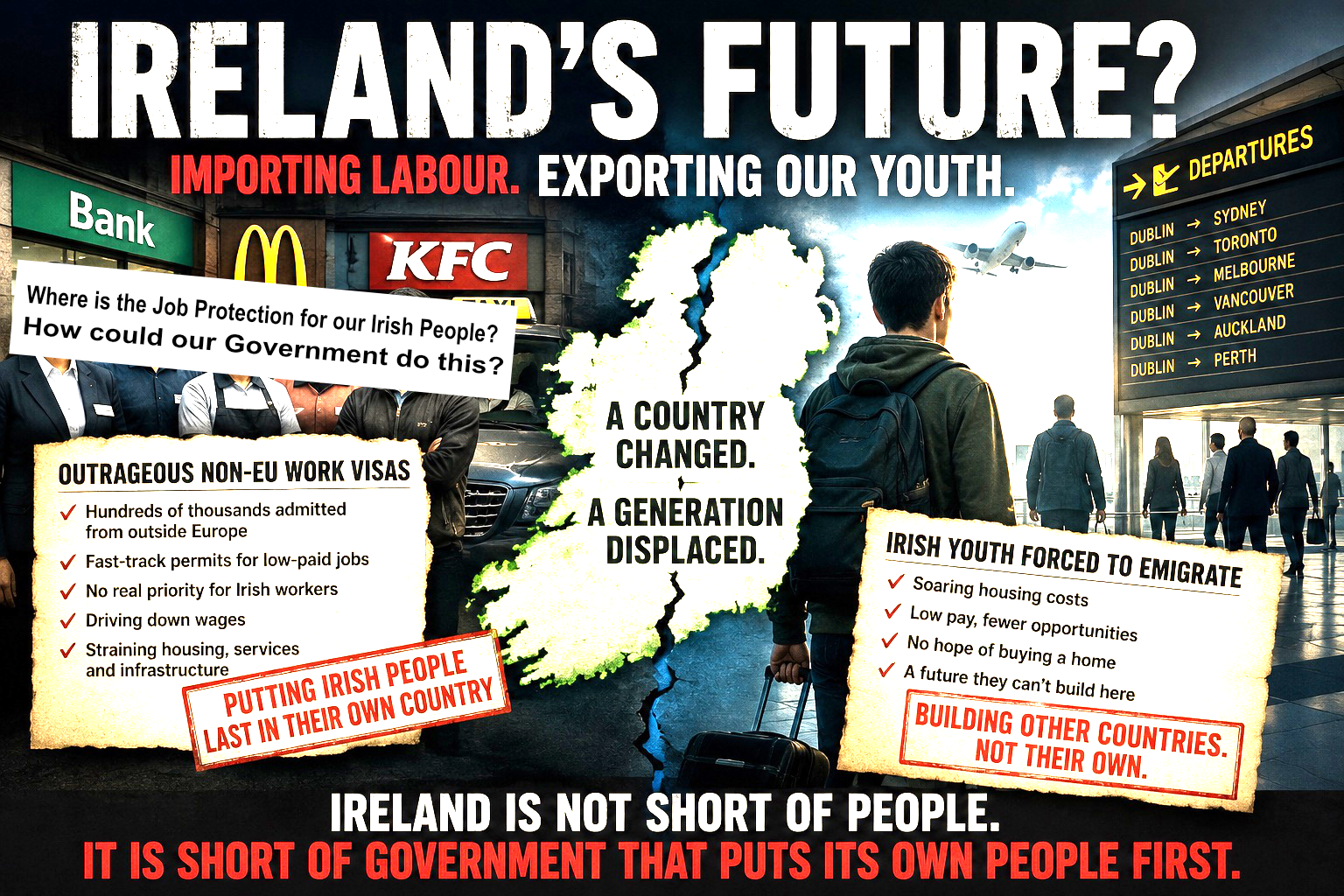
Step into almost any Irish bank, fast-food restaurant, taxi, hospital, nursing home, or care facility today, and you are increasingly likely to be served by someone born outside Ireland, often from outside the EU.
I walked into a restaurant yesterday and realised that the four people inside the counter were not Irish. This is now common place, it should not be allowed on moral grounds, if nothing else.
Why do Irish people open businesses in Ireland only to fill them up with foreign workers, are they that hard up for money. Do they have any love for our people and our country? In my opinion, It is disgusting and demeaning to our Irish people.
There is a profound sense of loss in seeing Irish workers become increasingly absent from everyday workplaces.
A government that cannot protect the interests of its own workforce has failed in its primary duty. If young Irish people are being priced out of housing, struggling to compete for jobs, and increasingly forced to emigrate to build a future, then something has gone profoundly wrong.
They were employed by the Irish people when they were elected and took on that job to protect our country, our people, our job security, livelihoods.
This transformation in Ireland has happened with remarkable speed. What was once uncommon has become an everyday reality, driven by government policies that have overseen record levels of immigration, emigration and a significant expansion of work permits for non-EU nationals.
Many believe that the continued erosion of opportunities for the Irish workforce, coupled with rising emigration, housing pressures, and declining prospects for young people, raises serious questions about whether elected officials have fulfilled their duty to act in the public interest.
Unfair competition in the jobs and housing market.
Irish people emigrated for generations to countries with mostly vast populations and territories capable of absorbing relatively small numbers of newcomers. Ireland, by contrast, is a small nation of just over five million people. When significant migration comes from countries with populations exceeding 1.5 billion, even a small proportion can have a substantial impact on a country of Ireland’s size, culture and demographics.
When population growth outpaces housing, infrastructure, public services, and job creation, the consequences are felt most acutely by ordinary Irish citizens.
They point to rising housing costs, increased competition for accommodation, and growing pressure on public services. These pressures are contributing to a new wave of emigration, as young Irish people increasingly feel compelled to leave the country in search of affordable housing and better opportunities abroad.
Rapid demographic change and accelerated cultural transformation
The past four years of sustained, large-scale immigration have placed unprecedented strains on Ireland’s infrastructure, workforce, communities, and cultural identity, the country is now buckling at the seams.
Disastrous immigration policies have created a system in which employers can recruit labour from abroad while many young Irish people feel compelled to leave the country.
Non-EU Work Permits – Forced Emigration
The escalating scale of Non-EU work permits is becoming a matter of growing public concern, yet there appears to be remarkably little political debate about where limits, safeguards, or oversight should lie. This has led some citizens to question whether vested interests are influencing the discussion, particularly given the extent to which property ownership and landlord interests are represented within political circles.
Are EU trade and labour agreements exerting unprecedented pressure on Ireland, and, unless subjected to greater scrutiny and national oversight, have the potential to cause lasting damage to our country’s economic, social, and cultural foundations?
Ireland is a small nation (5.3 million) with a relatively small workforce. Exposing it to labour market pressures from vastly larger European countries with a population of around 450 million places, Irish workers are at a seriously structural disadvantage.
Not to mind exposing us to, as an example and certainly not limited to:
India has about 1.4 billion people.
Pakistan has about 255 million people.
Nigeria has about 238 million people.
Bangladesh has about 181 million people.
Is it all political pandering for big jobs in the future in the EU, the best pupil in the class? Impressing Brussels rather than protecting the interests of the Irish people.
Pressure on housing, infrastructure, healthcare, and other public services already struggling to cope with rapid population growth. Increased supply of foreign labour weakens worker’s bargaining power and reduce incentives for employers to improve pay and conditions.
The debate is not about the character or contribution of individual immigrants. It is about whether government policy should place greater emphasis on retaining Irish workers, monitor, debate and reduce forced economic emigration, and ensuring that economic growth benefits existing citizens as well as newcomers.
For an increasing number of people, the question is simple: why is Ireland finding ways to import workers from around the world while so many of its own young Irish people believe they must leave to build a future?
Questions For Politicians
Can a business in Ireland legally employ a workforce that happens to contain no Irish employee?
Home>Government in Ireland >Irish Constitution> Fundamental rights under the Irish Constitution
“The State has a general duty to protect your right to work and earn a livelihood from unjust attack”
The State has a responsibility to protect the right of its citizens to earn a livelihood and build a future in their own country.
Would uncontrolled immigration and extreme work visa allocation equate to an unjust attack?
When we walk into businesses all over Ireland now and we observe at times, that not one Irish employee is working there, does this indicate that earning a living for Irish people is under “unjust attack“? Should Irish people be starting to challenge the legality of what is happening here now, should this situation be subjected to legal scrutiny to determine if the State is fulfilling its legal obligations to its own citizens.
While immigration and work permit policies serve legitimate purposes, they must be balanced against the interests of our Irish native domestic workforce.
If Irish citizens increasingly feel compelled to leave the country in search of opportunities that should be available at home, then serious questions arise as to whether the State is fulfilling one of its most fundamental responsibilities to its people.
Displacement of Irish workers
I believe we are approaching a significant shift in public attitudes. Many Irish people I have spoken to feel that the interests of Irish workers have been neglected for too long, and frustration is growing rapidly. If these concerns continue to be ignored, businesses, even at the counters, and politicians should expect increasing public disapproval, organised opposition, and demands for accountability. The public’s patience is not unlimited.
The question being asked with growing anger is this: how has Ireland reached a point where businesses across the country can operate with few or no Irish workers while recruitment from abroad continues to accelerate?
Many people are struggling to understand how any government can stand by and watch this happen all over Ireland now, without intervention. The protection of Irish livelihoods, employment opportunities, and the economic future of its citizens is one of the most fundamental responsibilities of the State.
The continued erosion of Irish participation in the workforce is not merely concerning,
it is unacceptable.
Public frustration is reaching a level where growing numbers of people are openly questioning whether those responsible for these government policies remain fit for office.
Calls for ministerial accountability, including resignations at both ministerial and party leadership level, are becoming increasingly difficult to ignore.