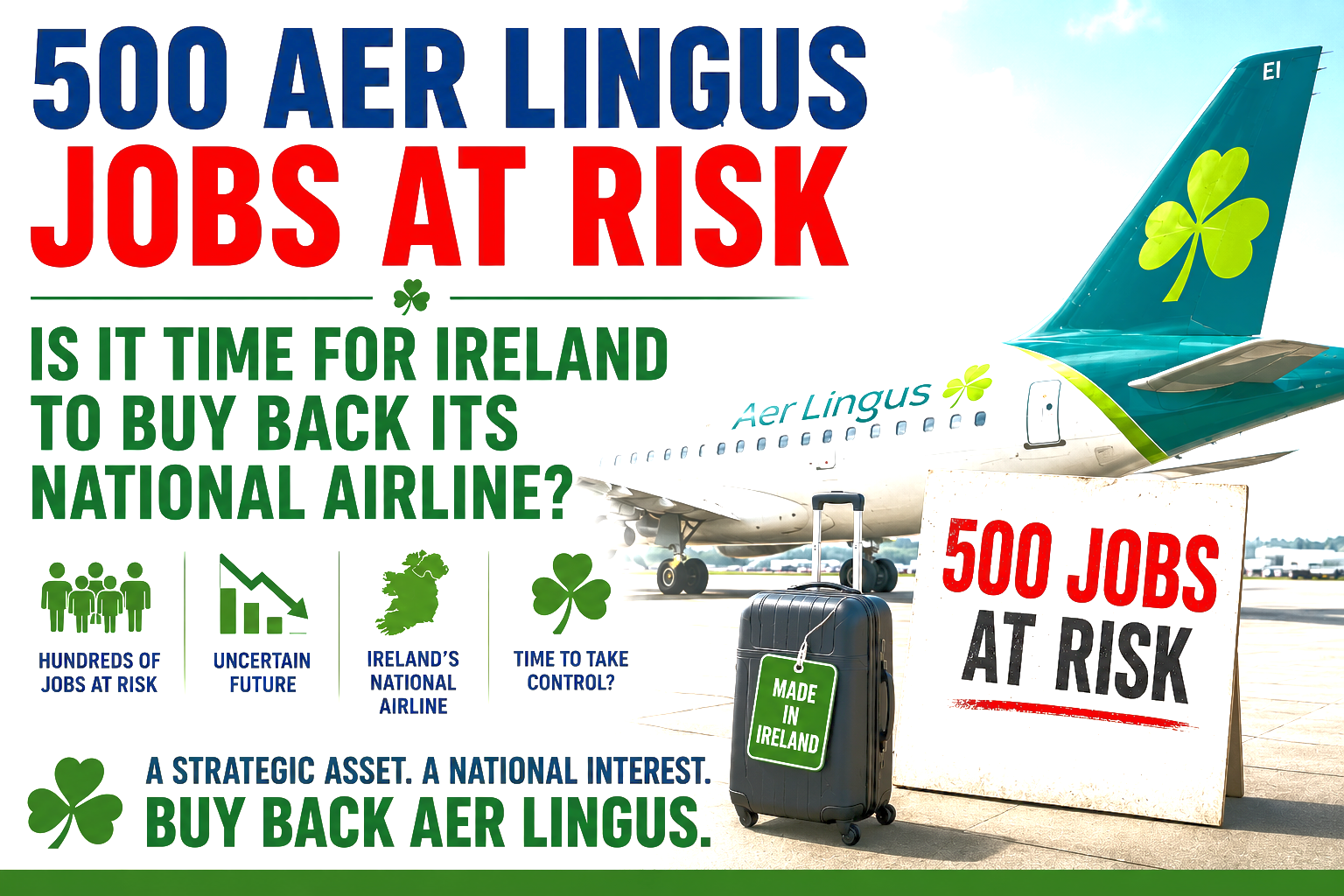
The announcement that Aer Lingus intends to cut up to 500 jobs has caused anger, disappointment and deep concern across Ireland. For many people, this is not simply a corporate restructuring exercise—it represents a serious question about the future direction of a company that has long been regarded as part of Ireland’s national identity.
Aer Lingus has stated that the proposed cuts are linked to financial pressures, including rising costs, competition and the need to restructure operations. However, many people are struggling to understand how a company of such importance can reach a position where hundreds of Irish employees and their families face such uncertainty.
There is a growing perception that the interests of shareholders and profits are being placed ahead of the people who built and supported the airline for decades.
This situation is particularly sensitive because of the controversy that surrounded the sale of Aer Lingus to International Airlines Group (IAG). At the time of the takeover, there were significant concerns raised in Ireland about the future of the airline, its national importance, and the protection of Irish jobs.
Many people argued that Aer Lingus was not simply another commercial company. It was a strategic national asset, an important part of Ireland’s connectivity with the rest of the world, and a major employer of Irish workers. There were fears that once ownership moved outside direct Irish control, decisions could increasingly be driven by international financial priorities rather than the long-term interests of Ireland.
Those concerns have now returned following the announcement of hundreds of job losses.
Many people are asking how a company of such importance can justify removing 500 Irish jobs and placing so many families under pressure. Employees are not simply figures on a balance sheet. Behind every position are people who have given years of service, developed valuable skills, and helped build the reputation of the airline.
There is also concern among workers and the public about what happens after these redundancies. While there is currently no evidence that Aer Lingus intends to replace Irish employees with workers from any particular country, many people are questioning whether cost-cutting measures could eventually lead to a workforce model increasingly focused on reducing labour costs.
These concerns deserve proper answers, not dismissal.
The Irish Government should now consider whether the time has come to examine the future ownership of Aer Lingus and whether this valuable Irish asset should ever have been sold in the first place.
For many people, the idea that Ireland could regain greater control over its national airline is not about nostalgia—it is about protecting strategic infrastructure, Irish employment and national interests. A national airline provides connectivity for businesses, tourism, communities and citizens abroad. It is a vital link between Ireland and the rest of the world.
A serious public discussion should take place about whether the State should explore options to regain ownership or a significant stake in Aer Lingus. Other countries have recognised the importance of maintaining influence over key transport assets, particularly those that have a wider economic and national role beyond simple profit calculations.
Aer Lingus and IAG should provide clear answers:
- Are these job losses genuinely required because of operational changes, or are they primarily a cost-reduction exercise?
- What guarantees exist that Irish-based jobs will be protected in the future?
- Will future recruitment prioritise the skills and experience of Irish workers?
- What is the long-term vision for Aer Lingus as an Irish employer?
A company has the right to make commercial decisions, but it also has responsibilities to the communities in which it operates. When hundreds of families face losing their livelihoods, the public deserves more than statements about efficiency and competitiveness.
The phrase “profit before people” is increasingly being used by concerned employees and members of the public who feel that large companies are forgetting their social responsibilities. Whether that criticism is fair or not, it reflects a genuine loss of trust.
Aer Lingus was built by generations of Irish workers who created the reputation and service standards the airline has enjoyed. Those employees are not merely a cost—they are the foundation of the company.
The Irish public deserves reassurance that this is not the beginning of a long-term decline in Irish employment at Aer Lingus. The company must demonstrate that it values its workforce as much as it values financial performance.
The Aer Lingus job cuts bring Ireland back to a question many have never forgotten: should Aer Lingus ever have been sold in 2015 in the first place?
At the time of the sale, many warned that Aer Lingus was not just a business but a vital national asset, supporting Irish jobs, tourism, trade and global connections.
Those responsible for the decision argued that private ownership would secure Aer Lingus’s future, but today, with 500 Irish jobs at risk, many are asking whether that decision can still be justified.
While there is no indication that closure is imminent, the concern is clear: has Ireland surrendered control of a strategic asset that should have remained under Irish ownership?
The debate is no longer only about job losses it is about whether Ireland should regain control of an airline that many believe should never have been sold.
IAG has now revealed what many feared from the beginning: that its ultimate priority is not Ireland, not Irish workers, and not the future of Aer Lingus as a national institution, but financial performance and shareholder returns above all else.
Decision to Sell
The decision to sell the State’s stake in Aer Lingus to IAG in 2015 was overseen by then Minister for Transport, Tourism and Sport Paschal Donohoe, as part of the Government led by Taoiseach Enda Kenny.
The Government approved the sale of its approximately 25.1% share in Aer Lingus, a move that was debated in the Dáil and passed by a vote of 74 TDs in favour and 51 against.
At the time, Minister Donohoe argued that accepting IAG’s offer was in the best interests of Aer Lingus, its employees, passengers, tourism and the wider Irish economy, particularly given the importance of international air connectivity for an island nation.
However, opponents of the sale warned that Ireland risked losing influence over a strategically important national asset and argued that protecting connectivity, employment and national interests should have taken priority over the financial return from selling the State’s stake.
With hundreds of Irish jobs now at risk, the decision to sell Aer Lingus has once again come under scrutiny, raising questions about whether the long-term consequences were fully considered at the time.
IAG Operating profit 2025
Where is Pascal Donohoe Now?