
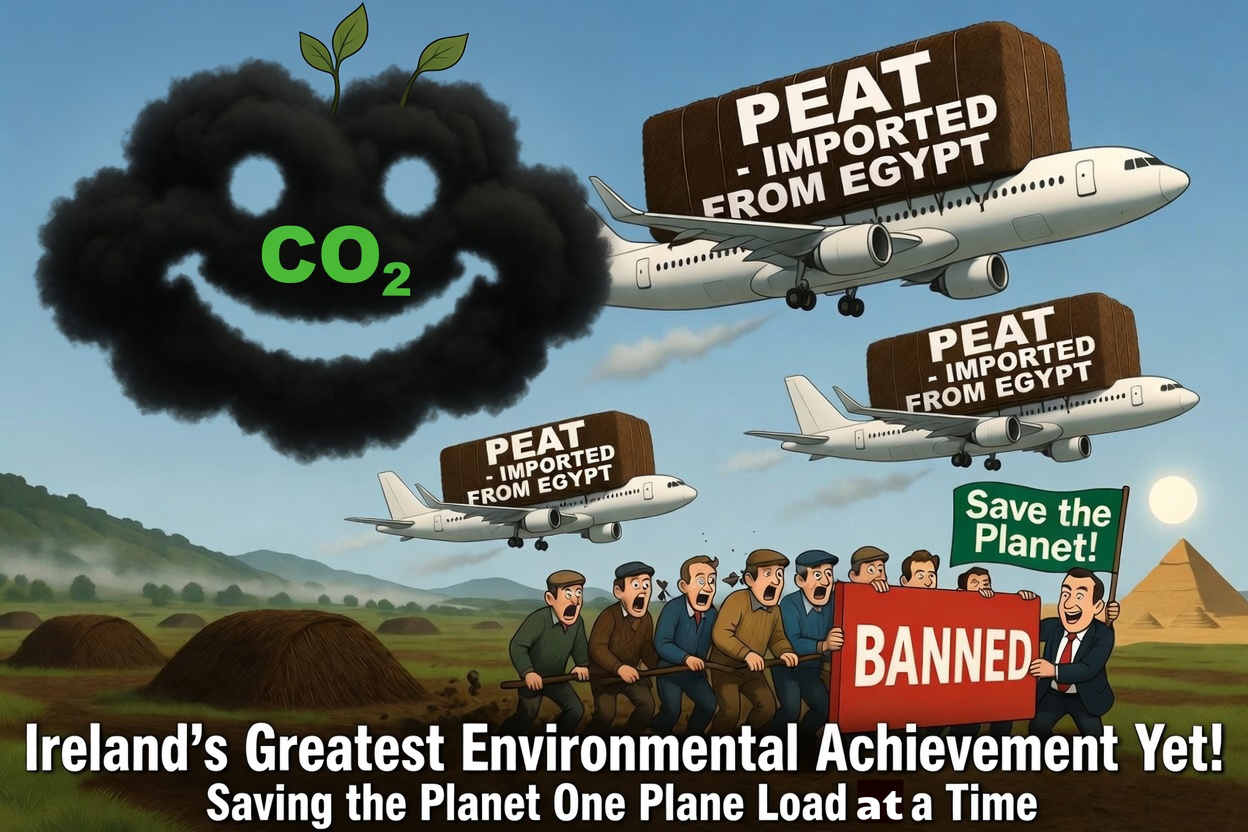
The Money Squanderers Strike Again. Bord na Móna’s Brain Dead Thinking: Ban Irish Peat, Import Egyptian Peat – Twice the Price, Twice the Carbon, Zero Logic.
When the Fianna Fáil–Fine Gael–Green Party coalition came to power in 2020 (with Eamon Ryan as Minister for Environment, Climate & Communications), the Greens pushed hard to speed things up in relation to closing peat production in Ireland. Highlighting the perceived hypocrisy that many associate with Green-driven climate policy in practice.
- Bord na Móna made the final decision to end all peat harvesting permanently in January 2021 (following a High Court case and strong Green pressure).
- The party actively welcomed and defended the rapid wind-down.
- Green ministers (Eamon Ryan, Pippa Hackett, Malcolm Noonan) were vocal supporters of the “Brown to Green” strategy and bog restoration.
Imported peat is approximately double the cost
Imported peat is approximately double the cost of what domestic Irish peat used to be for the horticulture and mushroom sectors. Including shipping it can increase up to three times the cost.
Exact Cost Comparison (2024–2026 data)
- Average import price (all sources): €275–€280 per tonne ($299 per tonne in 2024). indexbox.io
- Domestic Irish peat (pre-phase-out / when it was still available): Roughly half that price — around €130–€150 per tonne (industry estimates).
- Result: Imported peat is 100% more expensive (i.e. twice the price). agriland.ie
History
1930s–2015: Bord na Móna (established 1946) was Ireland’s main industrial peat harvester. It supplied peat for electricity generation, briquettes, and horticulture. Peat was a core part of Ireland’s energy mix for decades.2015: Bord na Móna announces it will phase out peat harvesting for power generation by 2030 as part of its shift to renewables and “climate solutions.”2018–2019: Last full peat harvest (2018) and partial harvest (2019). Harvesting already winding down significantly.
January 2021: Bord na Móna formally ends all peat harvesting on its lands permanently. This followed a High Court ruling and environmental pressures. The company pivots to bog restoration, renewables, and other businesses. No new large-scale cutting on their bogs.2021–2024:
- Domestic turf cutting by private individuals and small operators becomes heavily restricted in many areas due to environmental regulations, SAC designations, and enforcement.
- Horticulture and mushroom industries (which need specific peat moss/casing) face shortages.
- Ireland starts importing peat to fill the gap, especially for commercial uses like mushroom growing.
2024: Nearly 1,000 tonnes of peat imported from Egypt alone (revealed via Parliamentary Question by Aontú in April 2026). Imports also came from other countries like Latvia, Germany, and the Baltic states. Much of this was for the horticulture/mushroom sector, which relies on peat as a growing medium.
aontu.ie 2025–2026: Imports continue while domestic restrictions remain. Bord na Móna has fully transitioned away from peat revenues (zero peat revenue in FY2025 for the first time in its history). The company now focuses on rewetting bogs and renewable energy.
Simple Solution:
Just reverse the decision.