
Step into any Irish bank, McDonald’s, KFC, taxi, bus, hospital, nursing home, or care facility today, and the person serving you, whether behind the counter, at the teller window, or behind the wheel, is increasingly likely to be non-Irish and from a non-EU country.
What was once a rare sight is now the shocking everyday norm. For these companies, only the bottom line counts. They display no regard for our native Irish people, our heritage, our culture, or the nation they now operate in.
This visible shift isn’t organic market change, it’s the result of unchecked mass immigration for cheap labor combined with Diversity, Equity, and Inclusion (DEI) policies that reward companies for prioritizing non-Irish hires. Some care providers, are reporting employing staff over 40 different countries.
Our country is now barely recognizable from the Ireland of 2022.
Ireland’s population reached 5.46 million by Jan 2026, with the foreign-born share now at roughly 23%. Net migration continues to add tens of thousands annually, while young Irish people emigrate in droves to Australia and elsewhere amid housing shortages and lost opportunities at home. Non-EU workers now dominate many entry-level service and retail jobs that once served as pathways for locals.
The drive is simple: multinational chains and banks import cheaper labor on work permits. These workers accept lower wages and longer hours than Irish citizens expect in one of Europe’s priciest countries.
Fast-food giants like McDonald’s and KFC thrive on high-turnover roles that natives increasingly avoid, in some outlets no one is speaking English among staff. Nor is this “laziness” on the part of Irish workers; it’s a rational response to an economy that no longer makes these jobs viable for natives.
The outcome? Irish youth leave while imported staff fill the gaps—suppressing wages and sidelining natives in their own economy.
DEI provides the ideological cover.
Companies chase “diversity” awards by hitting racial and ethnic targets, often translating into hiring preferences that disadvantage white Irish applicants.
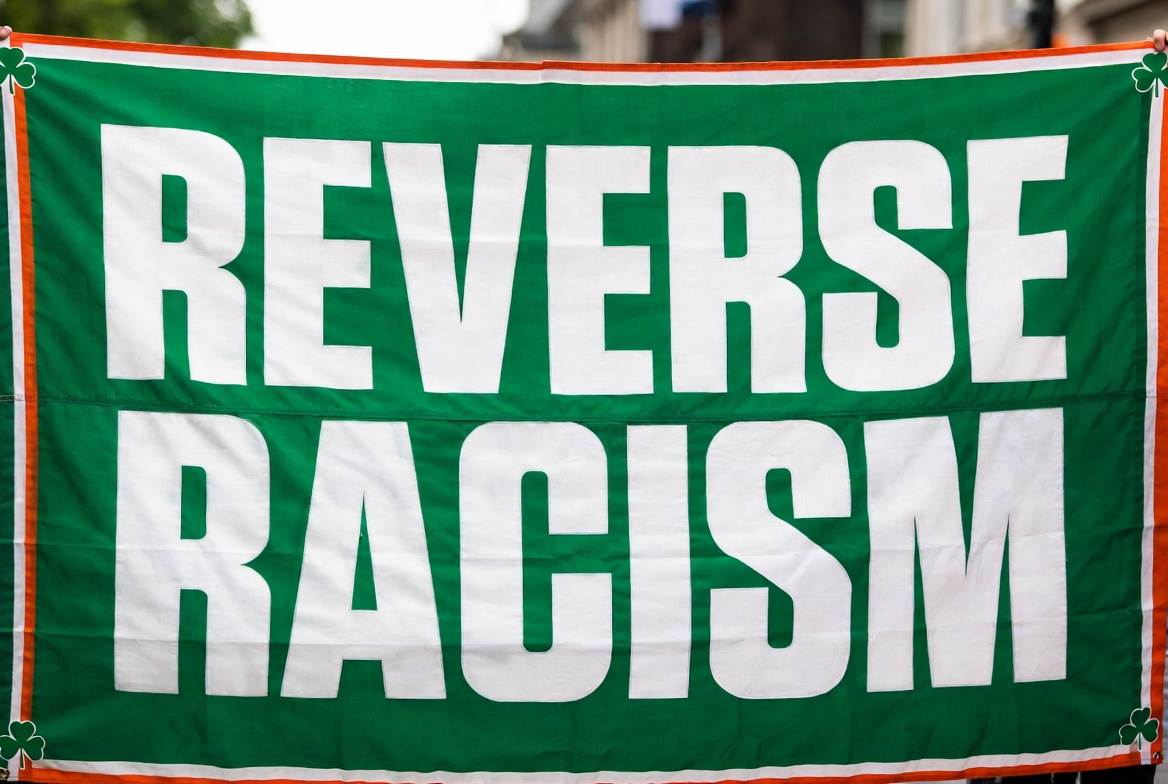
Is this really: Reverse Racism: systemic discrimination against the native majority under the banner of equity?
Banks and chains collect accolades for “inclusion” while effectively excluding the people whose ancestors built the nation. This isn’t accidental. Post-Celtic Tiger policies turned labor demand into a flood of non-EU migration, while Irish emigration hollows out the next generation.
Protests over housing and cultural change are dismissed as “racist” instead of addressing root causes. White Irish people aren’t oppressors in their own land, they’re citizens watching workplaces, neighborhoods, and opportunities change beyond recognition.
DEI isn’t neutral; it punishes the majority for existing.
While individual immigrants can integrate, policies that displace natives through wage competition and race-based hiring cross into discrimination. DEI isn’t neutral; it punishes the majority for existing.
Without tighter controls on non-EU labor, merit-based hiring over quotas, and a clear priority for Irish workers, this reverse racism will only worsen.
Foreign-Born Population
The foreign-born share has surged dramatically:
- 2004: ~6%
- 2022 Census: 20%
- 2025 (Eurostat): 23.3% (approximately 1.267 million people) — among the highest in the EU. en.wikipedia.org
Non-Irish citizens now make up a significant portion of the population.
Births and Second-Generation Impact
A profound shift is visible in births:
As of early 2026 CSO-linked data, one in four babies (25%) born in Ireland now has a non-Irish-born mother, up sharply due to sustained immigration since the mid-2010s.
Beyond the workplace, this rapid demographic shift is quietly eroding traditional Irish culture.
For centuries, Ireland’s identity was rooted in its language, humour, music, pubs, and shared social norms the very things that made the country feel unmistakably Irish. Today, in many urban areas, Gaelic is fading in schools with large numbers of non-Irish pupils, traditional festivals take on a more global flavour, and everyday life no longer looks or sounds the same.
The result is a growing sense of cultural dislocation among native Irish people. It is not hatred of newcomers, but a natural response to seeing their heritage diluted at speed. Without deliberate policies to preserve Irish cultural continuity alongside integration, Ireland risks trading its distinct character for a generic, rootless cosmopolitanism — a loss felt most keenly by the very people whose ancestors built it.
So what needs to be done to give our Irish people back our Irish jobs and protect Irish workers in the future?
1. Mandatory & Rigorous Labour Market Needs Test (LMNT) for ALL Non-EEA Permits
- What it is now: Employers must advertise jobs for 28 days on EURES and online platforms before hiring non-EEA workers for most General Employment Permits. Exempt for Critical Skills or very high-salary roles.
- Stronger version politicians could have passed: Make the LMNT mandatory for all non-EEA permits (no exemptions for lower-paid service roles). Extend advertising to Irish-specific job boards, require proof of interviews with Irish applicants, and impose heavy fines/ permit bans for sham tests.
- Why it protects Irish workers: Forces employers to genuinely try hiring locals first, especially in entry-level jobs where wage competition is fiercest.
2. Higher & Sector-Specific Salary Thresholds + Ineligible Occupations List
- Current: Thresholds were raised in 2025–2026 (e.g., General Employment Permit now ~€36,605+). Some low-skilled roles are already on the Ineligible List.
- Reform: Set much higher minimum salaries for permits in hospitality, retail, and banking customer service (e.g., €45,000+). Expand the Ineligible Occupations List to explicitly cover McDonald’s/KFC-style roles, bank tellers, and similar positions unless no Irish/EEA applicants exist after exhaustive search.
- Effect: Makes cheap non-EU labor unviable, protecting wage levels and local hiring pathways.
3. Nationality-Neutral “Irish-First” Hiring Incentives & Public Contract Rules
- Current Equality Acts (1998–2015) ban direct discrimination on nationality/race grounds, so “Irish-only” ads are illegal.
- Legal workaround politicians could legislate: Offer tax credits, grants, or public procurement preferences to companies that can prove they prioritised Irish/EEA applicants (via audited hiring data). Tie government contracts, subsidies, or DEI-style awards to demonstrated Irish hiring quotas in low-skilled sectors.
- This stays within EU law (which allows member states to favour nationals indirectly in certain economic measures).
4. Reform or Clarify DEI/Equity Policies to Prevent Reverse Discrimination
- Current law prohibits positive discrimination on race/nationality grounds in private employment.
- Action needed: Explicit legislation banning racial or ethnic hiring quotas/targets that disadvantage the Irish majority (e.g., in banks or chains chasing “diversity awards”). Require companies to publish anonymize hiring data by nationality/citizenship and face penalties if Irish applicants are systematically under-hired despite availability.
- This would curb the “DEI awards vs. reality” issue you mentioned.
5. Overall Non-EEA Immigration Caps Linked to Irish Employment & Housing
- Politicians could amend the Employment Permits Act to impose annual caps on non-EEA work permits, automatically reduced if Irish unemployment rises or net Irish emigration continues.
- Tie permit issuance to housing availability and local labour-market data (already partially done via recent 2025 policy tweaks on family reunification and citizenship).
6. Stronger Enforcement & Penalties on Employers
- Increase inspections and fines for employers who rely excessively on non-EEA staff while Irish applicants are available.
- Require large chains (McDonald’s, KFC, banks) holding public-facing licences or contracts to report annual % of Irish vs. non-EEA staff in entry-level roles.
These measures have been successfully used in countries like Australia, Canada, and even some EU states (e.g., stricter labour-market tests in Germany/Netherlands).
Implementing the above would require political will and in some cases EU negotiations but they are all within the realm of sovereign policy choices that prioritise citizens without violating core equality principles. They directly address the cheap-labour + DEI dynamic while remaining evidence-based and legally robust.